Sunday, September 8, 2013

The Race to Break Maris' Record


There are two things I will always remember about the summer of 1998 — the worst heat wave in nearly 20 years that gripped most of the country and the duel between St. Louis' Mark McGwire and Chicago's Sammy Sosa to see who would break Roger Maris' 37–year–old single–season home run record.

(Maris, as baseball historians will tell you, broke Babe Ruth's single–season home run record in 1961, but he benefited from the fact that baseball seasons were 162 games by then, not 154 as they were in the Bambino's day. And for many, many years, Maris' record had an asterisk next to it in the record book because it was not achieved in 154 games.)

The home run chase made that summer of '98 memorable. Well, the heat wave did, too. It was the worst heat wave I've seen since 1980. But the McGwire–Sosa duel was truly riveting. If one had to stay inside because it was so miserably hot outside, watching SportsCenter for the latest update in the home run chase was worth one's time. And there was almost always a daily update.

In hindsight, one must wonder if the '98 home run chase would have happened at all if not for steroids.

In fact, McGwire did concede at the time that he used an over–the–counter substance that had been banned by, among others, the NFL — but not (at that time) major league baseball.

(McGwire was slipperier on his use of other substances.)

So my feeling is that the '98 season should have an asterisk next to it — or maybe it would be more appropriate to have a little syringe instead — in the record books.

But it doesn't, and it probably won't so 1998 will stand as the year that McGwire broke Maris' record. McGwire was eclipsed three years later by Barry Bonds, who has his own unanswered questions about steroid use, but 15 years ago today, McGwire was on his way to wrapping up the home run–hitting season of a lifetime.

("These long–ball extravaganzas were putting fans back in the seats," Greg Stejskal wrote recently in the New York Daily News, "but the cost was the integrity of the game.")

McGwire hit 70 home runs that year. No one before — and only one man since — hit that many home runs in a single season. (That year, in fact, Bonds hit slightly more than half as many home runs as McGwire.)

That summer, I was working for a trade magazine that served the imprinted sportswear industry. Part of my job was attending trade shows in different parts of the country, and I recall attending a show in Chicago. Exhibitors at these shows were often regional representatives of licensed sports products, and major league baseball was a hot (pardon the expression) commodity in Chicago that summer.

At these shows, I would walk around the hall and sit down to interview exhibitors who caught my eye. As a former sports editor, I was particularly interested in these sports licenses. Major league baseball had a crippling strike a few years earlier, and there had been talk that baseball's popularity was on the decline.

The McGwire–Sosa home run derby was the first thing to breathe some life back into the sport. It was baseball's goose that laid the golden egg.

And the exhibitors were all too eager to talk about McGwire and Sosa — but none, that I can recall, had any interest in talking about steroids.

If they were concerned that I might quote them on the subject in one of my articles, they worried needlessly. I only asked because I'm a sports fan, and I like baseball (although not as much as I did when I was a boy).

Maris' record finally fell 15 years ago today, about three weeks before the scheduled end of the season. McGwire had broken the record in far fewer games than it took Maris — or Ruth, for that matter. That should have raised some red flags.

But, like the exhibitors I spoke to that summer, no one wanted to talk about steroids. Not the teams' management or coaches or players — or fans, for that matter. They wanted to talk about all the home runs, not the steroids that even a casual observer could conclude had made them possible.

The thought of steroids definitely crossed my mind in the summer of '98, but, as I say, I never found anyone who was interested in talking about that angle.

Perhaps now those people have learned that there is a frightful price to be paid for ignoring an approaching storm. It's like ignoring a persistent toothache, hoping it will go away. (In the words of writer Aldous Huxley, "Facts do not cease to exist because they are ignored.")

But then I remember — that's the kind who never learn from the past.

Saturday, September 7, 2013

One More Time For All of the Old Times


What is probably the last game (for awhile, anyway) in the Notre Dame–Michigan series to be played in the Big House is the headliner for this week's action.

There are other rivalries on the schedule. Twelfth–ranked Florida plays at Miami (Fla.) in an early ACC showdown, and sixth–ranked South Carolina visits 11th–ranked Georgia in the SEC opener for both schools.

But Notre Dame–Michigan is the big one this week, and it has been pretty entertaining in recent years. There is no reason to think it won't be entertaining tonight as well.

Unless you're Chris Mahr. I'm assuming that Mahr won't be watching. In a recent post at Lost Lettermen, Mahr asserts that the Notre Dame–Michigan rivalry is overrated.

Be that as it may ...

This is the 18th time these schools have played in Michigan Stadium. There have been some good games played there, but this will be the last time — at least for awhile.

It's worth tuning in for.

Drew Sharp of the Detroit Free–Press writes that Michigan will need to fill the slot in the schedule, and I agree. I disagree with his suggestion that scheduling "SEC middle–of–the–pack Arkansas" isn't the answer. Arkansas is my alma mater and, while "middle of the pack" may be a generous assessment now, when the teams are scheduled to meet on the playing field in about four or five years, things might be different.

Sharp acknowledges, though, that it is "a start."

Speaking of starts ...

I felt pretty good about my predictions last week. For awhile, I even flirted with perfection!

I predicted that the #8 Clemson Tigers would defeat the #5 Georgia Bulldogs — and they did. I picked the 12th–ranked LSU Tigers to beat the #20 TCU Horned Frogs — and they did.

I also picked unranked Washington to defeat #19 Boise State — and that, too, came to pass.

But I stumbled on Eastern Washington–Oregon State. Darn it.

Idle: #1 Alabama, #10 Florida State, #18 UCLA, #20 Washington

Today
  • #2 Oregon at Virginia, 2:30 p.m. (Central) on ESPN2: Oregon and Virginia have never faced each other in football.

    Virginia is the home team so the Cavaliers won't have to contend with the jet lag that the Ducks are sure to encounter. But Oregon has been one of the most fearsome football teams in America the last few years. A little jet lag doesn't seem likely to slow them down.

    The Cavaliers have begun the last two seasons at 2–0, but it doesn't look likely that they can extend that streak to three straight years.

    Admittedly, the Ducks' first opponent was Nicholls, but they still rolled up 66 points and nearly 800 yards on offense. That's going to get your attention.

    Mark Giannotto of the Washington Post observes that the Cavs "had little time to savor their season–opening victory," a 19–16 win over Brigham Young that would probably get noticed in almost any other year.

    In recent years, Virginia typically has opened the season against a non–IA school — and hasn't always been able to win. Beating a school like BYU in the opener is an achievement, but Giannotto is right. There is no time to savor it. Perhaps when the season is over.

    But not now. Now is a time to be focused. But, no matter how focused Virginia may be, I expect Oregon to win by double digits.
  • San Diego State at #3 Ohio State, 2:30 p.m. (Central) on ABC: These schools have met three times since 2001 — each game was played in Columbus, Ohio, and each game was won by Ohio State by an average of about two touchdowns.

    Today, for the fourth time, the teams will play in Columbus. And I predict that, once again, Ohio State will win — probably by about two touchdowns.
  • South Carolina State at #4 Clemson, 11:30 a.m. (Central) on ESPN3.com: The last time these schools met on the gridiron was in 2008. South Carolina State came to Clemson in September and was thrashed, 54–0.

    I expect something similar this time. That Clemson team finished 7–5 and went on to lose the Gator Bowl to Nebraska. This Clemson team looks much better.

    I pick Clemson to win.
  • San Jose State at #5 Stanford, 10 p.m. (Central) on Pac–12: Stanford was the only member of AP's Top 25 that did not play last weekend — and the Cardinal lost ground in the rankings.

    Last week, Stanford was ranked fourth. But Clemson, thanks to its victory over highly regarded Georgia, leaped past Stanford into the #4 slot, and Stanford fell back to fifth.

    Now Stanford has an opportunity to regain that lost ground against a familiar foe. Stanford and San Jose State have met 59 times, and Stanford has controlled the series, 44–14–1.

    Stanford actually has been more dominant on the road than at home. The Cardinal have won two–thirds of the time at home, more than three–fourths of the time on the road.

    Stanford has won nine straight against San Jose State and hasn't lost at home in the schools' practically annual game since 2000.

    Sounds like just the thing to revive Stanford's ranking. San Jose probably won't roll over, but I think Stanford will win by at least a touchdown.
  • #6 South Carolina at #11 Georgia, 3:30 p.m. (Central) on ESPN: Last week's loss to Clemson must have been a bitter pill for Georgia to swallow.

    But the Bulldogs have no time to grieve the loss. Sixth–ranked South Carolina comes to visit today, and the Gamecocks have their eyes on an SEC championship, too.

    These schools have been SEC rivals for a couple of decades, but their series goes back to the turn of the century. This will be their 61st game, and Georgia has dominated the series (42–16–2) but lost the last three encounters.

    Georgia has been particularly dominant at home, winning 75% of the time, but South Carolina has won two of the last three games played there.

    As I mentioned last week, Georgia was regarded by many observers as a potential national champion before the season began. The Bulldogs could still be in the national title conversation at the end of the season, but they will need to win the SEC East, and beating South Carolina would go a long way toward re–establishing the 'Dawgs nationally.

    I pick Georgia to win by a very narrow margin.
  • Sam Houston State at #7 Texas A&M, 6 p.m. (Central) on ESPN3.com: Jesse Yomtov writes in USA Today that A&M is ripe for an upset.

    Maybe so, considering that national champion Alabama will be coming to College Station next Saturday, but I really don't think Sam Houston State is the team to do it. I expect Texas A&M to win.
  • Eastern Kentucky at #8 Louisville, 11 a.m. (Central) on ESPN3.com: This is probably an important game in Kentucky, but it just doesn't mean much to me.

    The history of the series favors Louisville. So do the college football rankings. I just can't imagine that the Colonels will win this game. I pick Louisville.


  • Alabama–Birmingham at #9 LSU, 6 p.m. (Central) on ESPNU: Judging from what I saw in LSU's opener with TCU last week, LSU is set to challenge for the SEC West crown.

    But the Tigers would be advised not to overlook UAB. That may have been the problem the only other time the teams faced each other. In 2000, UAB upset LSU, 13–10, in Baton Rouge, where the teams will face other today.

    Keep in mind, though, that this is a different LSU team. In the two seasons prior to that game, LSU's record was 7–15. In the previous 10 seasons, the Tigers had had far more losing seasons than winning ones.

    But, in two–thirds of the seasons since that 2000 season, LSU has won 10 or more games (including the last three seasons) and gone 2–1 in national championship games.

    I expect this LSU team to win — assuming, of course, that 2000 mindset doesn't show up instead.
  • #12 Florida at Miami (Fla.), 11 a.m. (Central) on ESPN: These two schools have played 54 times, and Miami holds a paper–thin series edge, 28–26.

    But Miami has seized the series advantage by winning six of the last seven games. The Hurricanes haven't lost to Florida at home since 1985.

    Florida's glory days in the series probably came between 1968 and 1977, when the Gators won nine out of 10.

    I expect a close game — which would be appropriate, given how close the series is. I give a very slight edge to Florida.
  • #13 Oklahoma State at Texas–San Antonio, 11 a.m. (Central) on Fox Sports: After Oklahoma State opened the season in Houston last week, Berry Tramel and Gina Mizell of The Oklahoman ask, "Why is OSU playing Texas–San Antonio in San Antonio?

    It is a reasonable question. The Alamodome is, after all, a little bigger than Boone Pickens Stadium ‐ but seating capacity is not the issue. Tramel and Mizell observe that it is a 2–for–1 deal. In exchange for playing today's game in San Antonio, the Roadrunners are obligated to play two games in Stillwater.

    Home field shouldn't make much difference in this game. I pick Oklahoma State.
  • #14 Notre Dame at #17 Michigan, 7 p.m. (Central) on ESPN: This could be the very last time these teams face other in the Big House, and you can watch it.

    Even though Notre Dame coach Brian Kelly says it isn't an "historic rivalry."

    Well, I suppose that is a matter of opinion.

    Head to head, Michigan has won five of the last seven meetings, but the Wolverines lost in South Bend last year, 13–6. Until Alabama beat Notre Dame in the national championship game last January, only three teams had come closer to beating the Fighting Irish during the 2012 season — Purdue, Brigham Young and Pittsburgh.

    Actually, these two bitter rivals have managed to put on a pretty good show of late. The outcomes of each of their last four matchups could have been changed by a single score.

    I think it will be another close one, and I give the edge to the home team, Michigan.
  • #15 Texas at Brigham Young, 6 p.m. (Central) on ESPN2: It was almost 25 years ago — to the day — that Texas paid its only visit to BYU.

    The Longhorns lost that game decisively, 47–6.

    Well, they've had a quarter of a century to get over that. The Cougars, on the other hand, have only had a week to get over last week's loss at Virginia.

    But, as Jay Drew of the Salt Lake Tribune writes, it is the kind of game BYU's students and fans were promised when the program went independent a couple of years ago — games against elite national programs.

    Texas certainly qualifies. The Longhorns aren't what they were when they beat Southern Cal for the national crown — or even when they lost one a few years back — but they do occupy a special place in college football.

    It would be a tremendous achievement if BYU could win this game. But I don't think they will. I pick Texas.
  • West Virginia at #16 Oklahoma, 6 p.m. (Central) on Fox: This should be an interesting game to watch. At least, I think so.

    Historically, OU holds the edge, as one might expect. But the Sooners needed a narrow, one–point (50–49) victory at West Virginia last year to break a series tie.

    They only played four times before last season (once in the Fiesta Bowl). The Sooners won the first two games, both of which were played in Norman, then lost the third game, which was also played in Norman.

    And today they meet in Norman again.

    It's been 30 years since West Virginia won that game in Norman. Can the Mountaineers do it again? It would be huge for them if they could, but I don't think they will. I expect the teams to score a lot of points — maybe about half as many as last year — and I expect the margin to be a single score, but I predict that Oklahoma will win.
  • Syracuse at #19 Northwestern, 5 p.m. (Central) on Big Ten: This will be the 11th game in this series, and these teams have split the first 10 games right down the middle.

    Both teams are 3–2 at home so that would appear to favor Northwestern even though the Wildcats have only beaten Syracuse at home once in nearly 30 years.

    Make that twice. I think Northwestern will prevail.
  • Tennessee Tech at #21 Wisconsin, 11 a.m. (Central) on Big Ten: Wisconsin is adjusting to a first–year coach.

    I understand this because my alma mater (Arkansas) is also adjusting to a first–year coach, and he happens to be Wisconsin's former coach. Neither team seems to be suffering from the transition — at least, not yet.

    Both teams won last week, and both teams will probably win this week.

    Wisconsin's opponent rarely plays teams from power conferences like the Big Ten, and my expectation is that Wisconsin will win handily.
  • Southern Mississippi at #22 Nebraska, 5 p.m. (Central) on Big Ten: These schools have met four times, and the results have been pretty reliable indicators of the kind of season Nebraska had.

    The Cornhuskers have won three of the games, and each time they won, they finished the season with at least 10 wins. On the one occasion when Southern Miss was the winner, Nebraska finished the season 5–6.

    I think Nebraska will win handily this time, possibly foreshadowing a big season for the Cornhuskers.
  • Buffalo at #23 Baylor, 2:30 p.m. (Central) on Fox Sports: I don't see that there is much to say about this game.

    Baylor was regarded as a perennial pushover when I was a child, but even those teams were better than Buffalo has been. The Bulls have had only one winning season since 1999 — 2008 when they won the MAC title.

    Last year, they were 4–8. They lost seven of their first eight games, then finished the year with three wins and one loss.

    I've heard nothing to suggest they can win in Waco. I pick Baylor.
  • SE Louisiana at #24 TCU, 11 a.m. (Central) on Fox Sports: There was a time — in my lifetime — when having TCU on the schedule meant an easy win.

    It isn't that way anymore. Hasn't been for awhile. But I'm not sure it ever would have been an easy win for SE Louisiana.

    It won't be today. I predict TCU will win.
  • Washington State at #25 USC, 9:30 p.m. (Central) on Fox Sports: These schools have been conference rivals since 1922, and WSU has recorded nearly half of its eight victories over USC since 1997.

    They haven't played since 2010, but the Trojans blew out the Cougars on that occasion, 50–16. In fact, USC has an eight–game winning streak against WSU.

    The Trojans have dominated this series, 58–8–4, and they have been particularly dominant at home. They've won the last four meetings in Los Angeles.

    It's been 10 years since WSU won more than six games in a season. Southern Cal won 10 games or more in seven of those seasons and won a national title.

    The Trojans had an off–year last year, going 7–6. I expect them to be better this year. The Cougars were 3–9 last year — which was better than many of their recent seasons.

    I expect Southern California to win.
Last week: 21–1

Season: 21–1

Thursday, August 29, 2013

College Football Kicks Off


Fifth–ranked Georgia and #8 Clemson
face each other in Saturday's season opener.


College football returns tonight, and, as is usually the case in the first week or two, predictions are largely based on reputation.

At least until the teams show us what they can do on the field. Until then, it's really all on paper.

To be fair, you won't learn much about most of the Top 25 teams from the games they play. Not naming any names, but most of the games look like foregone conclusions. The ones that get out of hand early are likely to resemble an NFL preseason game — with the starters sitting on the bench for most of it.

(Every college football fan can tell you about an upset or two that happened in the first few weeks of a season, though. It does happen.)

To be sure, there are some intriguing matchups on this weekend's schedule — which starts tonight and continues through Labor Day. There are even a couple of head–to–head battles between Top 25 teams. Fifth–ranked Georgia and #8 Clemson will play on Saturday night, as will #12 LSU and #20 TCU.

But, unless we see an upset or two, you can expect next week's Top 25 to look a lot like this week's.

Idle: #4 Stanford

Today
  • North Carolina at #6 South Carolina, 5 p.m. (Central) on ESPN: These border rivals have played each other 55 times in the last 110 years, but this will be their first encounter since 2007, when South Carolina prevailed 21–15.

    And that was their first meeting since 1991.

    They played each other fairly regularly in the years before 1991. In fact, there were long stretches in which they played every season.

    Anyway, in the absence of any recent history in this series, I have to look at what the teams have done recently.

    North Carolina has had five straight winning seasons. South Carolina, on the other hand, hasn't lost more than it won since 2002, and the Gamecocks have now had two straight 11–win seasons. I pick South Carolina.
  • #24 USC at Hawaii, 10 p.m. (Central) on CBS Sports: This will be the ninth time these schools have faced each other in football, and the Trojans have won all eight of the previous meetings. No reason to expect anything different this time.

    Southern California should prevail.
Saturday
  • Virginia Tech vs. #1 Alabama in Atlanta, 4:30 p.m. (Central) on ESPN: Alabama has dominated this series, winning 11 of 12 meetings.

    But Virginia Tech's only victory over the Crimson Tide came when the teams met at a neutral site — as they are doing this year.

    Virginia Tech could be a deceptive opponent. Tech went 7–6 last year but won 10 or more games in each of the eight previous seasons. I think Alabama will win, but the Crimson Tide cannot afford to be complacent.
  • Buffalo at #2 Ohio State, 11 a.m. (Central) on ESPN2: This is the first meeting of these schools.

    Buffalo is coming off a 4–8 year. It was the school's fourth straight losing season, but it did indicate steady improvement. Buffalo was 3–9 in 2011, 2–10 in 2010.

    Ohio State, meanwhile, was 12–0 last year but ineligible for a bowl. The Buckeyes are eligible this year, and many folks are predicting that Ohio State and Alabama will meet for the national title in January.

    What's more, Ohio State has only lost 11 times at home since 2000. And those home losses usually come against acknowledged powerhouses from the Big Ten.

    I pick Ohio State.
  • Nicholls at #3 Oregon, 3 p.m. (Central) on Fox Sports: There can be no reason for most sports fans to watch this game.

    There will be other games being televised at the same time, and Oregon's starters should be on the bench by halftime.

    Oregon should win this one hands down.
  • #5 Georgia at #8 Clemson, 7 p.m. (Central) on ABC: There was a time when Georgia and Clemson played each other almost every year.

    Between 1902 and 2003, they met 57 times. Georgia leads the all–time series, 38–15–4, and the Bulldogs have won the last five meetings. In fact, the Tigers haven't won since 1990 — which also happens to be the last time the Tigers won at Clemson.

    Historically, Clemson has done better at home than on the road when playing Georgia. But that isn't really applicable, is it? These teams haven't played in a decade.

    This game may turn out to be more interesting than the LSU–TCU game. Clemson had a Top 10 offense last season; Georgia's offense was good, but it didn't even finish in the Top 20. Statistically, Georgia's defense was much better, and it may be prepared to make a season–opening statement, but only three starters return from last season.

    Some observers pick Georgia to play for the national title in January, but I am inclined to think that Clemson will win this game, perhaps ending such talk.
  • Rice at #7 Texas A&M, noon (Central) on ESPN: These two old Southwestern Conference foes meet for the first time since 1995. The Aggies own a 15–game winning streak over the Owls dating back to 1981, but Rice's last victory over A&M came at College Station in October 1980.

    There are lots of story lines surrounding the Aggies this season, and most of them have at least a connection to the SEC. It is taken for granted that A&M will win this game, even with Heisman winner Johnny Manziel on the bench for the first half — and next week's game against Sam Houston State — before the early season showdown with Alabama on Sept. 14. It will be a major upset if the Aggies lose either game.

    I think Texas A&M will win this game — and probably the one next week, too — but I need to give that third one some thought.
  • Toledo at #10 Florida: These schools have never played each other in football, but here's guessing Toledo will remember its trip to The Swamp.

    Unofficially the toughest place for a visiting team to play, The Swamp is known for the incredible noise generated by Gator fans. Not counting Florida's rivalry with Florida State, the Gators haven't lost at home to a nonconference foe since losing to Miami (Fla.) on Sept. 7, 2002 — and Miami went on to play for the national championship that year.

    If Toledo wins, it will be a huge upset. I don't think that will happen. Give me Florida.
  • #12 LSU vs. #20 TCU in Arlington, Texas, 8 p.m. (Central) on ESPN: TCU faces a considerable challenge in this game. LSU hasn't lost a regular–season nonconference game since falling to Virginia Tech in the 2002 season opener.

    That's 34 consecutive regular–season nonconference wins for LSU — so far.

    These teams have faced each other eight times, including once in the Sugar Bowl, but they haven't faced each other since Lyndon Johnson was president. In the absence of any recent history between these two teams, I have to go with my gut, and I expect LSU to win.
  • Mississippi State vs. #13 Oklahoma State in Houston, 2:30 p.m. (Central) on ABC: These teams have met four times in the past, and the winner of this game will take the lead in the series.

    It will also be the first time they have played in a truly neutral site. They played once in Jackson, Miss., which is about 100 miles from Mississippi State's campus, but that isn't much, considering it is nearly 500 miles from Oklahoma State's campus. Houston is another matter.

    This could be a really close game. I pick Oklahoma State.
  • Temple at #14 Notre Dame, 2:30 p.m. (Central) on NBC: When last we saw them, the Fightin' Irish were being destroyed by Alabama in the BCS Championship Game in Miami on Jan. 7.

    The crowd in South Bend should be much friendlier, and Temple, which went 4–7 last year and lost five of its last six games, should be easier to handle than the Crimson Tide.

    I've heard a lot of people say that Notre Dame wasn't the most appropriate foe for Alabama in that game, and the outcome of the game would tend to support that. The Irish will have a lot of work to do to prove themselves in 2013. I expect Notre Dame to win the opener, but I doubt the Irish will prove much by doing so.
  • New Mexico State at #15 Texas, 7 p.m. (Central) on Longhorn Network: These teams have met four times — always in Austin — and the Longhorns have won all four.

    I suspect their ranking is based on history — and not recent history, either. Texas is 22–16 in the last three seasons. But it's taken New Mexico State nearly a full decade to win 22 games.

    And I don't think these Aggies will be able to leave Austin with a win. The Longhorns have a lot to prove, but they won't prove anything in this game. I pick Texas.
  • Louisiana–Monroe at #16 Oklahoma: I'm inclined to be skeptical of Oklahoma and Texas when I see them in the rankings these days.

    Well, not so much Oklahoma. The Sooners have had 10 wins or more in every season but two in the last 13 years.

    I guess it's their postseason record that is the cause for concern. The Sooners have barely won more bowls than they've lost in those 13 seasons.

    Consequently, I suppose, Sooner fans should be concerned in December or January — not August.

    Besides, it's hard to see Louisiana–Monroe causing much trouble in Norman. I have to go with Oklahoma.
  • Central Michigan at #17 Michigan, 2:30 p.m. (Central) on Big Ten: The Wolverines won their first two games against Central Michigan, both of which were played in Ann Arbor.

    Historically, Michigan beats Central Michigan by about 30 points. That sounds about right to me. I pick Michigan.
  • Wyoming at #18 Nebraska, 7 p.m. (Central) on Big Ten: These teams have played each other half a dozen times in the last 80 years, and Nebraska has won them all.

    Most of the games have been, like this year's, at Nebraska. But the teams did meet in Wyoming two years ago. Nebraska prevailed, as usual. And I don't expect Wyoming, which has had nine losing seasons since the start of the 21st century, to reverse that this week.

    Nebraska will win.
  • #19 Boise State at Washington, 9 p.m. (Central) on Fox Sports: This is a rematch of last year's Las Vegas Bowl, which Boise State won, 28–26.

    I think it will be another close game, but I'm going to give the edge to the home team, Washington. Not so long ago, the Huskies were hard pressed to win a handful of games each season (they even went winless one year), but they've put together three straight winning seasons.

    I think they're ready to move to the next level.
  • Nevada at #21 UCLA, 9 p.m. (Central) on Pac–12 Network: These schools are only about 400 miles apart. You'd think they would play each other if not frequently then at least with some regularity.

    But the truth is the two have never met in football.

    I'll give the advantage to UCLA.
  • #22 Northwestern at California, 9:30 p.m. (Central) on ESPN2: These teams have only faced each other once — in the Rose Bowl on New Year's Day 1949.

    Obviously, there isn't much insight you can gain when two teams are about to meet for the first time in more than 60 years, but last year's numbers aren't much help, either. Northwestern was better than California on both sides of the ball, but neither team was terribly impressive. Cal went 3–9 and lost its last five games. Northwestern was 10–3 and won five of its last seven games, including the Gator Bowl.

    I'll take Northwestern.
  • Massachusetts at #23 Wisconsin, 11 a.m. (Central) on Big Ten: These teams have never faced each other in football.

    Last year, UMass was 1–11, its only win coming against Akron (also 1–11). Wisconsin was 8–6, destroyed Nebraska in the Big Ten championship game and lost to Stanford in the Rose Bowl.

    I'm comfortable picking Wisconsin to win.
  • Eastern Washington at #25 Oregon State, 5 p.m. (Central) on Pac–12 Network: I don't know much about either team, but I saw some of Oregon State's games near the end of last season, and I was impressed.

    I have to go with Oregon State to win this one.
Sunday
  • Ohio at #9 Louisville, 2:30 p.m. (Central) on ESPN: Next Sunday, the NFL will be back.

    But this week, the only football game in town will be the first–ever meeting between Ohio and Louisville.

    Ohio has enjoyed some success in recent years, but it really can't compare with what Louisville had in 2012. Louisville beat Florida in the Sugar Bowl last January, finishing the season 11–2.

    And Louisville did things the old–fashioned way last season — with a defense that was ranked 23rd in the nation.

    Ohio actually had a higher–ranked offense than Louisville last season, but its defense was ranked 55th.

    I'll give the edge to Louisville at home.
Monday
  • #11 Florida State at Pittsburgh, 7 p.m. (Central) on ESPN: Historically, this should be an interesting game.

    These two teams do have a limited history. They've played eight times, and Pitt has won five of them.

    On the other hand, this will be their first meeting in 30 years — so Pitt's three–game winning streak doesn't mean a lot.

    I pick Florida State.


Saturday, August 17, 2013

Attention, TWC and CBS: Settle Your Differences


I'm a football fan.

If you are also a football fan, you will understand what I am about to say.

Time Warner Cable has the concession in my apartment complex. As you may have heard, TWC is squabbling with CBS — and, until this matter is resolved, TWC is blacking out CBS affiliates and CBS–owned stations in certain cities.

One of which is Dallas.

Whether a city is blacked out depends on local terms of agreement, I suppose, because some cities, like Dallas, are blacked out, and others are not.

Now, I'll admit — without hesitation — that I don't know much about the business side of cable television.

But I do know that I have been waiting for football since February. And, because of this squabble, I haven't been able to watch the first two Cowboys preseason games.

Fox broadcasts NFC games during the regular season so I'll be able to watch the Cowboys play on Fox when the season begins.

Actually, missing the Cowboys games wouldn't bother me too much. See, I'm not a Cowboys fan. As I have mentioned here before, I am a Packers fan. Been one since I was a child. And the Packers, like the Cowboys, play in the NFC.

But I still like to watch the area teams, even if I don't tend to pull for them.

And if I don't have CBS when the season begins, I will be deprived of AFC games — and there are several teams in the AFC I would like to watch.

One more thing: Each teams plays a few interconference games which might be carried on CBS.

For me, this is a bad arrangement all the way around — and there are only a few weeks left before football season begins in earnest.

My advice to TWC and CBS is simple — Stop acting like petulant children, and settle your differences.

If this squabble drags into the official start of football season — and Bill Carter of the New York Times writes that this seems to be more and more likely — there are going to be some pretty angry subscribers, including yours truly.

Some of TWC's customers are pursuing a legal resolution. Frankly, I prefer to avoid being a part of that.

Perhaps most discouraging of all is BusinessWeek's Justin Bachman's conclusion that no one on either side has the influence necessary to resolve the dispute. Bachman writes that it may take the arrival of football season — and the blackouts of games involving NFL stars like Denver's Peyton Manning and New England's Tom Brady.

In the meantime, I suspect there are going to be a lot of increasingly frustrated football fans.

"The contract dispute is approaching the two–week mark with no hint of an imminent settlement," Carter writes. He goes on to quote a media analyst who believes "these guys are going to need the NFL to add a sense of urgency to this."

It isn't just the NFL. I'm a graduate of the University of Arkansas, and I've been pulling for the Razorbacks since I was a child. Back in those days, there were fewer college football broadcasts, and teams were restricted to one, maybe two appearances on TV during a regular season.

But now there are multiple channels carrying college football from morning until late at night on Saturdays in the fall.

Arkansas plays in the SEC, and CBS carries an SEC game of the week every Saturday. Now, Arkansas can appear — and has appeared — on other stations. But the big games — the ones with Texas A&M and Alabama and the LSU game on the Friday after Thanksgiving (which is always carried by CBS) might not be available to me.

What does the future hold? Well, Bachman reports that a spokesman for American Television Alliance, a pay–TV coalition, says, "If it goes to football season, I think Congress will definitely get involved."

Great. Congress can't agree on what to have for lunch.

Sunday, August 11, 2013

Herb Brooks' Inspiring Life


"You're looking for players whose name on the front of the sweater is more important than the one on the back. I look for these players to play hard, to play smart and to represent their country."

Herb Brooks (1937–2003)

Yesterday, I was surfing my cable channels, and I landed on an airing of "Miracle," the re–creation of the U.S. hockey team's triumph over the mighty Soviet Union in the 1980 Winter Olympics in Lake Placid, N.Y.

It is one of my favorite sports movies of the last 25 years — along with "Eight Men Out" and "Secretariat." I'm not a hockey fan, but I do remember watching that game when it happened. My heart was beating as if I had been a hockey fan all my life.

Trust me, whatever one was the rest of the time, on Feb. 22, 1980, every American was a hockey fan. I recall Al Michaels saying that most observers probably "don't know the difference between a blue line and a clothesline." There was a lot of truth in that.

Many of us — myself included — couldn't explain any of hockey's rules, but we were all chanting "U–S–A! U–S–A!" before that game ended.

I know I was.

If you ask people who watched that game on TV what their most memorable moment was, you'd probably get a variety of responses. Some would say it was Michaels' astonished comment in the final seconds, "Do you believe in miracles? Yes!"

For me, the most memorable moment came at the end, when the U.S. players were celebrating on the ice, and the Russians stood in a silent line, some leaning on their sticks, and watched the celebration. Some seemed genuinely bemused by the scene. And why not? That Soviet hockey team didn't lose very often.

That game came at the right time in America's history, a time when Americans were feeling helpless and knocked around by the rest of the world. Brooks and his hockey team gave the whole country a shot in the arm. It was a different place in the days after the United States beat the Soviet Union than it had been for weeks, months, even years before.

Many people mistakenly believe the Americans won the gold medal when they beat the Soviet Union that day. But the fact is that they still had to play the gold–medal game a couple of days later against Finland. The Americans, who were given virtually no chance to earn a medal before the Games began, did go on to defeat Finland, of course. It wasn't like boxing, where you win the title if you beat the champ. It was a tournament, and beating the defending champ only meant that you advanced to the next round — unless you beat the champ in the final round, and that was not what happened in 1980.

It seemed rather anticlimactic to most Americans, I guess, but it was still a shared national experience that Americans were reluctant to see end.

And they didn't have to, at least not at first.

Coach Herb Brooks made the obligatory appearance on The Tonight Show, of course. He was an instant celebrity, as was Mike Eruzione, the team captain who may have been the most recognizable player for ordinary viewers who knew little about hockey and next to nothing about the members of the team. At the time, everyone knew Eruzione had scored what proved to be the winning goal against the Russians.

A few of the other players were sort of minor celebrities, I guess, and the entire team was commemorated on Wheaties boxes.

(It is still possible to buy those boxes, too, but if you get one and it has any Wheaties in it, I would not recommend consuming the contents. Nothing against Wheaties, but 33–year–old Wheaties can't possibly have the radioactive half life of, say, a Twinkie ...)

I don't recall if the Olympic hockey team paid a visit to the White House the way Super Bowl champs and World Series champs do now. President Carter was kind of busy in those days.

Anyway, the movie brought all those memories back. It was so vivid that, even though I knew how the game ended, I was on the edge of my seat hoping the Americans could hold on to their one–goal lead for 10 more minutes.

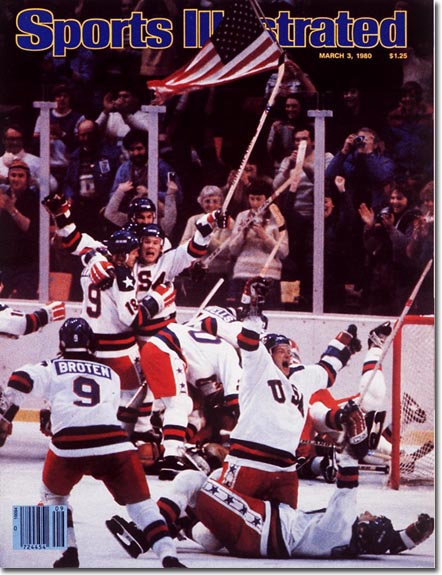
They did, of course, and the photo of their celebration became the only cover in Sports Illustrated's history that had no text with it — other than the magazine's nameplate, the date of publication and similar stuff.

But no headline. None was needed.

When the movie's final credits rolled, viewers were informed that it was dedicated to the memory of Brooks. He was killed in a car accident 10 years ago today, after the conclusion of filming but before the final product made its debut in theaters.

"He never saw it," the screen message said. "He lived it."

His life story was certainly compelling. As a young hockey player, he had been a member of the U.S. Olympic hockey team in 1960, but he was cut a week before the Games started.

The Americans went on to win the gold medal that year. The Soviets won the gold in every Olympics after that and didn't lose to the Americans again — until 1980, when Brooks guided the U.S. to the gold medal, finally winning the gold that had been denied to him 20 years earlier.

The year before he died, Brooks coached another U.S. Olympic hockey team, this time to a silver–medal finish. On the 22nd anniversary of the miracle on ice, the Americans defeated the Russians in Salt Lake City.

Talk about a storybook ending to a storybook life — a life that was filled, as most are, with disappointment and sadness but also a life that experienced joy and redemption.

It made me reflect, as I often do, about lives that are more inspiring than anything any fiction writer could make up.

Herb Brooks' was such a life.

He never saw "Miracle." He lived it.

And, because he lived it, the rest of us did as well.

Sunday, August 4, 2013

One More For The Road


As I have mentioned here before, I have been a Dodger fan since I was a boy.

Most of the time, it hasn't been very satisfying — kind of like most of the years that I spent as a Packer fan when I was growing up.

Twenty–five years ago, though, the Dodgers won it all. They confounded all the experts, who were convinced that the mighty Oakland A's would prevail.

During their late–season run in 1988, the Dodgers were led by pitcher Orel Hershiser, who threw 59 consecutive scoreless innings, breaking the major–league record that had been held by Don Drysdale for 20 years.

The baseball playoffs won't start for a couple of months, but I'm kind of having the same sensation this year that I had in 1988.

After a rough start to the season, the Dodgers have bounced back and surged to the lead in the National League West. OK, that's a team accomplishment, not an individual one, but I really like what they've been doing lately.

Yesterday, they matched the team record (which stood since 1924) for consecutive road wins — 13. As Steve Dilbeck of the Los Angeles Times pointed out, it was the longest road winning streak in the National League since the Philadelphia Phillies won 13 in a row in 1976.

Until today. The Dodgers beat the Chicago Cubs, 1–0, for their 14th straight win.

Having set a team record for consecutive road wins, I suppose the next thing for the Dodgers to do is take aim at the NL's all–time record of 17 set by the New York Giants in 1916.

We'll find out in the next few days if the Dodgers can set a new league record. They play a four–game series in St. Louis starting tomorrow.

Eventually, I know the road win streak will end. But when it started, the Dodgers were 16–24 on the road. Twenty–seven road games remain to be played now, and the Dodgers only need to win about two–fifths of them to have a winning record on the road.

And tonight, the Dodgers are 5½ games ahead of the slumping Arizona Diamondbacks in the NL West.

Wednesday, July 24, 2013

George Brett and the Pine Tar Incident


Baseball Hall of Famer George Brett turned 60 earlier this year.

That's kind of hard for me to wrap my mind around. I remember watching him play ball when I was a kid.

Well, we're all older now.

But I mention Brett's age because when he was exactly half his current age — 30 years ago today — he was involved in perhaps the most notorious incident of his time.

They called it the "pine tar incident" then, and I presume they still do today.

Brett's original major–league team, the Kansas City Royals, was playing the New York Yankees in Yankee Stadium on that day. Brett started playing in the major leagues in 1973. A decade later, the Royals and Yankees had met in the American League Championship Series four times, and they had kind of developed an animosity toward each other.

Now, I say that knowing that just about every team in baseball loathes the Yankees. They've won more championships than any other team — by far. The Royals were no different than any other team in baseball, but, since they didn't exist until 1969, they were just a little later to the party than the others.

Anyway, as I was saying, the teams were playing each other on this day in 1983. The Royals trailed by a single run with two outs in the top of the ninth, and Brett came to the plate. Hall of Fame reliever Goose Gossage was on the mound. Gossage delivered the pitch, Brett connected and the ball sailed over the fence. Home run. Two runs scored. Royals led, 5–4.

But when Brett crossed the plate with the apparent go–ahead run, Yankee manager Billy Martin left the New York dugout and walked up to the home plate umpire. Martin said he wanted Brett's bat examined. He had observed what he thought was an excessive amount of pine tar on the bat.

Now, at this point, it is probably useful to explain the relevance of pine tar in baseball. Pine tar is a sticky material that has several applications, one of which is to make a baseball bat easier for a player to grip and helps keep a bat from slipping out of a player's hands when he swings.

According to the rules of major league baseball, players may only apply pine tar from the handle of the bat up 18 inches. Martin believed the pine tar on Brett's bat exceeded the 18–inch restriction.

Actually, players are allowed to use any substance or material to improve the grip as long as it does not exceed 18 inches. If it exceeds 18 inches, the rules call for the bat to be removed from play. If a player made a hit with such a bat, it was termed at the time an "illegally hit ball" — resulting in an out.

So, the home plate umpire and the rest of the umpiring crew gathered at home plate to examine Brett's bat — with Brett and the rest of the Royals watching from their dugout. Apparently unable to make an eyeball assessment, the umpires measured the pine tar on the bat against the width of home plate, which is 17 inches, and they determined that Martin was right.

Brett was ruled out, giving the Yankees the victory.

Infuriated by the ruling, Brett ran from the dugout and vigorously objected. He had to be restrained by his manager and teammates, but his protest made no difference. The ruling stood.

(Memorably, a commentator on the scene said that Brett was the first player in history to hit a "game–losing home run.")

The Royals challenged the ruling, and American League President Lee MacPhail overruled it, awarding the victory to the Royals. He explained that the "spirit" of the rule had nothing to do with an unfair advantage for one player or team over another. Rather, it was based on economics. Pine tar that is any higher than 18 inches on a bat runs the risk of smearing the ball and rendering it unfit for use in a game. Home teams are required to provide the balls for games, and that would raise the home team's expenses.

MacPhail believed Brett had not violated the spirit of the rule and that the ball had not come in contact with the pine tar. He decided that the game should be resumed with the Royals leading, 5–4, and Brett was not to play. He was ejected for arguing with the umpire.

So the game was resumed nearly a month later on a scheduled off–day for both squads. Brett, his manager and two of his teammates were ejected per MacPhail's decision. There were additional maneuvers by the Yankees, made necessary by various things that had happened since the July 24 encounter (one of the Yankee players who was in the lineup that day was injured and another had been traded) but, in the end, Kansas City reliever Dan Quisenberry retired the side, and the Royals won the game.

And the pine tar incident took its place in baseball's history.

Thursday, July 18, 2013

Feeding Frenzy


The 142nd British Open started today at Muirfield, a privately owned course in Scotland.

Greg Norman (aka The Great White Shark) never won the British Open when it was played at Muirfield. He won his two British Opens at Royal St. George's Golf Club in Sandwich, Kent, England, the last time on this day 20 years ago. It was quite a sight to see.

In that 1993 edition of the Open, Norman set the aggregate score record for the four–day tournament with a total of 267. That's a daily average of 66.75. Pretty impressive, huh? Yep — but not as impressive as Norman's final round.

At the end of the first day of the tournament, Norman was tied for first with three other golfers at four–under par 66.

He shot a two–under par the second day but slipped to a tie for third behind Nick Faldo and Bernhard Langer. Faldo, who was three strokes off the lead when the day began, recorded a seven–under par 63 that day.

Nevertheless, Norman made the cut, which former British Open winners Jack Nicklaus, Gary Player, Tom Watson, Sandy Lyle and Tony Jacklin — all of whom were at least four–over par when the day ended — did not.

After the third round, in which Norman fired a one–under par 69, he was only one stroke behind the co–leaders, Faldo and Corey Pavin.

And that set up a truly remarkable final round.

On that last day, Norman shot a 64, his best day of the four, and secured his aggregate record, but, as Rick Reilly of Sports Illustrated observed, it went down to the wire for him. Norman, who finished before Faldo did, was all too well acquainted with finishing second, and, until Faldo wrapped up his final round, "the trapdoor could still open."

He could not permit himself to relax and enjoy his accomplishment until Faldo was in the clubhouse.

That trapdoor did not open on him this time. Faldo shot a 67 and finished two strokes behind Norman. Langer, who also shot a 67, finished third, one stroke behind Faldo.

Saturday, July 6, 2013

The Legs Feed the Wolf


As France's Marion Bartoli neared the conclusion of her straight–set triumph over Germany's Sabine Lisicki in Saturday's Wimbledon women's final, the announcing team — which included 10–time Wimbledon finalist Chris Evert — looked for explanations for Lisicki's apparent collapse.

It was suggested that Lisicki, who gained a reputation as a "giant killer" in this year's tournament, simply couldn't maintain that level of intensity. She knocked off Serena Williams in the fourth round, then defeated fourth seed Agnieszka Radwanska in the semifinal. Bartoli wasn't the big name that the other two were, but she was seeded in the top 20 (Lisicki was 23rd) — and, as always in a Grand Slam tournament, when you're in the final, you can count on facing an opponent who has been playing very well for at least the last couple of weeks.

It isn't impossible, the announcers agreed, for a player to remain focused against three more highly regarded opponents in the same week. It's just very hard to do, especially at the Wimbledon level.

I agree, but for a different reason.

Women's tennis matches are best–of–three–sets affairs. Men's matches are best of five. A quick start is essential in women's tennis because it is a comparative sprint. A fast start is important in men's tennis, too, but it is easier to overcome a bad set in men's tennis — unless it is the fifth one. It's more of a marathon.

If you have a bad first set in women's tennis, your back is against the wall.

And that was the situation Lisicki faced today. She lost the opening set to Bartoli, 6–1, and knew right then she would have to go the three–set distance to win the title.

She had done it before in this tournament.

Two days earlier, she beat Radwanska in three sets. That third set was a doozy, too, a marathon, and Lisicki finally prevailed, 9–7. Epic.

On Monday, Lisicki beat Williams in three sets. She won the first one, then lost the second one and had to turn back the champion in the third set, 6–4.

A few days before her match with Williams, Lisicki needed three sets to beat the lesser known but just as dangerous Samantha Stosur from Australia.

To reach the finals at Wimbledon, it was necessary to win six matches. Lisicki needed three sets to win half of them.

Bartoli, by comparison, won all six of her previous matches in straight sets, just as she did today, and she never faced anyone who was seeded higher than she.

As late U.S. Olympic hockey coach Herb Brooks allegedly said, "The legs feed the wolf." I don't know if Brooks really said that, but, whether he did or didn't, it was appropriate for his U.S. hockey team in 1980 and it is appropriate for this year's Wimbledon women's final.

It speaks to endurance. Strong legs permit a wolf to outrun its prey.

I think Lisicki ran out of gas. It wasn't a matter of motivation or emotion. She showed plenty of emotion when the match was over, and Bartoli accepted the trophy Lisicki had dreamed would be hers. The spirit was willing, but the flesh, worn down by seemingly endless tests in the earlier rounds, was too weak.

Killing the other giants had taken too much from her.

Bartoli, on the other hand, was fresh. She hadn't lost a set in the whole tournament. She had more left in the tank. A lot more. Once she got over her first–set jitters — and there weren't many of those — she could have gone into cruise control against the increasingly frantic but ineffective Lisicki.

The legs feed the wolf.

Friday, July 5, 2013

A Different Kind of Final


About 12 hours from now, Sabine Lisicki and Marion Bartoli will meet in the Wimbledon women's singles final.

I'm sure this isn't what most observers expected when this tournament began two weeks ago.

Lisicki defeated the defending champion, Serena Williams, in the fourth round. That's been typical for the women's singles this year. Bartoli is seeded 15th, Lisicki is 23rd. Only one of the top 14 seeds — Agnieszka Radwanska — got to the semifinals.

Bartoli will be making her second appearance in the championship (she lost in 2007); Lisicki is in her first–ever Wimbledon singles final. Obviously, no matter who wins, it will be her first title at Wimbledon, and that is something that Wimbledon watchers have rarely been able to say. By the time the field has been narrowed down to the last two, most of the time at least one has won the Grand Slam event before.

It has been rarer still for Wimbledon watchers to see a final in which both contestants were seeking their first Grand Slam title, but that is precisely what those in attendance tomorrow will see.

"Neither Bartoli nor Lisicki is a household name," writes Liz Clarke in the Washington Post — and, in the age of Maria Sharapova and the Williams sisters, who can argue with that?

The 28–year–old Bartoli seems to be savoring this shot at redemption. "I do just everything a bit better than what I was doing six years ago," Bartoli said this week.

Paul Birch of BBC Sports writes that the final will be a "fascinating encounter between the big–serving Lisicki, 23, and Bartoli, who boasts one of the best returns in tennis."

Birch reports that Martina Navratilova and Chris Evert pick Lisicki to win. Their selections are based primarily on the aspects of the individual games — Navratilova said, "I always go for the person who has the biggest game to win and she has a bigger game."

Evert was more restrained in her praise, but she said, "If Sabine Lisicki plays the same way she has been playing and serves like she has been serving ... then I think she definitely has a slight edge."

I agree with their assessments of the performances in the tournament, but my pick is based on how they have played against each other in the past. I know Bartoli was seeded higher in this tournament, but the fact remains that Lisicki beat a higher–seeded foe in the semifinals (Radwanska) than did Bartoli.

The two haven't faced each other often, but the head–to–head advantage belongs to Lisicki, who is 3–1 against Bartoli.

It should be interesting, and I'm looking forward to watching it tomorrow morning. I feel like I did when I was a child, and my mother made a big production of watching the Wimbledon finals. We would settle in to watch the women's and men's finals and eat strawberries and cream — or what I am sure was my mother's version of it (and may have borne no resemblance to what they actually eat).

I have no strawberries and cream to eat tomorrow — but I think I have a strawberry Pop–Tart somewhere ...