Showing posts with label women in sports. Show all posts

Thursday, September 21, 2017

The First Lady of Thoroughbred Racing


Secretariat is a name that has been known by hundreds of millions of people for more than 40 years — but most probably never heard of Penny Chenery until the Walt Disney Co. made a movie about Secretariat.

Chenery, who died last Saturday at the age of 95, was Secretariat's owner — but she was more than that, really. She was a tough old bird.

If you didn't grow up in the South, you may not know that is about the highest compliment one can pay. To be a tough old bird suggests that you have lived a long life and fielded everything life threw at you. Penny Chenery was a pioneer, and pioneers always have to be tough old birds.

They rarely win popularity contests.

In Penny Chenery's case she took over her father's once–successful horse breeding business when he became disabled and, applying what she had learned in business school, revived it and pursued her father's dream of winning the Kentucky Derby.

She had her father's love of horses, but she knew that horse breeding was not the kind of business she had studied in school. She encountered plenty of resistance along the way, but she achieved her father's goal with Riva Ridge in 1972.

In fact, with Secretariat, she went beyond her father's dream. She won all three of the Triple Crown races the following year, and Secretariat became the first Triple Crown winner in a quarter of a century.

Even now when I watch the footage of Secretariat's astonishing victory in the third and final jewel of the Triple Crown, the Belmont Stakes, I feel that same sense of awe and excitement that I felt on that Saturday afternoon in June of 1973.

A decade after that accomplishment, Chenery became one of the first three women to be admitted as members of The Jockey Club, which is the breed registry for thoroughbred horses in the U.S., Canada and Puerto Rico. A few years earlier she became a member of the Executive Committee of the American Horse Council, the horse industry trade association.

When the Disney movie was in the theaters seven years ago, some complained that it was more about Penny Chenery than it was about Secretariat, and there is some truth in that.

But the greater truth is that no movie could fully tell the story of Penny Chenery's remarkable life.

Rest in peace.

Sunday, August 3, 2014

The Cheshire Cat Strikes Olympic Gold


The 1984 Summer Olympics in Los Angeles were noteworthy before they began. Most of the world's communist–bloc nations declined to participate because the United States had led a boycott of the 1980 Summer Olympics in Moscow.

So the Games were noteworthy for who was not there.

But it was also noteworthy for who was there.

President Ronald Reagan, who served as governor of California for eight years, was there to open the Games. Track and field star Carl Lewis was there, and he won four gold medals, matching the 1936 performance of Jesse Owens. Michael Jordan, Patrick Ewing and Chris Mullin were there, and they participated on the U.S. basketball team that won the gold medal.

And Mary Lou Retton was there. Thirty years ago today, she became the first gymnast outside Eastern Europe to win the all–around competition.

Even with all those big names at the Games, Retton often seemed to be the only attraction. She had one of those smiles that was so big it seemed to exist all by itself — kind of like Lewis Carroll's Cheshire Cat.

Jordan, Ewing and Mullin had not yet begun their professional careers; Jordan, in particular, was not as famous as he would become. Eight years later, all three would be members of the so–called "Dream Team."

Mary Lou was America's sweetheart that summer. I don't think I have seen another U.S. female Olympian who was as adored as Mary Lou — with the possible exception of Dorothy Hamill.

In fact, it was during the '76 Summer Games — a few months after Hamill won her gold medal in figure skating — that Nadia Comaneci became the first gymnast to score a perfect 10.0 in Olympic competition. It was an achievement that most Americans probably dreamed — but dared not believe — one of their countrymen would match someday.

But Retton outdid Comaneci in 1984, scoring two perfect 10s, on the floor exercise and vault. The latter was particularly dramatic, given that Retton had knee surgery five weeks before the Games began.

Reagan, who was seeking a second term as president in 1984, enjoyed an approval rating of 52–54% during the Olympics — he accepted the Republican nomination in Dallas later that month — but my guess would be that Retton's approval far exceeded the president's that summer.

I don't know of any polls that were conducted at that time, but I'm reasonably sure Retton was the most popular person in America that year — at least in July and August.

Reagan went on to win 49 states in November, but, that summer, Retton might have been the only person in America who could have beaten him.

And she was only 16 years old.

Retton, now living in Houston with her husband and four daughters, recently attended a reunion of Team USA '84. A wistful time appears to have been had by all. Retton recalled that one of the highlights of her Olympic experience was riding on the bus to the Opening Ceremony with members of the U.S. basketball team.

Those '84 Olympic Games were, in the words of the Murfreesboro (Tenn.) Post, "one for the ages" — although I'm not sure where writer David Hunter heard that the Olympics in 1984 saved the Games.

(I know the Americans boycotted the 1980 Games in Moscow, and the Russians boycotted the '84 Games, but the Post's reasoning was too simplistic. Technically, Mr. Hunter was correct when he said that was "because of the Cold War," but that is really too general. The Americans and dozens of other countries boycotted because of the Soviet invasion of Afghanistan.)

Thursday, July 10, 2014

A Memorable Victory


I'm not a soccer fan. Really. I've been writing this blog for about six years now, and I believe this is only my second entry about soccer. Here is my first — written four years ago. Not too complimentary, is it?

One of my complaints then (as now) was the randomness — and infrequency — of scoring in soccer. If you watched the Germans score seven goals on Brazil in their historic World Cup semifinal, that might be hard to comprehend — although you really don't have to look any farther than the other semifinal, in which Argentina and the Netherlands fought through a scoreless match that was finally won by Argentina in the penalty shootout.

That is the kind of match that comes to my mind when I think of soccer, and it just doesn't appeal to me.

But today is the 15th anniversary of a soccer milestone that I just feel compelled to observe — even though it, too, was quite light on scoring. On this day in 1999, the U.S. women's soccer team won the World Cup. They won the World Cup in 1991, too, but they finished third in 1995. Norway won it that year.

Sixteen teams competed for the 1999 Women's World Cup. When the United States and China met for the championship in the Rose Bowl, more than 90,000 people were there to watch.

It was the highest attendance ever for a women's sports event.

The match went all the way through regulation and two overtimes with neither team scoring a goal so it went to a penalty shootout. On the fifth kick, 30–year–old Brandi Chastain scored to give the United States the victory.

Chastain spontaneously pulled off her jersey — as victorious male soccer players have been known to do — and, clad in a sports bra, waved her jersey in her clenched right fist.

"Momentary insanity, nothing more, nothing less," Chastain explained later. "I wasn't thinking about anything. I thought, 'This is the greatest moment of my life on the soccer field.'"

The image, which landed on the covers of several magazines, is regarded by many as one of the best–known images of a woman celebrating a sports victory.

Early on, 33–year–old Michelle Akers kept the United States in the game by blocking nearly every shot that came her way, but she and the U.S. goalkeeper collided late in regulation, and she had to leave the match.

After two scoreless overtimes, it came down to the penalty shootout, which the U.S. won on Chastain's goal.

As I mentioned four years ago, I'm just not a fan of soccer — and I didn't see the U.S.–China match. July 10 was a Saturday in 1999 so I suppose I could have. I just didn't. I don't remember why.

But I do remember seeing highlights of the match, and Chastain ripping off her jersey in exultation.

The United States has not won the World Cup since.

Monday, February 10, 2014

Back to the Future?


A couple of days ago, I read with interest a column by Linda Robertson of the Miami Herald in which she argues that figure skating in America desperately needs "an ice queen" to survive.

It is ironic, I suppose, that such a suggestion should be made this month, 20 years after the Tonya Harding–Nancy Kerrigan showdown in the Winter Games.

Tonya, as I observed last month, was part of a conspiracy to get Kerrigan out of the way so Harding could breeze to the championship in the Nationals and then — presumably — win the gold medal in Norway.

But the plot unraveled, and both were allowed to compete in the Winter Olympics. The buildup for that showdown had something for everyone — Kerrigan was the good girl, Harding was the bad girl. Ratings went through the roof. In spite of the assumptions of many, though, neither won the gold. Kerrigan took the silver.

The general mindset at the time was that women's figure skating was the domain of the Americans — not unlike the general belief that once accompanied women's gymnastics, that it was the domain of Russia and the communist–bloc countries.

Fast forward a couple of decades.

The American women haven't won a gold medal in figure skating since 2002. They didn't medal at all in the last Winter Games.

The general prospects for the 2014 Games don't look so good, either. It isn't all bad. Americans are favored in ice dancing, Robertson reports, and the U.S. team has a chance at a medal.

But "U.S. pairs will be outclassed and, most humbling of all, U.S. men's and women's skaters face the prospect of being shut out of the medals for the first time since 1936."

Robertson writes that dominance in skating is seen as a cyclical thing, and I suppose there is truth in that. Everything does seem to go in cycles, and perhaps this is a natural downturn for the Americans. That isn't good news for NBC, which holds the American Olympic broadcasting rights through 2020.

The Summer Games have a lot of appealing events for Americans — track and field, swimming, diving, volleyball, gymnastics — but the marquee event for the Winter Games is figure skating. Oh, sure, you have some who like to watch skiing and, for awhile, Olympic hockey thrived in traditionally non–hockey markets, but that faded after the U.S. hockey team failed to duplicate its gold–medal success in the 1980 Winter Games.

NBC needs women's figure skating to be what it once was — a ratings bonanza.

Monday, January 6, 2014

The Hole-in-the-Head Gang


"Why me? Why me?"

Nancy Kerrigan
Jan. 6, 1994

On this day 20 years ago, ice skater Nancy Kerrigan was clubbed on her right knee on the eve of the 1994 U.S. Figure Skating Championships in Detroit.

It was part of a plot to keep Kerrigan from competing in the 1994 Winter Olympics, ostensibly opening the door for rival Tonya Harding to win the gold medal.

The hit man, Shane Stant, had been instructed to break Kerrigan's leg so she could not compete. Kerrigan's leg was only bruised, though. While she had to withdraw from the national championship competition, both Kerrigan and Harding (the winner of the national championship in Kerrigan's absence) were chosen to compete in the Olympics in February 1994.

The motive for the clubbing wasn't immediately clear, though. I mean, there was no one calling media outlets to claim responsibility for it or anything like that.

The speculative soap opera that followed quickly became a media sensation and catapulted figure skating into an entirely new stratosphere.

As Barry Wilner of the Associated Press writes, "Often considered elitist because of its expense, and only something to watch whenever the Winter Olympics rolled around, skating entered an entirely different realm because of Tonya and Nancy. That surge in popularity lasted for the rest of the 1990s."

The surge continued through the 1994 Winter Olympics, held that year in tiny Lillehammer, Norway. It must have been the biggest media circus ever to hit that community. I wasn't there so I don't know, but, from the perspective of one who watched it play out on television, the Tonya and Nancy show truly was a media circus in every sense of the phrase.

It struck me at the time — and it still does — that the Kerrigan episode was evidence of just how provincial Americans were in 1994 (and still are, for that matter). The assumption was that the top American female skater would win the gold medal — ultimately, Oksana Baiul of the Ukraine took home the gold in 1994 — but why would Americans get that idea? It ignored all the talent in the rest of the world, not to mention the history of the sport.

East German Katarina Witt dominated Olympic women's figure skating in the 1980s. Ever since women's figure skating was introduced as an Olympic event, women from other countries had ruled the sport.

Peggy Fleming was the breakthrough figure skater for the U.S. in 1968, and Dorothy Hamill won the gold in 1976, but America's top finisher in 1980 was silver medalist Linda Fratianne. Witt beat Americans Rosalynn Sumners in 1984 and Debi Thomas in 1988.

Perhaps it was Kristi Yamaguchi's triumph over favored Japanese skater Midori Ito in 1992 that ignited the fire that led, possibly inevitably, to the assault on Kerrigan 20 years ago today.

The lust for lucrative commercial deals inspired Harding's husband, Jeff Gillooly, and some other ne'er–do–wells to hatch the plot to get Kerrigan out of the way.

I guess it never occurred to the Hole–in–the–Head Gang that someone from another country — Baiul, for example — might take the gold.

I also think the Nancy–Tonya spectacle of '94 serves as something of a 21st–century cautionary tale.

Because, in spite of what Gilloly and his accomplices thought, Olympic gold isn't really worth much more than that — it brings a little fame that really doesn't last as long as they probably thought it did and a little temporary income that is gone before you know it. In 1994, mostly what Olympic gold (or the lust for it) brought to Tonya Harding was notoriety.

For her part, Kerrigan retired from amateur competition after the Olympics. She performed in some ice shows and participated in other skating–related activities, but largely her life seems to have been dedicated to her husband, whom she married the year after the Olympics, and their children.

Friday, September 20, 2013

The Battle of the Sexes


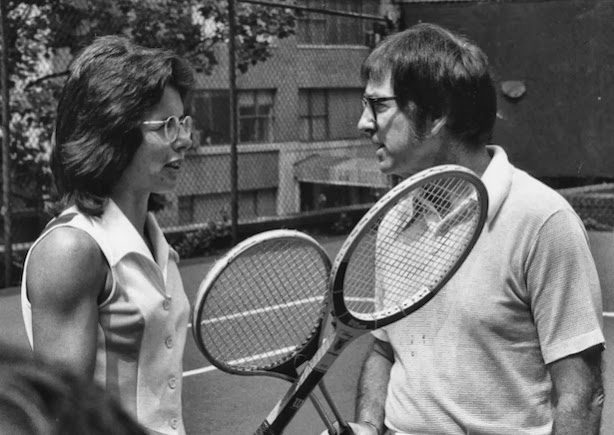
Forty years ago today, Billie Jean King struck a blow for women's liberation by beating notorious male chauvnist Bobby Riggs in a tennis match in Houston's Astrodome.

Or did she?

Just in time for this milestone anniversary came the revival of a longstanding urban myth — that Riggs deliberately lost the match, which was known as the "Battle of the Sexes." The story goes that he threw the match to settle a six–figure gambling debt with the mob.

ESPN wryly suggested that the match should have an asterisk next to it in the sports history books.

"We are always refighting old battles," wrote Gail Collins in the New York Times. "But I honestly did not expect to be spending any time in 2013 arguing about whether Billie Jean King beat Bobby Riggs."

There really are bigger fish to fry.

Such rumors have been around virtually since the match ended. I must admit that, as a child, I was baffled. Riggs (who died in 1995) was 55 years old and had been retired for many years; King was 29 and had just won both the singles and doubles championships at Wimbledon. In 1973, she was one of the best women's tennis players in the world.

The fact that she won raised no red flags for me. I expected her to win.

Howard Cosell, who was better known for calling professional fights and Monday Night Football, provided the commentary for ABC. That made the event more legitimate in my eyes.

Legitimacy was the issue, it seemed to me then — because it seemed that way to a lot of people. As Gerald Eskenazi, a veteran tennis writer, observes in the Wall Street Journal, "It wasn't until [this day] that I fully understood that a seismic change was under way." That's probably an apt description of my mindset at the time.

King responded to the allegations in the way that people, famous and not famous, tend to address things these days — via Twitter — and she insisted that Riggs wanted to win, that he tried to win.

"I just beat his butt and that's it," she said.

Seems to me that ought to be the final word on it.

But I'm certain that won't be enough for some people.

Saturday, July 6, 2013

The Legs Feed the Wolf


As France's Marion Bartoli neared the conclusion of her straight–set triumph over Germany's Sabine Lisicki in Saturday's Wimbledon women's final, the announcing team — which included 10–time Wimbledon finalist Chris Evert — looked for explanations for Lisicki's apparent collapse.

It was suggested that Lisicki, who gained a reputation as a "giant killer" in this year's tournament, simply couldn't maintain that level of intensity. She knocked off Serena Williams in the fourth round, then defeated fourth seed Agnieszka Radwanska in the semifinal. Bartoli wasn't the big name that the other two were, but she was seeded in the top 20 (Lisicki was 23rd) — and, as always in a Grand Slam tournament, when you're in the final, you can count on facing an opponent who has been playing very well for at least the last couple of weeks.

It isn't impossible, the announcers agreed, for a player to remain focused against three more highly regarded opponents in the same week. It's just very hard to do, especially at the Wimbledon level.

I agree, but for a different reason.

Women's tennis matches are best–of–three–sets affairs. Men's matches are best of five. A quick start is essential in women's tennis because it is a comparative sprint. A fast start is important in men's tennis, too, but it is easier to overcome a bad set in men's tennis — unless it is the fifth one. It's more of a marathon.

If you have a bad first set in women's tennis, your back is against the wall.

And that was the situation Lisicki faced today. She lost the opening set to Bartoli, 6–1, and knew right then she would have to go the three–set distance to win the title.

She had done it before in this tournament.

Two days earlier, she beat Radwanska in three sets. That third set was a doozy, too, a marathon, and Lisicki finally prevailed, 9–7. Epic.

On Monday, Lisicki beat Williams in three sets. She won the first one, then lost the second one and had to turn back the champion in the third set, 6–4.

A few days before her match with Williams, Lisicki needed three sets to beat the lesser known but just as dangerous Samantha Stosur from Australia.

To reach the finals at Wimbledon, it was necessary to win six matches. Lisicki needed three sets to win half of them.

Bartoli, by comparison, won all six of her previous matches in straight sets, just as she did today, and she never faced anyone who was seeded higher than she.

As late U.S. Olympic hockey coach Herb Brooks allegedly said, "The legs feed the wolf." I don't know if Brooks really said that, but, whether he did or didn't, it was appropriate for his U.S. hockey team in 1980 and it is appropriate for this year's Wimbledon women's final.

It speaks to endurance. Strong legs permit a wolf to outrun its prey.

I think Lisicki ran out of gas. It wasn't a matter of motivation or emotion. She showed plenty of emotion when the match was over, and Bartoli accepted the trophy Lisicki had dreamed would be hers. The spirit was willing, but the flesh, worn down by seemingly endless tests in the earlier rounds, was too weak.

Killing the other giants had taken too much from her.

Bartoli, on the other hand, was fresh. She hadn't lost a set in the whole tournament. She had more left in the tank. A lot more. Once she got over her first–set jitters — and there weren't many of those — she could have gone into cruise control against the increasingly frantic but ineffective Lisicki.

The legs feed the wolf.

Friday, July 5, 2013

A Different Kind of Final


About 12 hours from now, Sabine Lisicki and Marion Bartoli will meet in the Wimbledon women's singles final.

I'm sure this isn't what most observers expected when this tournament began two weeks ago.

Lisicki defeated the defending champion, Serena Williams, in the fourth round. That's been typical for the women's singles this year. Bartoli is seeded 15th, Lisicki is 23rd. Only one of the top 14 seeds — Agnieszka Radwanska — got to the semifinals.

Bartoli will be making her second appearance in the championship (she lost in 2007); Lisicki is in her first–ever Wimbledon singles final. Obviously, no matter who wins, it will be her first title at Wimbledon, and that is something that Wimbledon watchers have rarely been able to say. By the time the field has been narrowed down to the last two, most of the time at least one has won the Grand Slam event before.

It has been rarer still for Wimbledon watchers to see a final in which both contestants were seeking their first Grand Slam title, but that is precisely what those in attendance tomorrow will see.

"Neither Bartoli nor Lisicki is a household name," writes Liz Clarke in the Washington Post — and, in the age of Maria Sharapova and the Williams sisters, who can argue with that?

The 28–year–old Bartoli seems to be savoring this shot at redemption. "I do just everything a bit better than what I was doing six years ago," Bartoli said this week.

Paul Birch of BBC Sports writes that the final will be a "fascinating encounter between the big–serving Lisicki, 23, and Bartoli, who boasts one of the best returns in tennis."

Birch reports that Martina Navratilova and Chris Evert pick Lisicki to win. Their selections are based primarily on the aspects of the individual games — Navratilova said, "I always go for the person who has the biggest game to win and she has a bigger game."

Evert was more restrained in her praise, but she said, "If Sabine Lisicki plays the same way she has been playing and serves like she has been serving ... then I think she definitely has a slight edge."

I agree with their assessments of the performances in the tournament, but my pick is based on how they have played against each other in the past. I know Bartoli was seeded higher in this tournament, but the fact remains that Lisicki beat a higher–seeded foe in the semifinals (Radwanska) than did Bartoli.

The two haven't faced each other often, but the head–to–head advantage belongs to Lisicki, who is 3–1 against Bartoli.

It should be interesting, and I'm looking forward to watching it tomorrow morning. I feel like I did when I was a child, and my mother made a big production of watching the Wimbledon finals. We would settle in to watch the women's and men's finals and eat strawberries and cream — or what I am sure was my mother's version of it (and may have borne no resemblance to what they actually eat).

I have no strawberries and cream to eat tomorrow — but I think I have a strawberry Pop–Tart somewhere ...

Saturday, June 8, 2013

Beating the Divine Miss M ... Again


"I mean, a lot of what I have or possess has helped me get to the stage where I am today."

Maria Sharapova

The challenge for defending champion Maria Sharapova in today's French Open women's final couldn't have been clearer.

Her opponent, Serena Williams, held a 13–2 head–to–head advantage over Sharapova and had won the previous 30 consecutive matches.

And there were times when I thought she would meet that challenge.

But it was not to be.

There was a lot of interest in this match. It was the first time that the top two women in the world had met in the French Open final in nearly 20 years. Sharapova, as I say, was the defending champion, but Williams hadn't won in Paris in more than a decade — since defeating her sister Venus in straight sets in 2002. Today was the first time she had been in the French Open final since that day.

I suppose a defending champion, whether in an individual sport or a team sport, is favored to repeat. Consequently, I guess, Sharapova would have been expected to be the favorite today. But Williams has been hitting the ball so well that I think she was favored by most observers.

Most of them may have thought that Williams would have an easy time of it, but that was not true. While she did sweep the sets, Sharapova doggedly fought back in each and made Williams work for the title.

The bottom line? Williams defeated Sharapova, 6–4, 6–4.

Prior to today's match, Judy Battista wrote in today's New York Times that Williams, so long in the shadow of her sister (even though Serena has won more Grand Slam titles and more money), is reminiscent of Steffi Graf a quarter of a century ago. Battista wondered if Williams could match Graf's dominance of Natasha Zvereva in the 1988 final.

Graf, too, swept the sets in the final, but she did so at 6–0, 6–0 in a little more than half an hour. If you know nothing but the scores of today's final, you know Williams did not dominate Sharapova like that. The Divine Miss M, as I have already said, put up a great fight — and there were times when I really thought she might come back and win.

But Williams controlled the match. She didn't dominate it, but it was clearly hers practically from the start, and she went on to become, at 31, the oldest women's singles champion at the French Open since the dawn of the open era in the 1960s.

In 1988, a year before she turned 20, Graf swept the Grand Slam. Williams has won all four Slam events at least twice in her career, and she is the defending champion in the remaining two Slams this year — Wimbledon and the U.S. Open — but she didn't win the Australian Open so she will have to wait until at least next year before she will have another chance to win her first true Grand Slam.

She might not do it. There are several talented — and hungry — women on the tour these days, and she can't be expected to continue to play at this level indefinitely.

But right now, she's on top of the world.

Wednesday, June 5, 2013

Making History at the Belmont


The Belmont Stakes has been the scene of great drama over the years.

That stands to reason, doesn't it, since the Belmont is the third jewel in the Triple Crown. If a horse comes into the Belmont having already won the Kentucky Derby and the Preakness, a win in the Belmont will secure a Triple Crown. Eleven horses have done that since World War I.

Twenty–two others came into the Belmont with wins in those two races but failed to pull off the hat trick. Most failed to win the Belmont; a few, for one reason or another, were not entered.

But it still can be a dramatic race even if a Triple Crown is not on the line — which it will not be this year.

That being the case, a certain amount of attention can be expected to be given in Saturday's race to Rosie Napravnik, who is the first female jockey to ride in all three Triple Crown races in the same year. Napravnik will be riding Unlimited Budget, a filly and currently an 8–to–1 shot starting in the 13th position.

Napravnik would certainly make news if she wins — once she rides in the Belmont, she will make history as the first female to ride in all three Triple Crown races in the same year — but she won't make history as the first woman to win a Triple Crown race. That distinction was achieved by Julie Krone, who won the Belmont Stakes aboard Colonial Affair 20 years ago today.

"I've been in one Derby, and this is my third Belmont," Krone said before the race. "But I've never thought of the fact that I haven't won a Triple Crown race. I'm not like that. I always look at the sunshine of things."

The '93 Belmont was an example of why I love to watch horse racing. There really is no such thing as a sure thing.

Colonial Affair was practically an afterthought through much of the race, holding back in the pack behind half a dozen other horses who set the early pace. As the horses made their way along the backstretch, Colonial Affair seemed to be settled in sixth place.

Not much movement could be detected in the order of the horses as they made the turn and started down the homestretch. But then, Colonial Affair seemed to appear from nowhere on the outside and sprinted past the leader to a two–length victory.

Oh, to have been a gambler with the knowledge of how that race would play out! A $2 wager on the 13–to–1 shot paid $29.80, $14.80 and $9.40.

"I don't think the question needs to be genderized," Krone said when asked how it felt to be the first woman to win a Triple Crown race. "It would feel great to anyone. But whether you're a girl or a boy or a Martian, you still have to go out and prove yourself again every day."

I would say she proved herself.

Krone retired in 1999 with 3,545 career wins, the most ever for a woman. In 2000, she became the first female jockey inducted into the National Museum of Racing's Hall of Fame. She came out of retirement for a year and finished her career with more than 3,700 victories.

Unlimited Budget doesn't face the long odds that Colonial Affair did, but observers believe the winners of the first two races, Orb and Oxbow, are the favorites to win on Saturday.

Friday, February 8, 2013

Peggy Fleming's Triumph


I'm not precisely sure when my family got a television set for the first time.

But I'm pretty sure we had one 45 years ago this month.

I say that because I can remember my mother gathering my younger brother and me in front of the TV to watch Peggy Fleming skate in the 1968 Winter Olympics, which began in Grenoble, France, on Feb. 6. We were both very young at the time. I'm reasonably sure I had no idea who Peggy Fleming was — nor, for that matter, did I know what the Olympics were — and I am almost positive that my brother knew nothing about either as well.

But Mom definitely knew who Fleming was, and what I remember most of that occasion was Mom watching our tiny (by modern standards) black–and–white TV in rapt silence. Whenever I started to ask her anything, she would hold up one hand to quiet me, her eyes never leaving the screen.

I have fleeting memories of watching Fleming skate that night. I have since watched film of her performance, and each viewing serves to confirm what I remember. She was brilliant, and she, probably more than anyone, was responsible for the explosion in popularity of the Olympics in America.

Well, ABC's coverage of those Games — including extensive reports on Fleming and French skier Jean–Claude Killy — had a lot to do with it, too.

As far as American audiences were concerned, though, Fleming was the clear star. She was the only American to win a gold medal in the Grenoble Olympics.

Other American women achieved stardom as Olympic figure skaters in the years to come, but Fleming, while not the first, blazed the modern–day trail. It was Fleming who truly made it possible for Dorothy Hamill, Kristi Yamaguchi, Tara Lipinski and Sarah Hughes to claim Olympic gold.

She overcame the loss of her coach in an airplane crash in Belgium almost exactly seven years earlier. That plane crash decimated the American skating program, and it must have been devastating for Fleming, who was 12 at the time. Nevertheless, Fleming rose to Olympic prominence from the ashes of that crash, in large part because of her unusual style.

Even though Christine Brennan writes in USA Today that there is no dominant American woman in figure skating today, it seems to me that modern American observers, being as provincial as they are, long ago grew accustomed to the idea that an American woman will be among the favorites at the Winter Olympics. It's taken for granted by some.

But that is a relatively recent phenomenon.

By 1968, only five American women had ever won medals for figure skating since the Winter Olympics began six decades earlier — and only two won gold. Four U.S. women have won gold since, and none of them really carried the national burden that Fleming did.

(Perhaps the 1980 U.S. hockey team did, but no single individual has — at least not in the Winter Games.)

When she ascended the podium to receive her gold medal, Fleming was joined by silver medalist Gabriele Seyfert of East Germany and bronze medalist Hana Mašková of Czechoslovakia. It was, as I say, the United States' only gold medal of the Winter Olympics.

That made her the darling of the Olympics as far as Americans were concerned.

I didn't fully understand the significance of Fleming's triumph at the time. I was just too young.

But, as young as I was, I could see that it had a great impact on my mother. I always felt that Mom looked at Fleming as a role model, a symbol of what a woman could achieve.

Mom seldom spoke of it, but she always made a point of watching Fleming when she was on TV; sometimes I watched with her.

And sometimes she asked me if I remembered watching Fleming win her gold medal.

I always told her I did, but the truth was that my memory was spotty.

The truth also was that I clearly saw a lot of pride in Mom's eyes — and I heard a lot of pride in her voice — when she spoke of Fleming.

It made me realize how symbolic these triumphs were to young women in America.

Such symbolic victories, though, are accomplished through a lot of hard work and dedication. That was the thing I didn't appreciate at the time.

But I do appreciate it now.

Thursday, August 9, 2012

The Olympic Spirit


Like most Americans, I guess, I have been watching the Summer Olympics these last two weeks, rooting for the USA and all that.

And, as we near the conclusion of the 2012 Games, we have had some memorable moments but not necessarily iconic ones.

Well, I'll make a couple of exceptions on that one.

Although I already knew the outcome, last night I watched the women's beach volleyball gold–medal game — and applauded Kerri Walsh and Misty May on winning their third consecutive gold in the event.

After all, everyone knew it would be their final match together. It was a special moment.

I would say that watching them in that match, knowing it was the last one, was comparable to watching Michael Jordan play his final game of basketball or Babe Ruth play in his final game of baseball.

Except that, with only two athletes per team, it probably had more in common with tennis. So watching them play was probably like watching the final championship match between Martina Navratilova and Chris Evert.

They are legends of their sport — even if their sport, like so many Olympic sports, grabs our attention for a few days every four years.

Between now and 2016, if I watch beach volleyball at all, it probably will be accidental, a case of stumbling onto a broadcast while looking for something else to watch.

And I may stop and watch it for a few minutes — until I remember that there are other channels to check and, after making a mental note to return to the broadcast if I don't find something else to watch (which I probably will not do, settling instead for something that is vastly inferior), I will move on.

The Olympics make us temporary fans of sports we seldom watch at any other time.

I've seen nothing on the field to compare with the final seconds of the U.S.–U.S.S.R. hockey game of 1980 or the American gold rush at the 1984 Games in Los Angeles.

Or Kerri Strug's one–foot landing to secure the all–around gold medal for the U.S. gymnastics team in 1996.

Fortunately, though, we've had nothing similar to the killings of the Israeli athletes by terrorists at the 1972 Games in Munich — an event that has been rarely mentioned, at least in the TV coverage I have seen.

Maybe I have missed it, but I was sure that someone would say something about it since 2012 is the 40th anniversary of that indisputably dark chapter in Olympic history.

But it has been all but ignored at these Games.

Well, others may have overlooked the anniversary — either intentionally or unintentionally — but Aly Raisman did not.

Raisman, an 18–year–old American gymnast and "official Jewish heroine of the 2012 Olympic Games," in the words of Haaretz Israeli News' Allison Kaplan Sommer, saluted the "Munich 11" on the occasion of what must be considered her greatest personal triumph to date — her gold medal–winning performance in the floor exercise.

Leonard Greene of the New York Post put it this way:

"The martyrs were remembered this week during a London ceremony filled with sadness and reflection," Greene wrote. "But not a peep about them has been said publicly in the one place where it counts — at the Summer Games on Olympic soil."

Until Raisman.

Saturday, July 7, 2012

Sibling Rivalry


She needed three sets to do it, but Serena Williams held off a determined Agnieszka Radwanska to claim her fifth Wimbledon singles title Saturday.

"I always wanted everything Venus had," she joked after being reminded (for what, I am sure, was not the first time) that her sister Venus also has five Wimbledon singles titles — including one she claimed against Serena in 2008 (although three of Serena's titles have been won against Venus, including a 2009 rematch).

Serena has now won 14 Grand Slam titles, and, at the age of 30, the window for her to match Chris Evert and Martina Navratilova (with 18 each) may be closing — and the odds that she can match the all–time leader, Steffi Graf (22), may be nonexistent.

But even at 30, people speak in awe of Serena's serve, even her second serve, which most players seem to treat timidly. It is the best in the business, they say — and when I say "they," I include in that group Chris Evert, who was a commentator during today&apos's match.

Serena had the proper appreciation for her serve, Simon Cambers wrote in The Guardian, but she seemed baffled by its power.

"My serve really helped me throughout this tournament," she told Cambers. "I can't describe why it was so good or how it was so good. It's not like I practise it that much. I just had the rhythm."

Radwanska, who was seeded third, was no easy mark.

Serena cruised to a 6–1 victory in the first set but then faltered in the rain–delayed second set and had to hold off the hard–charging Radwanska in the third set, 6–2.

Over and over again, Radwanska seemed to be on the brink of overcoming Serena in that final set, just as she had in the first, but, in the end, the result was the same.

ESPN's announcers spoke of Radwanska's competitive nature, how the fact that she made it to the women's singles championship would not be enough for her, and that certainly appeared to be the case. Clutching her runnerup plate, she almost seemed to be in mourning.

Before the match, she had spoken with confidence of her chances to upend Serena.

A three–set duel clearly did not satisfy her.

I expect we will see her in Centre Court again.

Saturday, June 9, 2012

Back in the Saddle Again?


Not long ago, I wondered if Maria Sharapova was past her prime at the tender age of 24.

Well, she has observed a birthday since I wrote that — so she is now 25 — and today she won the women's singles title at the French Open for the first time — so she is now one of a handful of pro players to win a career Grand Slam.

I think I may have been a bit hasty in speculating about whether she was over the hill.

Her victory over Sara Errani, who secured a spot in the world's Top 10 rankings with her performance in Paris, showed that concerns about the lingering effects of her shoulder injury were baseless.

She undoubtedly will go to Wimbledon as one of the favorites.

But her victory in Paris gave her a career Grand Slam — at least one singles title in all four Grand Slam tournaments — and should have erased all doubt.

Errani, also 25, is an up–and–comer. She and Roberta Vinci won the women's doubles title, and she defeated the 2008 and 2009 French Open winners en route to today's match.

Before the match, I heard Errani described as petite. Presumably, that was a reference to her height. At 5–foot–5, she is a few inches shorter than just about everyone she faces, and the height difference is even more pronounced when she stands next to Sharapova, who is nine inches taller.

But Errani is also muscular, and that is something I definitely do not associate with the term petite. I've always thought of petite as being synonymous with dainty — which it is, according to my thesaurus, but it is also listed as synonymous with small.

(I would argue the point to an extent. I have known women who were nearly as tall as Sharapova whom I would characterize as dainty. In fact, before I saw her play, I would have regarded Sharapova herself as dainty. But that is one thing she is not, at least not on the tennis court.)

As I watched Errani futilely, gamely trying to overcome Sharapova, I realized that, barring something completely unexpected, Errani will become a familiar face in tournament finals.

The final score was lopsided. The match was not.

Saturday, March 31, 2012

Has Maria Peaked?


Today, while most of the rest of the sports world was anticipating the NCAA Tournament's Final Four, I was doing something I did a year ago in what was a true deja vu moment.

I watched the women's final of the Sony Ericsson tennis tournament in Key Biscayne, Fla. And, just like last year, Maria Sharapova lost in straight sets.

Last year, Sharapova lost to Victoria Azarenka, an up–and–comer who had been attracting some attention for awhile (and continued to do so through the end of the year). This time she lost to Agnieszka Radwanska of Poland. Radwanska has been a professional for several years, but she has kept such a low profile that most people who consider themselves tennis fans probably never heard of her until just recently.

This title was the biggest of Radwanska's brief career, and I don't wish to take anything away from her, but I can't help wondering if Sharapova has peaked.

I asked a friend of mine who used to write about tennis for the Arkansas Gazette when I was there if he thought Sharapova has peaked. He replied that he hadn't seen the match, but he thinks her shoulder injury may still be bothering her.

That's a plausible argument, based on what I saw today. But it doesn't explain everything.

Saturday, January 28, 2012

Scream 2


As I have mentioned here before, I used to work on the sports copy desk of the old Arkansas Gazette.

I made many friends during my time there. "Some are dead and some are living," in the words of John Lennon, and one of the living ones, with whom I have reconnected via Facebook, is, as I have told him, the foremost authority on tennis that I know.

I thought of him today when I was watching Maria Sharapova battle Victoria Azarenka in the women's final of the Australian Open.

It was a rematch of a tournament showdown I watched last spring, and the outcome was nearly the same. The 22–year–old Azarenka completely dominated Sharapova and appears to be well on her way to the top ranking in the world.

I wanted to get some feedback from my friend so I e–mailed him after the match, and this is what he had to say.

Of Azarenka, whose victory this morning was her first Grand Slam title, he said, "[S]he's mentally strong enough to win some slam tournaments. She plays big points well."

That was my impression as well. She continues to impress me every time I see her play — and in unexpected ways.

And, perhaps, nothing I saw in today's match made a greater impression on me than what I saw at the end — a triumphant Azarenka dropped to her knees and appeared to be stunned that she had actually won a Grand Slam event.

Never mind that she had completely dominated Sharapova, who has been regarded as a formidable force in women's tennis since winning Wimbledon nearly eight years ago.

Shortly, though, Azarenka's bewilderment turned to pure unadulterated joy as she ripped the sweatband from her brow and threw it into the cheering crowd, then threw tennis ball after tennis ball to the fans.

Her domination of Sharapova had been so complete, in fact, that none other than Chris Evert observed, at one point, that, in her day (and, I would presume, the practice predated her career), it was said that if one player won five consecutive sets (or more) against someone else, the first player owned the second.

And, based on that, Evert continued, it could fairly be said that Azarenka owns Sharapova.

Certainly, based on my observations, that is true. Azarenka beat Sharapova in straight sets in the match I watched last spring — and I thought at the time that it was their first encounter, but, as I understand it, they actually met for the first time a few years earlier. Azarenka won on that occasion, too, which means she has won at least five straight sets against Sharapova.

Of Sharapova, my friend said, "I love watching Sharapova but I don't think she's that interested in winning on the court. She can make more money posing."

Regretfully, that seems to be true.

She's still making noises about wanting to win Grand Slam tournaments, but I have to wonder, especially as Azarenka's star is ascending, if she isn't being drawn to a more lucrative modeling career.

And, frankly, who could blame her?

She is an attractive young woman, and there is always a lot of money for young women who are willing to parlay their physical attributes into bank accounts.

And, if she chooses to dedicate herself to the pursuit of easy paydays, that's fine. It might even be the wisest choice she could make.

Because Azarenka, it seems, is dedicating herself to the pursuit of Grand Slam titles. And, as Geoff MacDonald writes in the New York Times, "she is an attacking, all–court player capable of success on any surface. With her new–found equilibrium on the court, and her fearless competitive spirit, Azarenka will contend for all four Grand Slam titles."

Might be hard for Sharapova to compete.

Friday, January 20, 2012

Death of a Skier


I don't know if most Americans have ever heard of Canadian skier Sarah Burke.

Until recently, I must admit, I knew little about her myself. But, apparently, she was well known among extreme sports enthusiasts. And Burke' death dramatically alters expectations for the next Winter Olympics.

Burke, who died yesterday at the age of 29, was a freestyler who successfully lobbied to have her sport included in the Winter Olympics and was widely expected to win a medal in the sport when it makes its debut in the 2014 Winter Games in Russia. She died from injuries suffered 10 days ago in a training accident in Utah.

The death of one so young is always a tragedy, and the circumstances of Burke's death make it even more tragic. She was practicing the sport to which she had committed everything. Her commitment to it appears to have been even more binding than the marriage vows she took less than two years ago.

As I have observed, she was the driving force behind the inclusion of freeskiing in the Winter Olympics — and the ironic (and, apparently, inevitable) outcome of her death may well be a renewed and reinvigorated debate over the risks of her sport.

That may or may not be an overreaction. Burke's death is a tragedy, but from what I know of her I think she would agree that the sport has gone to great lengths to minimize the risks.

And the accident that caused her death appears to be more of a fluke than anything else. Observers say the accident occurred not on a complicated maneuver but on a routine jump that Burke had performed hundreds, if not thousands, of times before without incident.

Perhaps, as some have suggested, she landed at just the right angle to cause her fatal accident, that the odds against such a thing happening again are astronomical.

Accidents and injuries are "part of the game," Burke said. "Everybody gets hurt."

Canadian Freestyle Ski Association chief executive Peter Judge said, "[Burke] will be greatly missed by all of us at the CFSA and the entire ski community."

Burke may not have been a mainstream household name, but my guess is that the Olympic debut of the sport to which she dedicated herself will be among the most emotional of the next Winter Games.

And I predict that, in death, Burke will inspire far more people than she ever did in life.

It would be a tragedy compounding another to turn the situation into something it isn't, whatever the motivation.

Monday, October 31, 2011

A Preview of Coming Attractions?


I am a football fan, and, at this time of the year, my weekends are typically spent with my TV tuned to football games, but I must admit that yesterday afternoon I periodically monitored ESPN's coverage of the WTA finals in Istanbul.

I found it compelling. Wimbledon champ Petra Kvitova defeated Victoria Azarenka to clinch her first WTA title.

The match also decided who would be ranked second in the world behind Caroline Wozniacki — who won no Grand Slams this year and, in fact, lost to Kvitova last week.

Reportedly, Wozniacki was ailing — and things might well have been different if she had been healthy. She lost to Kvitova in straight sets and managed to win only six games — not the kind of performance one would expect from the world's top–ranked player.

Anyway, Wozniacki secured the top spot in the WTA's ranking system when Maria Sharapova had to withdraw with an ankle injury. And then the Kvitova–Azarenka match was guaranteed to result in the #2 ranking for the winner. Azarenka, who was ranked fourth going into the match, moved up one spot to third and Sharapova dropped to fourth.

This brings me to the really compelling part — what will this mean when the first Grand Slam event of 2012, the Australian Open, commences in January?

Wozniacki made it to last year's semifinals in Australia. Kvitova fell in the quarterfinals, and Azarenka didn't make it out of her section. Neither did Sharapova.

I'm not really sure what significance that will have — if any — in Australia.

Kvitova, though, seems to have momentum on her side. She won Wimbledon, as I said before, and she won the WTA championship to wrap up the year. It is reasonable to conclude that she will be a force to reckon with in Melbourne.

I haven't been this intrigued by women's tennis since the Evert–Navratilova days.

Saturday, July 23, 2011

True Grit


The United States has hosted only two Summer Olympic Games since World War II.

The Olympic Games often produce great moments for the host country, and the Summer Games in America were no exceptions to that rule. Both were noteworthy in several sports — but they were especially so for America's female gymnasts.

In 1984, the Games came to Los Angeles, where Mary Lou Retton became the first American gymnast to earn a perfect score in Olympic competition. The fact that the gymnasts from Russia and the Eastern European nations, who had dominated the sport for many years, were not there did not seem to dampen American spirits at all.

And, in fact, Retton's perfect score was a significant individual achievement — even though it is lampooned a bit in a recent Dairy Queen commercial.

But I'm inclined to think that what happened 15 years ago today in Atlanta was even more significant.

And I believe I would think that even if the United States had not won the team all–around competition for the first time.

On this day, the United States was on the brink of that achievement. Going into the final rotation, either the Russians or the Americans (also known as the "Magnificent Seven") could win. The Americans were on the vault and held the lead, but if they stumbled, the Russians were positioned to capture the gold.

And stumble certainly seemed to sum up what was happening to the Americans that evening.

Most of the other Americans landed their vaults but did not do so cleanly. One of Strug's teammates didn't even land one of her two attempts cleanly — and was awarded a poor score by Olympic standards.

Then it was Strug's turn — and the misfortune continued. She fell on her landing and was clearly in pain as she limped back to the start of the runway.

I've heard that Strug asked her coach, Bela Karolyi, if it was necessary for her to make a second attempt, and he told her that they needed her to do so — although, in fact, they really didn't. The Russians were competing in the floor exercise, and their last competitor turned in a poor performance.

It was so poor that, even with the scores that were awarded to Strug's teammate who failed to land both of her vaults and to Strug following her first attempt, the Americans would have won the competition.

But they couldn't have known that at the time because the final Russian gymnast had not started her floor exercise when Strug made her vaults.

So Strug, who had damaged her ankle on the first vault, persevered despite the pain.

It wasn't so obvious that she was hurt when she ran down the runway, but when she landed — practically on one foot although she did hold a two–footed landing just long enough to receive credit for it from the judges — it was clear to all who could see.

She collapsed on the mat as announcer John Tesh exclaimed, "Kerri Strug is hurt! She's hurt badly!"

But Strug had accomplished her goal. Her score mathematically secured the team gold medal.

However, her unselfishness cost her. Because of her injury, she was unable to compete in the individual all–around, for which she had qualified.

But, on this evening 15 years ago, a night that will always be remembered for the drama and true grit of one Olympian, that didn't matter.

There are several enduring images of that evening. One remembers, of course, the sight of Strug standing on one foot after her second vault, then taking a step or two and collapsing on the mat.

And then there was the sight of Karolyi carrying Strug, her left ankle wrapped in tape, to the podium to receive her medal with her teammates.

After the medals presentation, Strug was taken to a hospital, where it was determined that she had suffered a third–degree lateral sprain and tendon damage.

And, as I say, Strug was unable to compete in the individual all–around because of her injury — so she was replaced by Shannon Miller.

There is a certain irony to this. Miller, a five–time medalist in the 1992 Games, was considered the leader of the '96 team, and Dominique Moceanu, the girl who stumbled twice in the team vault, was regarded as one of the team's stars.

But Strug, who was probably seen more as a utility player before the Atlanta Games, is the one who is remembered. If she had not been hurt, she would have qualified over both Miller and Moceanu for the all–around competition because of their performances in the vault.

Miller is often said to be the United States' greatest gymnast, and that may well be true. She won more medals than anyone else, which is a convincing argument for the title of greatest individual gymnast.

But I'm not entirely sure that Miller was a team player.

Make no mistake about it. Miller did make her contribution to the team's all–around triumph. She was second in individual scoring when the team competition ended, but she struggled at times with a pulled hamstring and tendinitis in her left wrist when the individual competition got under way. She finished eighth.

Strug, on the other hand, was a team player who sacrificed her shot at individual Olympic glory and clinched Miller's final Olympic gold medal with her iconic vault.

Strug isn't in the news much anymore. She got married in 2010. For the most part, I think she has remained out of the public eye.

I don't know if Strug would have fared better than Miller if she had been able to compete in the individual all–around competition.

And, thanks to hindsight, I do know that it wasn't necessary for Strug to make that second vault.

But she demonstrated — in a way nothing else could — what the true Olympic spirit has always been about.

Monday, July 18, 2011

A Perfect 10


On this day in 1976, something happened that had never before happened in Olympic gymnastic competition.

A perfect score — 10.00 — was recorded.

Thirty–five years ago, these were uncharted waters. The scoreboards in Montreal (where the Summer Games were being played) weren't set up to display a four–digit score so they showed 1.00 instead.

Who achieved this milestone? Nadia Comaneci of Romania, a 14–year–old dynamo of a pixie who instantly replaced Olga Korbut, the star of the 1972 Games, as the world's favorite gymnast.

Korbut was back in 1976, but she was almost an afterthought. She wasn't even the best Russian gymnast, let alone the best in the world. For that matter, she wasn't even the second–best Russian gymnast.

In Montreal, Korbut was treated more like a celebrity who was recognized for past achievements than a serious competitor. There was a vacuum in women's gymnastics, at least as far as ordinary viewers of the Olympics (such as myself) were concerned. There was no clear star.

And then Comaneci shot across the gymnastics firmament.

Maybe the folks who followed gymnastics closely in those days had heard about Comaneci before the Olympics, but my memory is that almost no one knew who she was. Certainly, I had never heard of her before.

In all, Comaneci recorded seven perfect scores in the Montreal Games. Mind you, that did not mean seven gold medals.

Some of those perfect scores were recorded in competition for the team all–around medals — as a team, the Romanians finished second — and the others propelled Comaneci to three individual gold medals.

No doubt about it. She was a sensation that summer, the new center of the international gymnastics universe. Whenever the female gymnasts were competing, TV ratings went through the roof. People were tuning in to see if Comaneci would record another perfect score — and, most of the time, they got what they wanted.

In a decade that saw three Triple Crown winners in horse racing, Jack Nicklaus flirt with golf's Grand Slam a couple of times, Hank Aaron replace Babe Ruth as baseball's home run king and swimmer Mark Spitz win seven gold medals at the '72 Olympics, individual accomplishments were practically expected — even in team sports.

Perfect scores are somewhat commonplace in gymnastics today — at least when compared to 1976 and all that had come before. In fact, only eight years later, in 1984, 16–year–old Mary Lou Retton became the first American to do it.

That was pretty remarkable in many ways — but especially for Americans, who had been longing for a gymnastics champion of their own for many years. The sport had been the domain of Russian and Eastern European women for decades.

The fact that the Russians and Eastern Europeans did not participate in the '84 Games didn't seem to matter much to Americans — but it might have cheapened the achievement in the eyes of the rest of the world.

(Anyway, to show how far things had come technologically since Comaneci's day in Montreal, the scoreboards in Los Angeles were equipped to handle four–digit scores when Retton recorded her 10.)

Perfect scores were sort of regarded as impossible dreams when Nadia Comaneci burst onto the scene in 1976 — and her name was hardly a household word. Before the Olympics, most Americans probably had never heard of her.

The anchors of the Olympic TV coverage didn't know how to pronounce her last name when the Games began. They mispronounced it throughout the competition and only began pronouncing it correctly when the closing ceremonies were about to begin on August 1.

Initially, it was pronounced in an almost Italian sort of way, with the "i" spoken. But, in fact, it rhymes with "peach" — with a "ch" sound, not a "y" sound, at the end.

Someone from the Romanian Olympic team brought it to the announcers' attention. My memory is that they corrected themselves with little, if any, fanfare.

I'm told they were pronouncing it correctly four years later, when Comaneci participated in the 1980 Summer Games in Moscow. But I didn't see those Games. Because of the Soviet invasion of Afghanistan, President Carter ordered a boycott by American athletes and athletes representing countries that sympathized with the United States.

In that atmosphere, Comaneci won two more gold medals — but she had retired from competition when Retton scored her perfect 10 in Los Angeles. (And, because the Romanians didn't come to Los Angeles in 1984, it hardly mattered.)

The torch had been passed.