Showing posts with label U.S. Olympic hockey team. Show all posts

Sunday, August 11, 2013

Herb Brooks' Inspiring Life


"You're looking for players whose name on the front of the sweater is more important than the one on the back. I look for these players to play hard, to play smart and to represent their country."

Herb Brooks (1937–2003)

Yesterday, I was surfing my cable channels, and I landed on an airing of "Miracle," the re–creation of the U.S. hockey team's triumph over the mighty Soviet Union in the 1980 Winter Olympics in Lake Placid, N.Y.

It is one of my favorite sports movies of the last 25 years — along with "Eight Men Out" and "Secretariat." I'm not a hockey fan, but I do remember watching that game when it happened. My heart was beating as if I had been a hockey fan all my life.

Trust me, whatever one was the rest of the time, on Feb. 22, 1980, every American was a hockey fan. I recall Al Michaels saying that most observers probably "don't know the difference between a blue line and a clothesline." There was a lot of truth in that.

Many of us — myself included — couldn't explain any of hockey's rules, but we were all chanting "U–S–A! U–S–A!" before that game ended.

I know I was.

If you ask people who watched that game on TV what their most memorable moment was, you'd probably get a variety of responses. Some would say it was Michaels' astonished comment in the final seconds, "Do you believe in miracles? Yes!"

For me, the most memorable moment came at the end, when the U.S. players were celebrating on the ice, and the Russians stood in a silent line, some leaning on their sticks, and watched the celebration. Some seemed genuinely bemused by the scene. And why not? That Soviet hockey team didn't lose very often.

That game came at the right time in America's history, a time when Americans were feeling helpless and knocked around by the rest of the world. Brooks and his hockey team gave the whole country a shot in the arm. It was a different place in the days after the United States beat the Soviet Union than it had been for weeks, months, even years before.

Many people mistakenly believe the Americans won the gold medal when they beat the Soviet Union that day. But the fact is that they still had to play the gold–medal game a couple of days later against Finland. The Americans, who were given virtually no chance to earn a medal before the Games began, did go on to defeat Finland, of course. It wasn't like boxing, where you win the title if you beat the champ. It was a tournament, and beating the defending champ only meant that you advanced to the next round — unless you beat the champ in the final round, and that was not what happened in 1980.

It seemed rather anticlimactic to most Americans, I guess, but it was still a shared national experience that Americans were reluctant to see end.

And they didn't have to, at least not at first.

Coach Herb Brooks made the obligatory appearance on The Tonight Show, of course. He was an instant celebrity, as was Mike Eruzione, the team captain who may have been the most recognizable player for ordinary viewers who knew little about hockey and next to nothing about the members of the team. At the time, everyone knew Eruzione had scored what proved to be the winning goal against the Russians.

A few of the other players were sort of minor celebrities, I guess, and the entire team was commemorated on Wheaties boxes.

(It is still possible to buy those boxes, too, but if you get one and it has any Wheaties in it, I would not recommend consuming the contents. Nothing against Wheaties, but 33–year–old Wheaties can't possibly have the radioactive half life of, say, a Twinkie ...)

I don't recall if the Olympic hockey team paid a visit to the White House the way Super Bowl champs and World Series champs do now. President Carter was kind of busy in those days.

Anyway, the movie brought all those memories back. It was so vivid that, even though I knew how the game ended, I was on the edge of my seat hoping the Americans could hold on to their one–goal lead for 10 more minutes.

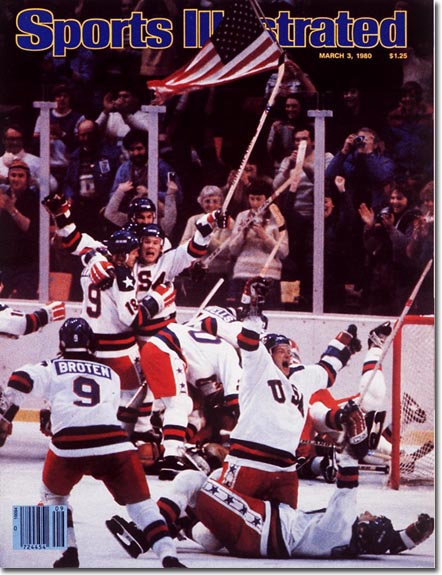
They did, of course, and the photo of their celebration became the only cover in Sports Illustrated's history that had no text with it — other than the magazine's nameplate, the date of publication and similar stuff.

But no headline. None was needed.
When the movie's final credits rolled, viewers were informed that it was dedicated to the memory of Brooks. He was killed in a car accident 10 years ago today, after the conclusion of filming but before the final product made its debut in theaters.

"He never saw it," the screen message said. "He lived it."

His life story was certainly compelling. As a young hockey player, he had been a member of the U.S. Olympic hockey team in 1960, but he was cut a week before the Games started.

The Americans went on to win the gold medal that year. The Soviets won the gold in every Olympics after that and didn't lose to the Americans again — until 1980, when Brooks guided the U.S. to the gold medal, finally winning the gold that had been denied to him 20 years earlier.

The year before he died, Brooks coached another U.S. Olympic hockey team, this time to a silver–medal finish. On the 22nd anniversary of the miracle on ice, the Americans defeated the Russians in Salt Lake City.

Talk about a storybook ending to a storybook life — a life that was filled, as most are, with disappointment and sadness but also a life that experienced joy and redemption.

It made me reflect, as I often do, about lives that are more inspiring than anything any fiction writer could make up.

Herb Brooks' was such a life.

He never saw "Miracle." He lived it.

And, because he lived it, the rest of us did as well.

Monday, February 22, 2010

The Miracle on Ice


There are moments in life that are unique.

Sometimes it's obvious. You know when they happen that you will always remember where you were and what you were doing when those moments occurred.

Most of the time, they seem to be moments you wouldn't want to repeat — like September 11 or the JFK assassination. But, from time to time, a moment comes along that is so inspirational, so uplifting that you wish you could experience it again and again.

Today is the 30th anniversary of such a moment. It was on this day in 1980 that the U.S. Olympic hockey team upset the powerful Soviets in Lake Placid, N.Y., and went on to win the gold medal a few days later.

I really thought somebody would show the movie "Miracle" today, but, if it is being shown, I haven't been able to find it in the listings. At the very least, I thought ESPN Classic would show a replay of the game, but that doesn't seem to be the case, either.

Apparently, though, some people are trying to recapture the feeling. Craig Custance of The Sporting News wrote the following about yesterday's victory over Canada in the Olympics: "If the Americans can play the role of favorite as well as they have the underdog, they're a serious threat to win [the gold medal]."

Fortunately, some people kept their perspective. "USA Hockey's win over Canada was hardly 'Miracle 2.0,' " writes Dan Shanoff.

With all due respect to the 2010 U.S. Olympic team and what it has accomplished so far, this is not 1980 and the Canadians are not the fearsome foes that the Soviets were — although, in some ways, the times are similar.

It's kind of hard to explain — if you aren't old enough to remember it — what a shot in the arm that victory was for the entire country. It was more than a game. It was about a beaten and bloodied America bouncing back in spite of the hostages in Iran, in spite of a recession and high unemployment.

Seems like a lot for a bunch of college kids to carry on their shoulders, but that was what those hockey players represented to millions of Americans who wanted to feel good about their country again. That became their mission, at least as far as the American public was concerned. They were standing in for the millions of Americans who had had it up to here, who were mad as hell and weren't going to take it anymore.

After the U.S. hockey team prevailed over the heavily favored Soviets, the accomplishment was dubbed the "Miracle on Ice." Two years ago, when the International Ice Hockey Federation marked its 100th anniversary, it chose the U.S. victory as the #1 international hockey story of the century.

I don't believe that anyone who watched that game could ever forget it — or how they felt as sportscaster Al Michaels counted down the final seconds and uttered his legendary call as time ran out: "Do you believe in miracles? YES!" Just watching the clip at the top of this post brings the memories rushing back, and I feel the same chill run down my spine that I felt on that Friday 30 years ago.

I've never been a hockey fan. Most Americans probably wouldn't call themselves hockey fans. But the members of that U.S. team — Jim Craig, Mark Johnson, Mike Eruzione, coach Herb Brooks and all the rest of the squad — became latter–day American heroes. And, after that game, everyone in America was a hockey fan.

Until the end of the Olympic Games, anyway.

Two days after the Americans beat the Russians, I recall watching Jim McKay talking on ABC as the network prepared to televise the gold medal game. He told the audience about a conversation he had had with his wife earlier that morning. "This will be a first for you," he said he told his wife, "watching sports on TV on a Sunday morning."

He smiled as he recalled her reply: "I know — and to watch hockey!"

How big was it? When Sports Illustrated ran the picture of the Americans celebrating, there was no caption or headline. That's the only time in SI's history that a cover photo did not have any "cover language." "It didn't need it," the photographer said. "Everyone in America knew what happened."

A year later, a made–for–TV film about the U.S. hockey team was shown on the small screen. It was OK, although even casual hockey observers could tell that Karl Malden was more than two decades older than Brooks. If it had anything going for it, it was the way it incorporated actual game footage, giving viewers an opportunity to relive a moment when they not only felt free to dream again but also to hope again.

It wasn't until nearly 25 years later that the story of the U.S. hockey team finally made it to the big screen with a cast that was plausible. I thought the movie was great. But I couldn't help wondering why it took a quarter of a century for someone to make a genuine dramatization of that accomplishment. Surely there were times in the intervening years when America needed the inspiration that hockey team provided the Americans of 1980.

Well, a recession has hammered America in the last couple of years, leaving more people filled with self–doubt than I have seen in my lifetime. Perhaps now, 30 years after that truly amazing achievement, this generation's hockey team will step forward and do the unthinkable — and inspire us to rise above our circumstances.

Beating Canada yesterday was big, but it wasn't really comparable to the win over the Soviets 30 years ago — even if the Canadians were wearing red uniforms.

At the end of "Miracle," some text appears on the screen dedicating the film to Brooks' memory. The film had been completed just before Brooks was killed in a single–vehicle crash at the age of 66.

Brooks never saw "Miracle," the dedication read. "He lived it."

And so did we all.