Showing posts with label tennis. Show all posts

Saturday, July 15, 2017

The Changing of the Guard at Wimbledon?


I did something today I haven't done much since I was a child; as I have written here before, it is something I used to do with my mother.

I watched the women's tennis final at Wimbledon.

Mom's been gone for 22 years so, clearly, it has been awhile since we watched Wimbledon together. But I remember when I was a child and Mom would buy fresh strawberries for us to eat while we watched (a nod to the Wimbledon tradition of strawberries and cream). I did my part this morning. I typically eat oatmeal for breakfast, and I buy these boxes of instant oatmeal that have two packets each of five different flavors, one of which is strawberries and cream. That was my breakfast this morning.

Garbiñe Muguruza, a 23–year–old Venezuela–born player who represents Spain and lives in Switzerland, won her first Wimbledon championship, defeating 37–year–old Venus Williams in two sets.

That was reminiscent of some of my times with Mom. We watched some Wimbledon finals when frequent champions fell — to time as much as their opponents — and I definitely had that déjà vu sensation today.

Venus has won five women's championships at Wimbledon, and she played a tough first set against Muguruza — but simply failed to capitalize on enough opportunities and lost 7–5. Then she seemed to hit the wall in the second set as Muguruza blanked her 6–0.

How astonishing was that? Well, Muguruza's other five opponents at Wimbledon all managed to win at least one game in the second set. Last year's runnerup, Angelique Kerber of Germany, even took Muguruza to three sets in Monday's Round of 16. But Muguruza prevailed.

Williams was dealing with plenty of distractions, primarily the June 9 car accident in which she was involved that led to the death of a 79–year–old passenger in the other car. Questions about that accident persist, but it appears that Williams will no longer be held responsible for what happened. Ultimately that should be a relief, but it is sure to be a constant presence in her thoughts these days.

And she lost her very first set at Wimbledon on July 5, but she seemed like the old Venus after that, winning 10 straight sets before encountering Muguruza today.

Venus may well return to competitive play, but time waits for no one. Eventually she will have to step aside and let the next generation have its moment in the sun.

In her post–match remarks, Muguruza unwittingly hinted at that, observing that she had grown up watching Williams play. Then, realizing the implications of her words, she tried to backtrack, adding that facing her in the final was "incredible."

But many observers must have wondered, as I did, if we were witnessing the changing of the guard. Muguruza has long been said to be the next big thing in women's tennis. She even made it to the Wimbledon final two years ago and lost to Williams' sister.

Now, with two Grand Slam titles under her belt (she won the French Open last year), she may be fulfilling those expectations and leaping to tennis' elite level.

And Williams may have at last reached the end of a long and successful career.

Friday, September 20, 2013

The Battle of the Sexes


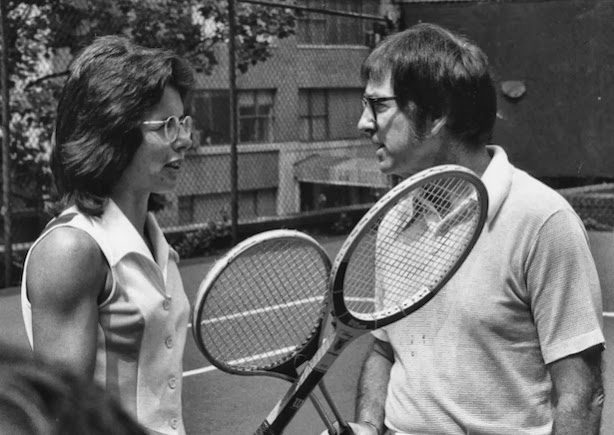
Forty years ago today, Billie Jean King struck a blow for women's liberation by beating notorious male chauvnist Bobby Riggs in a tennis match in Houston's Astrodome.

Or did she?

Just in time for this milestone anniversary came the revival of a longstanding urban myth — that Riggs deliberately lost the match, which was known as the "Battle of the Sexes." The story goes that he threw the match to settle a six–figure gambling debt with the mob.

ESPN wryly suggested that the match should have an asterisk next to it in the sports history books.

"We are always refighting old battles," wrote Gail Collins in the New York Times. "But I honestly did not expect to be spending any time in 2013 arguing about whether Billie Jean King beat Bobby Riggs."

There really are bigger fish to fry.

Such rumors have been around virtually since the match ended. I must admit that, as a child, I was baffled. Riggs (who died in 1995) was 55 years old and had been retired for many years; King was 29 and had just won both the singles and doubles championships at Wimbledon. In 1973, she was one of the best women's tennis players in the world.

The fact that she won raised no red flags for me. I expected her to win.

Howard Cosell, who was better known for calling professional fights and Monday Night Football, provided the commentary for ABC. That made the event more legitimate in my eyes.

Legitimacy was the issue, it seemed to me then — because it seemed that way to a lot of people. As Gerald Eskenazi, a veteran tennis writer, observes in the Wall Street Journal, "It wasn't until [this day] that I fully understood that a seismic change was under way." That's probably an apt description of my mindset at the time.

King responded to the allegations in the way that people, famous and not famous, tend to address things these days — via Twitter — and she insisted that Riggs wanted to win, that he tried to win.

"I just beat his butt and that's it," she said.

Seems to me that ought to be the final word on it.

But I'm certain that won't be enough for some people.

Saturday, July 6, 2013

The Legs Feed the Wolf


As France's Marion Bartoli neared the conclusion of her straight–set triumph over Germany's Sabine Lisicki in Saturday's Wimbledon women's final, the announcing team — which included 10–time Wimbledon finalist Chris Evert — looked for explanations for Lisicki's apparent collapse.

It was suggested that Lisicki, who gained a reputation as a "giant killer" in this year's tournament, simply couldn't maintain that level of intensity. She knocked off Serena Williams in the fourth round, then defeated fourth seed Agnieszka Radwanska in the semifinal. Bartoli wasn't the big name that the other two were, but she was seeded in the top 20 (Lisicki was 23rd) — and, as always in a Grand Slam tournament, when you're in the final, you can count on facing an opponent who has been playing very well for at least the last couple of weeks.

It isn't impossible, the announcers agreed, for a player to remain focused against three more highly regarded opponents in the same week. It's just very hard to do, especially at the Wimbledon level.

I agree, but for a different reason.

Women's tennis matches are best–of–three–sets affairs. Men's matches are best of five. A quick start is essential in women's tennis because it is a comparative sprint. A fast start is important in men's tennis, too, but it is easier to overcome a bad set in men's tennis — unless it is the fifth one. It's more of a marathon.

If you have a bad first set in women's tennis, your back is against the wall.

And that was the situation Lisicki faced today. She lost the opening set to Bartoli, 6–1, and knew right then she would have to go the three–set distance to win the title.

She had done it before in this tournament.

Two days earlier, she beat Radwanska in three sets. That third set was a doozy, too, a marathon, and Lisicki finally prevailed, 9–7. Epic.

On Monday, Lisicki beat Williams in three sets. She won the first one, then lost the second one and had to turn back the champion in the third set, 6–4.

A few days before her match with Williams, Lisicki needed three sets to beat the lesser known but just as dangerous Samantha Stosur from Australia.

To reach the finals at Wimbledon, it was necessary to win six matches. Lisicki needed three sets to win half of them.

Bartoli, by comparison, won all six of her previous matches in straight sets, just as she did today, and she never faced anyone who was seeded higher than she.

As late U.S. Olympic hockey coach Herb Brooks allegedly said, "The legs feed the wolf." I don't know if Brooks really said that, but, whether he did or didn't, it was appropriate for his U.S. hockey team in 1980 and it is appropriate for this year's Wimbledon women's final.

It speaks to endurance. Strong legs permit a wolf to outrun its prey.

I think Lisicki ran out of gas. It wasn't a matter of motivation or emotion. She showed plenty of emotion when the match was over, and Bartoli accepted the trophy Lisicki had dreamed would be hers. The spirit was willing, but the flesh, worn down by seemingly endless tests in the earlier rounds, was too weak.

Killing the other giants had taken too much from her.

Bartoli, on the other hand, was fresh. She hadn't lost a set in the whole tournament. She had more left in the tank. A lot more. Once she got over her first–set jitters — and there weren't many of those — she could have gone into cruise control against the increasingly frantic but ineffective Lisicki.

The legs feed the wolf.

Friday, July 5, 2013

A Different Kind of Final


About 12 hours from now, Sabine Lisicki and Marion Bartoli will meet in the Wimbledon women's singles final.

I'm sure this isn't what most observers expected when this tournament began two weeks ago.

Lisicki defeated the defending champion, Serena Williams, in the fourth round. That's been typical for the women's singles this year. Bartoli is seeded 15th, Lisicki is 23rd. Only one of the top 14 seeds — Agnieszka Radwanska — got to the semifinals.

Bartoli will be making her second appearance in the championship (she lost in 2007); Lisicki is in her first–ever Wimbledon singles final. Obviously, no matter who wins, it will be her first title at Wimbledon, and that is something that Wimbledon watchers have rarely been able to say. By the time the field has been narrowed down to the last two, most of the time at least one has won the Grand Slam event before.

It has been rarer still for Wimbledon watchers to see a final in which both contestants were seeking their first Grand Slam title, but that is precisely what those in attendance tomorrow will see.

"Neither Bartoli nor Lisicki is a household name," writes Liz Clarke in the Washington Post — and, in the age of Maria Sharapova and the Williams sisters, who can argue with that?

The 28–year–old Bartoli seems to be savoring this shot at redemption. "I do just everything a bit better than what I was doing six years ago," Bartoli said this week.

Paul Birch of BBC Sports writes that the final will be a "fascinating encounter between the big–serving Lisicki, 23, and Bartoli, who boasts one of the best returns in tennis."

Birch reports that Martina Navratilova and Chris Evert pick Lisicki to win. Their selections are based primarily on the aspects of the individual games — Navratilova said, "I always go for the person who has the biggest game to win and she has a bigger game."

Evert was more restrained in her praise, but she said, "If Sabine Lisicki plays the same way she has been playing and serves like she has been serving ... then I think she definitely has a slight edge."

I agree with their assessments of the performances in the tournament, but my pick is based on how they have played against each other in the past. I know Bartoli was seeded higher in this tournament, but the fact remains that Lisicki beat a higher–seeded foe in the semifinals (Radwanska) than did Bartoli.

The two haven't faced each other often, but the head–to–head advantage belongs to Lisicki, who is 3–1 against Bartoli.

It should be interesting, and I'm looking forward to watching it tomorrow morning. I feel like I did when I was a child, and my mother made a big production of watching the Wimbledon finals. We would settle in to watch the women's and men's finals and eat strawberries and cream — or what I am sure was my mother's version of it (and may have borne no resemblance to what they actually eat).

I have no strawberries and cream to eat tomorrow — but I think I have a strawberry Pop–Tart somewhere ...

Saturday, June 8, 2013

Beating the Divine Miss M ... Again


"I mean, a lot of what I have or possess has helped me get to the stage where I am today."

Maria Sharapova

The challenge for defending champion Maria Sharapova in today's French Open women's final couldn't have been clearer.

Her opponent, Serena Williams, held a 13–2 head–to–head advantage over Sharapova and had won the previous 30 consecutive matches.

And there were times when I thought she would meet that challenge.

But it was not to be.

There was a lot of interest in this match. It was the first time that the top two women in the world had met in the French Open final in nearly 20 years. Sharapova, as I say, was the defending champion, but Williams hadn't won in Paris in more than a decade — since defeating her sister Venus in straight sets in 2002. Today was the first time she had been in the French Open final since that day.

I suppose a defending champion, whether in an individual sport or a team sport, is favored to repeat. Consequently, I guess, Sharapova would have been expected to be the favorite today. But Williams has been hitting the ball so well that I think she was favored by most observers.

Most of them may have thought that Williams would have an easy time of it, but that was not true. While she did sweep the sets, Sharapova doggedly fought back in each and made Williams work for the title.

The bottom line? Williams defeated Sharapova, 6–4, 6–4.

Prior to today's match, Judy Battista wrote in today's New York Times that Williams, so long in the shadow of her sister (even though Serena has won more Grand Slam titles and more money), is reminiscent of Steffi Graf a quarter of a century ago. Battista wondered if Williams could match Graf's dominance of Natasha Zvereva in the 1988 final.

Graf, too, swept the sets in the final, but she did so at 6–0, 6–0 in a little more than half an hour. If you know nothing but the scores of today's final, you know Williams did not dominate Sharapova like that. The Divine Miss M, as I have already said, put up a great fight — and there were times when I really thought she might come back and win.

But Williams controlled the match. She didn't dominate it, but it was clearly hers practically from the start, and she went on to become, at 31, the oldest women's singles champion at the French Open since the dawn of the open era in the 1960s.

In 1988, a year before she turned 20, Graf swept the Grand Slam. Williams has won all four Slam events at least twice in her career, and she is the defending champion in the remaining two Slams this year — Wimbledon and the U.S. Open — but she didn't win the Australian Open so she will have to wait until at least next year before she will have another chance to win her first true Grand Slam.

She might not do it. There are several talented — and hungry — women on the tour these days, and she can't be expected to continue to play at this level indefinitely.

But right now, she's on top of the world.

Saturday, July 7, 2012

Sibling Rivalry


She needed three sets to do it, but Serena Williams held off a determined Agnieszka Radwanska to claim her fifth Wimbledon singles title Saturday.

"I always wanted everything Venus had," she joked after being reminded (for what, I am sure, was not the first time) that her sister Venus also has five Wimbledon singles titles — including one she claimed against Serena in 2008 (although three of Serena's titles have been won against Venus, including a 2009 rematch).

Serena has now won 14 Grand Slam titles, and, at the age of 30, the window for her to match Chris Evert and Martina Navratilova (with 18 each) may be closing — and the odds that she can match the all–time leader, Steffi Graf (22), may be nonexistent.

But even at 30, people speak in awe of Serena's serve, even her second serve, which most players seem to treat timidly. It is the best in the business, they say — and when I say "they," I include in that group Chris Evert, who was a commentator during today&apos's match.

Serena had the proper appreciation for her serve, Simon Cambers wrote in The Guardian, but she seemed baffled by its power.

"My serve really helped me throughout this tournament," she told Cambers. "I can't describe why it was so good or how it was so good. It's not like I practise it that much. I just had the rhythm."

Radwanska, who was seeded third, was no easy mark.

Serena cruised to a 6–1 victory in the first set but then faltered in the rain–delayed second set and had to hold off the hard–charging Radwanska in the third set, 6–2.

Over and over again, Radwanska seemed to be on the brink of overcoming Serena in that final set, just as she had in the first, but, in the end, the result was the same.

ESPN's announcers spoke of Radwanska's competitive nature, how the fact that she made it to the women's singles championship would not be enough for her, and that certainly appeared to be the case. Clutching her runnerup plate, she almost seemed to be in mourning.

Before the match, she had spoken with confidence of her chances to upend Serena.

A three–set duel clearly did not satisfy her.

I expect we will see her in Centre Court again.

Saturday, June 9, 2012

Back in the Saddle Again?


Not long ago, I wondered if Maria Sharapova was past her prime at the tender age of 24.

Well, she has observed a birthday since I wrote that — so she is now 25 — and today she won the women's singles title at the French Open for the first time — so she is now one of a handful of pro players to win a career Grand Slam.

I think I may have been a bit hasty in speculating about whether she was over the hill.

Her victory over Sara Errani, who secured a spot in the world's Top 10 rankings with her performance in Paris, showed that concerns about the lingering effects of her shoulder injury were baseless.

She undoubtedly will go to Wimbledon as one of the favorites.

But her victory in Paris gave her a career Grand Slam — at least one singles title in all four Grand Slam tournaments — and should have erased all doubt.

Errani, also 25, is an up–and–comer. She and Roberta Vinci won the women's doubles title, and she defeated the 2008 and 2009 French Open winners en route to today's match.

Before the match, I heard Errani described as petite. Presumably, that was a reference to her height. At 5–foot–5, she is a few inches shorter than just about everyone she faces, and the height difference is even more pronounced when she stands next to Sharapova, who is nine inches taller.

But Errani is also muscular, and that is something I definitely do not associate with the term petite. I've always thought of petite as being synonymous with dainty — which it is, according to my thesaurus, but it is also listed as synonymous with small.

(I would argue the point to an extent. I have known women who were nearly as tall as Sharapova whom I would characterize as dainty. In fact, before I saw her play, I would have regarded Sharapova herself as dainty. But that is one thing she is not, at least not on the tennis court.)

As I watched Errani futilely, gamely trying to overcome Sharapova, I realized that, barring something completely unexpected, Errani will become a familiar face in tournament finals.

The final score was lopsided. The match was not.

Saturday, March 31, 2012

Has Maria Peaked?


Today, while most of the rest of the sports world was anticipating the NCAA Tournament's Final Four, I was doing something I did a year ago in what was a true deja vu moment.

I watched the women's final of the Sony Ericsson tennis tournament in Key Biscayne, Fla. And, just like last year, Maria Sharapova lost in straight sets.

Last year, Sharapova lost to Victoria Azarenka, an up–and–comer who had been attracting some attention for awhile (and continued to do so through the end of the year). This time she lost to Agnieszka Radwanska of Poland. Radwanska has been a professional for several years, but she has kept such a low profile that most people who consider themselves tennis fans probably never heard of her until just recently.

This title was the biggest of Radwanska's brief career, and I don't wish to take anything away from her, but I can't help wondering if Sharapova has peaked.

I asked a friend of mine who used to write about tennis for the Arkansas Gazette when I was there if he thought Sharapova has peaked. He replied that he hadn't seen the match, but he thinks her shoulder injury may still be bothering her.

That's a plausible argument, based on what I saw today. But it doesn't explain everything.

Saturday, January 28, 2012

Scream 2


As I have mentioned here before, I used to work on the sports copy desk of the old Arkansas Gazette.

I made many friends during my time there. "Some are dead and some are living," in the words of John Lennon, and one of the living ones, with whom I have reconnected via Facebook, is, as I have told him, the foremost authority on tennis that I know.

I thought of him today when I was watching Maria Sharapova battle Victoria Azarenka in the women's final of the Australian Open.

It was a rematch of a tournament showdown I watched last spring, and the outcome was nearly the same. The 22–year–old Azarenka completely dominated Sharapova and appears to be well on her way to the top ranking in the world.

I wanted to get some feedback from my friend so I e–mailed him after the match, and this is what he had to say.

Of Azarenka, whose victory this morning was her first Grand Slam title, he said, "[S]he's mentally strong enough to win some slam tournaments. She plays big points well."

That was my impression as well. She continues to impress me every time I see her play — and in unexpected ways.

And, perhaps, nothing I saw in today's match made a greater impression on me than what I saw at the end — a triumphant Azarenka dropped to her knees and appeared to be stunned that she had actually won a Grand Slam event.

Never mind that she had completely dominated Sharapova, who has been regarded as a formidable force in women's tennis since winning Wimbledon nearly eight years ago.

Shortly, though, Azarenka's bewilderment turned to pure unadulterated joy as she ripped the sweatband from her brow and threw it into the cheering crowd, then threw tennis ball after tennis ball to the fans.

Her domination of Sharapova had been so complete, in fact, that none other than Chris Evert observed, at one point, that, in her day (and, I would presume, the practice predated her career), it was said that if one player won five consecutive sets (or more) against someone else, the first player owned the second.

And, based on that, Evert continued, it could fairly be said that Azarenka owns Sharapova.

Certainly, based on my observations, that is true. Azarenka beat Sharapova in straight sets in the match I watched last spring — and I thought at the time that it was their first encounter, but, as I understand it, they actually met for the first time a few years earlier. Azarenka won on that occasion, too, which means she has won at least five straight sets against Sharapova.

Of Sharapova, my friend said, "I love watching Sharapova but I don't think she's that interested in winning on the court. She can make more money posing."

Regretfully, that seems to be true.

She's still making noises about wanting to win Grand Slam tournaments, but I have to wonder, especially as Azarenka's star is ascending, if she isn't being drawn to a more lucrative modeling career.

And, frankly, who could blame her?

She is an attractive young woman, and there is always a lot of money for young women who are willing to parlay their physical attributes into bank accounts.

And, if she chooses to dedicate herself to the pursuit of easy paydays, that's fine. It might even be the wisest choice she could make.

Because Azarenka, it seems, is dedicating herself to the pursuit of Grand Slam titles. And, as Geoff MacDonald writes in the New York Times, "she is an attacking, all–court player capable of success on any surface. With her new–found equilibrium on the court, and her fearless competitive spirit, Azarenka will contend for all four Grand Slam titles."

Might be hard for Sharapova to compete.

Monday, October 31, 2011

A Preview of Coming Attractions?


I am a football fan, and, at this time of the year, my weekends are typically spent with my TV tuned to football games, but I must admit that yesterday afternoon I periodically monitored ESPN's coverage of the WTA finals in Istanbul.

I found it compelling. Wimbledon champ Petra Kvitova defeated Victoria Azarenka to clinch her first WTA title.

The match also decided who would be ranked second in the world behind Caroline Wozniacki — who won no Grand Slams this year and, in fact, lost to Kvitova last week.

Reportedly, Wozniacki was ailing — and things might well have been different if she had been healthy. She lost to Kvitova in straight sets and managed to win only six games — not the kind of performance one would expect from the world's top–ranked player.

Anyway, Wozniacki secured the top spot in the WTA's ranking system when Maria Sharapova had to withdraw with an ankle injury. And then the Kvitova–Azarenka match was guaranteed to result in the #2 ranking for the winner. Azarenka, who was ranked fourth going into the match, moved up one spot to third and Sharapova dropped to fourth.

This brings me to the really compelling part — what will this mean when the first Grand Slam event of 2012, the Australian Open, commences in January?

Wozniacki made it to last year's semifinals in Australia. Kvitova fell in the quarterfinals, and Azarenka didn't make it out of her section. Neither did Sharapova.

I'm not really sure what significance that will have — if any — in Australia.

Kvitova, though, seems to have momentum on her side. She won Wimbledon, as I said before, and she won the WTA championship to wrap up the year. It is reasonable to conclude that she will be a force to reckon with in Melbourne.

I haven't been this intrigued by women's tennis since the Evert–Navratilova days.

Thursday, July 14, 2011

A Rivalry Like No Other


It is much too early to label Maria Sharapova and Petra Kvitova the successors to Chris Evert and Martina Navratilova as the greatest rivals in women's tennis.

Sharapova and Kvitova have only played in one Grand Slam final. There may be several more clashes in their future — or there may be no more.

But, since we are only removed from their memorable Wimbledon final by a few weeks, I just thought I would reflect a little on that Evert–Navratilova rivalry.

Their last Grand Slam final was played 25 years ago. It was in the French Open, where they played for a Grand Slam title the first time, back in 1973. When they played for that French Open title in 1986, Evert was 31. Navratilova was not yet 30. The world had watched them grow from teenagers to their sport's elder stateswomen.

I don't know if we will ever witness another rivalry like it. In a 15–year span, they met 80 times. More than three–quarters of the time, they met in the final of a tournament — and nearly a quarter of those matches were Grand Slam finals.

I have compared them to the Lakers and the Celtics of the 1980s. That's a good comparison, I think, although it doesn't hold up 100%.

True, those teams didn't face each other in the NBA Finals as frequently in the 1980s as they did in the 1960s; nevertheless, in the 1980s it often seemed that, no matter how well any of the other teams had played, the early rounds of the playoffs merely served as warmups for the inevitable championship series between Boston and Los Angeles.

And that's what the women's singles were like in Grand Slams in the 1970s and 1980s. Yes, other women did win those titles from time to time — but the early rounds of tournaments often seemed like a waste of time in those days.

There was Chris Evert, and there was Martina Navratilova. And then there was everyone else.

Sunday, July 3, 2011

Breakfast at Wimbledon


For me, it was like old times.

When I was a child, I remember that my mother always made a production of the women's singles final at Wimbledon. She would get up early on the designated Saturday, prepare bowls of fresh strawberries and cream, the traditional Wimbledon snack, and we would watch the final on TV together.

I guess my earliest such memory is of watching Billie Jean King win it all. I'm not sure which year that was — she won it six times.

Sometimes my younger brother would join us, but mostly it was just my mother and me.

Anyway, yesterday morning I got up early to watch Maria Sharapova take on Petra Kvitova. As I say, it was like old times — except no strawberries and cream. And no Mom.

It differed in another way, too. The person I was pulling for did not win.

I was rooting for Sharapova. I've been a fan of hers since she won Wimbledon seven years ago. Since that day, she struggled to get back to the final, eventually overcoming injuries and inconsistent play; I have found her persistence admirable, even inspiring, a metaphor for our times.

The world needs inspiring people today — and I thought folks could find inspiration in Sharapova's gritty push to re–claim the Wimbledon crown.

But — almost in spite of myself — I found Kvitova's dogged determination inspiring, too.

Even though she had been seeded eighth, Kvitova proved that she is a force with which the others must contend. She is only 21. They can expect her to be around for awhile.

In many ways, Kvitova is, as Mark Hodgkinson of The Telegraph writes, the anti–Maria. A lot of folks are put off by her much–publicized shrieking on the court. They just can't warm up to it.

I think one of the things that drew people to Sharapova when she won Wimbledon in 2004 was her youth and apparent innocence. There was talk at the time of how she would shriek on court, but lots of folks seemed to overlook it.

Perhaps they were willing to do so because she was so young, and people were inclined to think it was simply a youthful anomaly — something she would outgrow.

She was young, all right (17), but she might not have been as innocent as many folks may have wanted to believe. As at least one sports journalist observed recently, when Sharapova was something of a prodigy at the age of 13, she was asked if she would rather get multi–million–dollar endorsements or a Wimbledon championship.

She replied that she would prefer to win Wimbledon — because, if she did that, the rest would follow.

That suggests not the dreamy ambition that is typical of the young — but the cold, calculated conclusion of a much more mature person.

Kvitova comes to the spotlight older and, presumably, more mature than Sharapova was when she won Wimbledon, but their accomplishments were similar. Both upset established (and favored) foes.

Now, we will see if it takes longer for Kvitova to return to the championship than it took Sharapova — or whether, for that matter, Kvitova will ever raise that plate in triumph again.

Friday, July 1, 2011

A Singular Sensation


I have to admit, I really would have liked to see Maria Sharapova square off with Victoria Azarenka for the women's singles title at Wimbledon tomorrow.

A few months ago, I watched those two face each other in a spirited match for the Sony Ericsson Open title — and I'm sure a rematch in a Grand Slam final would have been even more entertaining.

Sharapova held up her end of the deal — but, as Oliver Brown writes in The Telegraph, her opponent played poorly.

That doesn't take anything away from Sharapova's performance — which was, I will admit, somewhat lackluster. She did what she had to do against Sabine Lisicki, and she'll be playing in tomorrow's final.

Mission accomplished ... so far.

Her opponent will be Petra Kvitova, the eighth seed who needed three sets to dispose of Azarenka. The 21–year–old southpaw will be making her first appearance in a Grand Slam final.

It's getting hard to remember when one could say that about Sharapova. It's been seven years since, as a 17–year–old, she defeated Serena Williams in straight sets in the Wimbledon final. She's kind of old news.

As Greg Couch writes for The Sporting News, the "casual sports fan" couldn't be blamed for looking at the other three names besides Sharapova's in Wimbledon's women's semifinals and say, "Who?"

Even Azarenka, who has enjoyed some success but is still looking for her first berth in a Grand Slam singles final, remains a virtual unknown in the sport.

But I watched her beat Sharapova three months ago, and I'm convinced the 21–year–old has a bright future in front of her.

It would have been fun, as I say, to watch the two of them go at it in tomorrow's final — especially considering that (a) Azarenka, like Sharapova, has a reputation for making loud grunting noises on the court and (b) Wimbledon has been trying to crack down on that sort of thing.

It would have been, as the Sydney Morning Herald speculated a few days ago, "[a] deafening Wimbledon final."

I know practically nothing about Kvitova. Does she make loud grunting noises, too — loud enough to match the so–called "queen of scream," Sharapova?

Or is she more quiet, like the legendary Martina Navratilova, who was very reserved en route to 18 career Grand Slam singles titles and doesn't think the grunting in today's game is necessary?

That would be a real contrast in styles, wouldn't it?

Today's players, Navratilova says, "are making sounds like they are lifting 300 pounds, and it's not the case. The ball is not that heavy."

Well, I guess that is a matter of perspective. It might feel like 300 pounds for either of these ladies — after all, Sharapova wants to prove she isn't over the hill and Kvitova wants to prove she belongs in the Wimbledon final. The weight of expectations for both must be enormous.

You can watch the final on NBC starting at 8 a.m. (Central) tomorrow.

Thursday, June 30, 2011

The End of the Borg Era


They're playing the men's semifinals at Wimbledon tomorrow, which is a good time to pause and remember when John McEnroe defeated Björn Borg in the men's singles final at Wimbledon in July 1981.

If you just shrugged your shoulders at that, you probably don't realize just how dominant Borg had been in men's tennis up to that time.

By July 1981, he had won five consecutive men's singles championships at Wimbledon.

During that stretch (1976–80), he beat Ilie Năstase (whose name may be mostly forgotten now but he was one of the sport's best in the 1970s), Jimmy Connors (twice) and Roscoe Tanner (mostly a journeyman but he was in the Top 5 when he faced Borg) in the final — and he had beaten McEnroe in an epic, five–set, three–hour–and–53–minute duel for his fifth consecutive title in 1980.

It would be hard to top that one, but the truth was that McEnroe did just about everything — except win — in 1980. A victory in the men's singles final was the only thing that would be an improvement on that memorable performance, and he came into the match determined to do what he failed to do the last time.

Perhaps that was Borg's problem. Maybe Borg had no fire in the belly. Maybe he felt he had nothing left to prove — and, to be honest, he probably didn't. In the late 1970s, there was no one in men's tennis who could compete with him. He had proven that time and time again.

Until McEnroe came along. And even McEnroe couldn't overcome Borg the first time.

But theirs was a compelling rivalry — and one that was over far too soon. It was meteoric, really. It was comparable, in its way, to the Roger Federer–Rafael Nadal duels except for a couple of things.
  • The Borg–McEnroe rivalry was over almost before it began, and

  • McEnroe was, as Mike McGovern writes in the Reading (Pa.) Eagle, "borderline crazy."
Borg and McEnroe were opposites, in almost every way. To be blunt about it, they were good copy for sports journalists who found themselves struggling at times to bring some excitement to the dreary days of summer.

McEnroe was always a ticking time bomb, ready to blow up at the officials or his foes ... or the fans.

Borg, on the other hand, was much more reserved. He wasn't prone to outbursts. He did have — as the world has learned in the last three decades — personal issues, but he tended to let his tennis do the talking on the court.

He had a deceptive appearance — he was bowlegged yet quick — and a devastating two–handed backhand shot that evolved from the slap shot he preferred when he played hockey as a young boy.

To put it simply, Borg was great. He won more than two–fifths of the Grand Slam tournaments in which he participated. He won nearly nine out of every 10 singles matches in those tournaments.

Surfaces never seemed to bother him. He was as comfortable — and successful — on the clay of the French Open as he was the grass of Wimbledon. That's always a tricky transition.

Historically, it has been nearly impossible to win both of those tournaments in the same year, coming back to back as they do, but Borg did it in three consecutive years — 1978, 1979 and 1980.

Winning five straight Wimbledon titles might not impress as many folks in the 21st century as it did three decades ago, but, until Federer came along, Borg was the only men's player to do it since professionals have been included.

(Federer, by the way, is one of only three men to win more Grand Slam singles titles than Borg, but he won't be adding to his total at Wiimbledon. He lost in Wednesday's quarterfinals — his first loss ever after taking a two– set lead.)

Năstase, arguably the world's best male tennis player until he lost the Wimbledon title to Borg in '76, once said, "We're playing tennis, he's playing something else."

Personally, I never knew what there was to comprehend. Borg was a baseliner, perhaps the best there ever was. I always suspected that, because he was so good, most of his contemporaries couldn't see how deceptively simple the whole thing was.

But Arthur Ashe had it right, I think.

"I think Bjorn could have won the U.S. Open," Ashe said. "I think he could have won the Grand Slam. But by the time he left, the historical challenge didn't mean anything. He was bigger than the game. He was like Elvis or Liz Taylor or somebody. He'd lost touch with the real world."

Thirty years ago, McEnroe must have figured out what Borg's game was — because McEnroe beat him at it.

There were reports that Borg's life had been threatened after he beat Connors in the semifinals. I never saw any credible evidence to support that. Perhaps only by inserting an element of personal stress and danger could some people rationalize the reality of a brash upstart like McEnroe toppling one of the greatest tennis players of all time.

That match wasn't as legendary as the one played the year before, but it was noteworthy for two things:
  • It ended Borg's record 41–match winning streak at Wimbledon, and

  • it turned out to be his last Wimbledon final.
It was nearly his last Grand Slam final, but Borg and McEnroe met in the U.S. Open a couple of months later. McEnroe won the title in four sets, and Borg decided it was time to go.

Borg said at the time that he had lost his motivation, and perhaps he had. But the tennis world had lost a great rivalry, perhaps the only one that could have matched the one between Chris Evert and Martina Navratilova (who met in 14 Grand Slam finals).

Evert and Navratilova were truly the Lakers and Celtics of women's tennis — of individual sports — and other individual sports (especially men's tennis) wanted the same thing. Mostly, it would bring attention to the sport — the way Ali and Frazier brought attention to boxing, the way Nicklaus and Palmer brought attention to golf, and the way the rivalry between Nancy Kerrigan and Tonya Harding brought attention to skating when it boiled over into something more sinister.

The rivalry that developed between McEnroe and Connors was good — but they only met in two Grand Slam finals, exactly half as many as McEnroe and Borg.

The Pete Sampras–Andre Agassi duels of the 1990s were memorable — but the two played for only five Grand Slam titles.

Borg and McEnroe met in four Grand Slam finals between 1978 and 1981 — and three of those matches came in the last 15 months of that time span.

We will never know what might have been.

Saturday, April 2, 2011

Duel in the Sun


It may not always seem like it, especially when you look at the scores, but there are dramatic moments — turning points — in a tennis match.

I was reminded of that today when I watched the women's final of the Sony Ericsson Open in Miami between Maria Sharapova and Victoria Azarenka. If Sharapova won, Susan Miller Degnan of the Miami Herald reminded her readers, it would be her first title since last May.

I don't know why, but I always tended to view tennis as a women's sport, even though I knew that some pretty talented male athletes played tennis.

When I was a teenager, I followed women's tennis because I had a crush on Chris Evert — and she was almost always in the finals of every tennis tournament. In fact, it was almost routine to see Evert (or Evert–Lloyd, as she was known after marriage) face Martina Navratilova in championships.

Frankly, it was so routine that I always thought it was a waste of time to play the earlier rounds — except on those occasions when one or both did not survive them (which rarely happened).

I didn't really follow men's tennis too closely. I admired Jimmy Connors — mostly because he had won Chris Evert's heart — and I kind of followed McEnroe and Borg, but mostly I followed women's tennis.

I gravitated away from women's tennis after Evert and Navratilova retired. But I started to feel myself being drawn back to it when Sharapova won Wimbledon in 2004 at the age of 17. I knew about her tendency to shriek every time she hit a tennis ball, and that may have been a bit upsetting for some people, but I kind of liked it. When I watched Sharapova play, I knew she was giving everything she had.

And, OK, I'll admit it. I thought she was cute, too. Who didn't?

Sometimes, promoters have tried to manufacture momentum for female athletes who had succeeded mostly because they were cute and not because they were talented. But some female athletes who were cute also happened to be talented. Sharapova was one of those, and she was deceptive. There was a lot of power in her slender physique.

She suffered a shoulder injury in 2008, though, and disappeared from professional tennis for nearly a year. Her appearance in today's championship was seen by some as a hopeful sign.

But it was not to be. Not quite yet.

Remember those turning points I mentioned earlier? There were two of those in today's match, both in the second set.

Azarenka handled Sharapova fairly easily in the first set, winning 6–1, then led 3–0 when the two got into battle over the fourth game. Sharapova took the lead, then held on as Azarenka rallied to force it to deuce.

(Since I don't watch tennis very often, it was a little difficult to orient myself. I remembered that Sharapova was blonde and shapely so I decided to watch for the one who was blonde and shapely — but it turned out that Azarenka is blonde and shapely, too.

(So I decided to look for the shrieker. But that was no help, either. Azarenka is a shrieker, too. And they wore similar headgear. From a distance, they looked remarkably similar. But I quickly discovered, through the brief closeup shots, that Azarenka was dressed in white and Sharapova was dressed in blue. Kind of a North Carolina Tar Heel blue.)

The two exchanged the advantage several times before Azarenka finally prevailed and led 4–0. At that point, I thought Sharapova was finished. I had seen similar matches when one contestant was dominated until a critical point, when everything turned around, and that contestant rallied for an improbable victory.

But I had seen other matches in which the contestant had a chance to turn things around but failed to seize the opportunity — and I feared that what I had just seen was an example of the latter.

Well, it was — and it wasn't.

It wasn't because, a few minutes later, Sharapova had rallied to win two games since losing the deuce and trailed 4–2 when the two were deadlocked again.

Again, it went back and forth, but finally Sharapova broke the tie and trailed only 4–3. Momentum seemed to be on her side, and I could imagine her rallying for a dramatic victory.

But it turned out that it was one of those times when the contestant fails to seize the opportunity after all.

Azarenka won two of the next three games and took a two–set victory in the final.

Sharapova has said that she hopes to retire early, that her plans for life include marriage and children. I hope those plans work out. It would be nice to see her win Wimbledon again, though.

And Azarenka showed me today that she has a lot of talent. I'm inclined to think she will win a few Grand Slams herself before she is through.

And I'm inclined to think the future of women's tennis is in good hands.

Monday, December 21, 2009

Happy Birthday, Chris Evert


Chris Evert and President George H.W. Bush
play tennis at Camp David in 1990.


It may come as a bit of a shock if you're old enough to remember when she was squaring off regularly with Martina Navratilova in Grand Slam tennis tournaments.

But today is Chris Evert's 55th birthday.

Chris Evert made her Grand Slam debut in the 1971 U.S. Open.


In the mind's eye, of course, she is still young, still the teen–age Chris Evert who burst onto the sports scene with her famous two–handed backhand in the 1970s.

Evert dominated that decade; according to the Women's Tennis Association, she was the top–ranked singles player in 1975, 1976, 1977, 1980 and 1981. Depending upon the source, she was the top–ranked singles player in 1974 and 1978 as well.

Many young boys of that time had crushes on Evert, but her heart went, initially, to Jimmy Connors, also a star tennis player. It was dubbed a "love match," and the two even competed in mixed doubles in the 1974 U.S. Open, but the relationship did not last. In 1979, Evert married a British tennis player, John Lloyd, and began going by the name of Chris Evert–Lloyd. That marriage ended in 1987.

The next year, Evert married a downhill skier named Andy Mill. The marriage lasted until 2006 and produced three sons.

Evert married for a third time in 2008. Her third husband was golfer Greg Norman, but it was announced a couple of months ago that that marriage, too, was ending.

These days she runs a tennis academy in Boca Raton, Fla., helps coach a high school tennis team and contributes to Tennis Magazine.