Showing posts with label Houston. Show all posts

Friday, September 20, 2013

The Battle of the Sexes


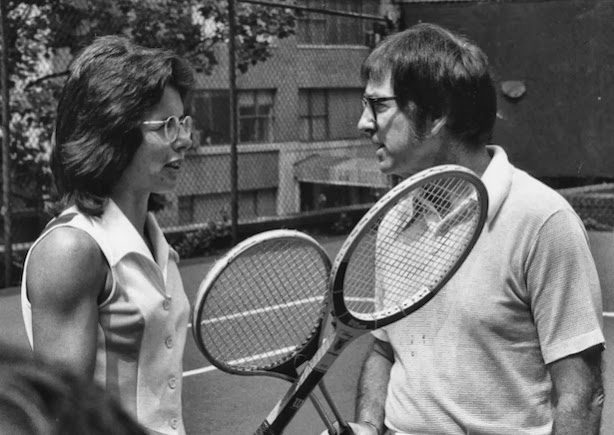
Forty years ago today, Billie Jean King struck a blow for women's liberation by beating notorious male chauvnist Bobby Riggs in a tennis match in Houston's Astrodome.

Or did she?

Just in time for this milestone anniversary came the revival of a longstanding urban myth — that Riggs deliberately lost the match, which was known as the "Battle of the Sexes." The story goes that he threw the match to settle a six–figure gambling debt with the mob.

ESPN wryly suggested that the match should have an asterisk next to it in the sports history books.

"We are always refighting old battles," wrote Gail Collins in the New York Times. "But I honestly did not expect to be spending any time in 2013 arguing about whether Billie Jean King beat Bobby Riggs."

There really are bigger fish to fry.

Such rumors have been around virtually since the match ended. I must admit that, as a child, I was baffled. Riggs (who died in 1995) was 55 years old and had been retired for many years; King was 29 and had just won both the singles and doubles championships at Wimbledon. In 1973, she was one of the best women's tennis players in the world.

The fact that she won raised no red flags for me. I expected her to win.

Howard Cosell, who was better known for calling professional fights and Monday Night Football, provided the commentary for ABC. That made the event more legitimate in my eyes.

Legitimacy was the issue, it seemed to me then — because it seemed that way to a lot of people. As Gerald Eskenazi, a veteran tennis writer, observes in the Wall Street Journal, "It wasn't until [this day] that I fully understood that a seismic change was under way." That's probably an apt description of my mindset at the time.

King responded to the allegations in the way that people, famous and not famous, tend to address things these days — via Twitter — and she insisted that Riggs wanted to win, that he tried to win.

"I just beat his butt and that's it," she said.

Seems to me that ought to be the final word on it.

But I'm certain that won't be enough for some people.

Thursday, April 4, 2013

Shocking Phi Slama Jama


"Sure, 15–footers are fine, but I like to dunk."

Clyde Drexler

I've seen a few really noteworthy upsets in championship settings in my life.

Most of the time they seem to come in baseball — the Amazin' New York Mets of 1969 and the Kirk Gibson—led Los Angeles Dodgers of 1988 come to mind — and, occasionally, they come in football — when the Miami Hurricanes knocked off top–ranked Nebraska in the 1984 Orange Bowl, for example, or when Joe Namath took the New York Jets to a triumph in the third Super Bowl.

Sometime the outcome hinges on an obvious mistake. Perhaps it is a bad call, like the one that turned things around for the Kansas City Royals against the St. Louis Cardinals in 1985. Other times, it may be a poor strategic decision by a coach or a player.

And sometimes the upset occurs in an individual sport, not a team one — like when Mike Tyson lost his heavyweight title to Buster Douglas.

But of all the team sport championships in my memory that were not decided by a blown call or a blatantly poor decision by a coach or a player, there was one really epic upset, the NCAA Tournament finale between the University of Houston and North Carolina State played 30 years ago tonight.

Houston's Cougars were widely regarded as just too good to lose. The roster had Hakeem Olajuwon and Clyde Drexler, the best and probably best–known members of "Texas' Tallest Fraternity" — Phi Slama Jama — but they had plenty of talented support from guys like Benny Anders, Larry Micheaux and Michael Young.

Phi Slama Jama specialized in dunking the ball. The players were big and physical, and they played in the last years when neither the shot clock nor the three–point shot existed in college basketball. If the game's pace had been faster or if making a long shot had been rewarded with an additional point, Phi Slama Jama might not have been as successful as it was.

But in its time, Houston went to back–to–back NCAA finals and lost both. In their second appearance, the Cougars went up against a pretty strong Georgetown team led by Patrick Ewing. My memory is that Houston's loss in that game really didn't surprise me. The Hoyas and the Cougars were considered to be evenly matched.

But the same could not be said of Houston's foe 30 years ago tonight, the North Carolina State Wolfpack. N.C. State barely managed to get in to the NCAA Tournament that year; the Wolfpack were seeded sixth in the West but won three cliffhangers en route to the Final Four.

Cliffhangers weren't anything new for the Wolfpack. They had to endure seven of them in their last nine games just to qualify for the NCAA Tournament. In so doing, they had earned the nickname "Cardiac Pack."

Top–ranked Houston, by comparison, had cruised through the tournament. In their national semifinal with #2 Louisville 48 hours earlier, the Cougars won by 13 points.

It was probably the greatest Cinderella story in my lifetime — so far, anyway.

N.C. State was a huge underdog that night. I remember that, at the time, I was working for a small–town newspaper in central Arkansas, and I was covering a county government meeting that night. I covered these meetings on a regular basis, and I knew that, even though they tended to draw very small crowds, the officials tended to get into long–winded arguments about damn near everything.

In my experience, if one of those meetings was over in less than two hours, it was a miracle.

I was disheartened by this knowledge because I really wanted to see the game, and I was convinced that I would miss most, if not all, of it.

But fate seemed to be on my side. The meeting ended early. I asked a few of the officials some questions, and I left, certain that I could be home before tipoff.

As I walked out, a county police officer who always attended the meetings called out to me. We chatted for a few minutes, then I excused myself, explaining that I wanted to see the game.

"Who do you think will win?" he asked me as I started walking down the hall.

"Houston," I said, without hesitation. I simply couldn't imagine North Carolina State winning the game.

But I was wrong.

N.C. State led by eight points at halftime, then squandered the lead in the second half but rallied by exploiting Houston's Achilles' heel — free–throw shooting.

The Wolfpack frustrated the Cougars, fouling them every time they had their hands on the ball. Olajuwon fared pretty well, hitting six of seven attempts, but, as a team, Houston barely managed to sink half its free throws.

Phi Slama Jama's reputation was built on power ball. As Drexler said, he liked to dunk — as did the rest of the Cougars. Free throws weren't something on which they spent a lot of time.

Still, it took a slam dunk by Lorenzo Charles just before the buzzer to lift the Wolfpack to that improbable triumph.

Charles died nearly two years ago when the bus he was driving crashed.

Real Clear Sports recently named Charles as the top player who found fame in the NCAA Tournament.

The Wolfpack didn't find fame in the 1983 championship game. N.C. State had won a national crown before.

But the title they won 30 years ago tonight was their most memorable.

Tuesday, June 28, 2011

The Dunk Heard 'Round the World


Ever since I heard the news of Lorenzo Charles' death in a one–vehicle accident Monday in North Carolina, I have been thinking of the spring night in 1983 when his upstart North Carolina State Wolfpack upset the heavily favored Houston Cougars in the national championship.

I remember the night vividly. I was working as a reporter for a newspaper in central Arkansas — my first job out of college.

One of my standing assignments was to cover city and county government meetings (I wasn't alone in that; it was a small newspaper staff so everyone — even those whose job titles might make you think they were above such routine duties, like managing editor — had to cover some city and county government meetings) ...

... and such a meeting was being held that night.

But the meeting was scheduled to begin at 6:30, as I remember, and the game wasn't supposed to begin until two hours later.

I had been following the NCAA Tournament closely that year, as I tended to do at that time in my life, and I was interested in seeing the championship game — even though I was sure I knew how it would turn out.

When the meeting wrapped up earlier than I expected, I was elated. It meant I could go home and see most, if not all, of the game.

As I was walking down the hallway of the building in the direction of the exit, I recall a brief conversation I had with a city police officer who was on hand (why he was there, I do not know, unless he was assigned to provide routine security that night).

I told him I was on my way home to watch the game. He wanted to know which team I thought would win.

"Houston," I told him. "No way N.C. State can win."

But I was wrong.

Oh, Houston did race to the lead, but the Cougars squandered it with terrible free throw shooting in the second half. The game was still anyone's to win as the final seconds ticked off.

That was when one of the most iconic moments in modern sports history occurred.

With the score tied at 52–52, one of Charles' teammates fired a shot from 30 feet (it would have been a three–point shot under modern rules, but the three–pointer was still a few years away).

The shot appeared to be coming up just short of its mark when, seemingly from nowhere, Charles came into view, grabbed the ball in the air and dunked it for the winning points.

It was one of those moments when the entire world seemed to stop for maybe a split second — and tried to absorb what had just happened. I have only experienced a couple of these moments in my life, and they are never merely upsets or the unexpected.

They are unthinkable.

It was a time when 12 teams were seeded in each region (the 12th seeds had to win the equivalents of play–in games), and N.C. State had been seeded eighth in its region. That season, the Wolfpack (who lost 10 games in all) had earned the nickname of the "Cardiac Pack" for winning seven nail–biters in their last nine games just to get into the tournament.

Houston, meanwhile, was ranked #1 in the nation, was making its second consecutive Final Four appearance and had the look of a dynasty.

The 1982–83 Cougars went undefeated in the Southwest Conference, losing only three games all season — and, in fact, they returned to the national championship game the following year (but lost to Georgetown).

Six members of the team eventually were drafted into the NBA.

A stunned N.C. State coach Jim Valvano dashed madly around the court, looking for someone to hug, some way to express his delight at winning the upset of a lifetime.

It was for such a moment that the song "The Impossible Dream" was written.

Some of N.C. State's players might have ended up in the NBA, anyway, even if the Wolfpack had not won that game. But the fact is that three players were drafted into the NBA later that year, including the fellow whose lob Charles plucked out of the air and dunked for the winning points — and it is possible that some or all might not have been chosen had it not been for their victory over Houston.

Later, Charles and another teammate were drafted into the NBA as well, bringing to 11 the number of future NBA draftees who were on the court that night.

Charles' NBA career was brief, however, and the Brooklyn native had short stints with some European teams, but his basketball career had been over for more than 20 years. He was operating a bus for the rental company for which he apparently worked when it crashed in Raleigh, N.C.

Sadly, it seems, great things did not happen for Charles after that evening of almost unimaginable glory.

But if you have ever watched an NCAA Tournament game, you are almost sure to have seen in the archival footage Charles' sublime, almost tentative, dunk that clinched a championship ...

... and seized a slice of immortality.

Wednesday, October 7, 2009

The Granddaddy of All Blowouts


I often hear football fans complain that a game they went to was a "blowout."

But I can only imagine how the fans in Lebanon, Tenn., must have felt on this date in 1916 — when Cumberland College traveled to Atlanta and was handed the worst beating in football history.

The final score that day was 222–0.

Aside from the lopsided nature of the score, there were a few noteworthy points:
  • The name of Tech's coach lives on in college football today. He was John Heisman, for whom the most prestigious trophy given to an individual player in college football is named.

  • Cumberland already had discontinued football, but it couldn't cancel its game with Tech for financial reasons. The schools had a scheduling agreement, and Cumberland would have had to pay $3,000 to Tech if it didn't play. In those days, $3,000 was the equivalent of nearly $60,000 in today's money so Cumberland apparently assembled a team just for the occasion.

  • I have heard that Heisman was motivated to run up the score because Cumberland's baseball team whipped Tech earlier in the year.
In the 93 years that have passed since that day, a few teams have scored 100 points in a game, but none have come close to matching Tech's output.

Twenty years ago, it was believed by many that the University of Houston, with its "run and shoot" offense under the guidance of coach Jack Pardee, might exceed the century mark — and the Cougars came close with their 95–21 triumph over SMU (which was coming off the NCAA–imposed "death penalty").

But it was actually Pardee's predecessor, Bill Yeoman, who presided over the last triple–digit scoring performance in major college football. In 1968, Yeoman's Cougars beat Tulsa, 100–6.