As I observed on that occasion, it was 19 years exactly since Steve's — and my — beloved Arkansas Razorbacks won their Sweet Sixteen encounter with Tulsa in the 1994 NCAA Tournament here in Dallas.
That day on the calendar has come around again. It is a year since Steve died, and it is now 20 years since the Razorbacks won that game and advanced to the Elite Eight for only the third time in 15 years. They beat Michigan two days later to earn a spot in that year's Final Four, where they would defeat Arizona in the national semifinals and then Duke in the national championship.
That is something that will live in Razorback fans' minds and hearts forever, and my guess is that Steve would prefer that his friends remember that — and not think of this day last year.
Today I am thinking of both. I miss Steve, and I am sorry he is gone. If he could somehow come back today, I would want him to know that he was not forgotten. The Razorbacks are part of that memory. I watched many Razorback games with Steve, including a Cotton Bowl that he and I and a mutual friend, Mike, attended together.
The Tulsa game was one part of a memory that I cherish and always will. That game is often the forgotten piece of the puzzle for Razorback fans, though. Victories over Georgetown, Michigan, Arizona and Duke get more attention, probably because those basketball programs have enjoyed more success over the years.
But Arkansas and Tulsa are natural rivals. The campuses are only about 100 miles apart. When I was growing up, the football teams met every year. Arkansas usually got the best of Tulsa — but not always.
To top it off, Arkansas coach Nolan Richardson coached at Tulsa before he went to Arkansas. The game was loaded with regional significance. Frankly, I was hoping for a classic game. Most Arkansas fans probably hoped for the same thing. We all hoped Arkansas would win, of course, but we hoped Tulsa would make it memorable.
Twenty years ago tonight, the game wasn't competitive. Arkansas simply outclassed Tulsa. The Razorbacks led by 15 at intermission and won by nearly 20.
This year, the Razorbacks made it back to the postseason — NIT this time, not the NCAA Tournament — for the first time since 2008. Last night, they played in the second round against California.
Unfortunately, the Razorbacks lost that game. They fell behind early and, even though they made a few runs at the Bears, they still lost. Ironically, if they had won, their next game would have been here in Dallas — against old Southwest Conference foe SMU.
Steve and I didn't watch that Tulsa game together 20 years ago, and I'm sorry about that. I was living in Oklahoma at the time, and he was back in Little Rock. I'm sorry he didn't live to see the 20th anniversary of that national championship. It probably would have pleased him to reminisce about those days. If I live another two weeks — and I certainly expect to live another two weeks — I will get to do that.
And I will raise a glass to Steve when I toast the Razorbacks of '94.
"You're looking for players whose name on the front of the sweater is more important than the one on the back. I look for these players to play hard, to play smart and to represent their country."
Herb Brooks (1937–2003)
Yesterday, I was surfing my cable channels, and I landed on an airing of "Miracle," the re–creation of the U.S. hockey team's triumph over the mighty Soviet Union in the 1980 Winter Olympics in Lake Placid, N.Y.
It is one of my favorite sports movies of the last 25 years — along with "Eight Men Out" and "Secretariat." I'm not a hockey fan, but I do remember watching that game when it happened. My heart was beating as if I had been a hockey fan all my life.
Trust me, whatever one was the rest of the time, on Feb. 22, 1980, every American was a hockey fan. I recall Al Michaels saying that most observers probably "don't know the difference between a blue line and a clothesline." There was a lot of truth in that.
Many of us — myself included — couldn't explain any of hockey's rules, but we were all chanting "U–S–A! U–S–A!" before that game ended.
I know I was.
If you ask people who watched that game on TV what their most memorable moment was, you'd probably get a variety of responses. Some would say it was Michaels' astonished comment in the final seconds, "Do you believe in miracles? Yes!"
For me, the most memorable moment came at the end, when the U.S. players were celebrating on the ice, and the Russians stood in a silent line, some leaning on their sticks, and watched the celebration. Some seemed genuinely bemused by the scene. And why not? That Soviet hockey team didn't lose very often.
That game came at the right time in America's history, a time when Americans were feeling helpless and knocked around by the rest of the world. Brooks and his hockey team gave the whole country a shot in the arm. It was a different place in the days after the United States beat the Soviet Union than it had been for weeks, months, even years before.
Many people mistakenly believe the Americans won the gold medal when they beat the Soviet Union that day. But the fact is that they still had to play the gold–medal game a couple of days later against Finland. The Americans, who were given virtually no chance to earn a medal before the Games began, did go on to defeat Finland, of course. It wasn't like boxing, where you win the title if you beat the champ. It was a tournament, and beating the defending champ only meant that you advanced to the next round — unless you beat the champ in the final round, and that was not what happened in 1980.
It seemed rather anticlimactic to most Americans, I guess, but it was still a shared national experience that Americans were reluctant to see end.
And they didn't have to, at least not at first.
Coach Herb Brooks made the obligatory appearance on The Tonight Show, of course. He was an instant celebrity, as was Mike Eruzione, the team captain who may have been the most recognizable player for ordinary viewers who knew little about hockey and next to nothing about the members of the team. At the time, everyone knew Eruzione had scored what proved to be the winning goal against the Russians.
A few of the other players were sort of minor celebrities, I guess, and the entire team was commemorated on Wheaties boxes.
(It is still possible to buy those boxes, too, but if you get one and it has any Wheaties in it, I would not recommend consuming the contents. Nothing against Wheaties, but 33–year–old Wheaties can't possibly have the radioactive half life of, say, a Twinkie ...)
I don't recall if the Olympic hockey team paid a visit to the White House the way Super Bowl champs and World Series champs do now. President Carter was kind of busy in those days.
Anyway, the movie brought all those memories back. It was so vivid that, even though I knew how the game ended, I was on the edge of my seat hoping the Americans could hold on to their one–goal lead for 10 more minutes.
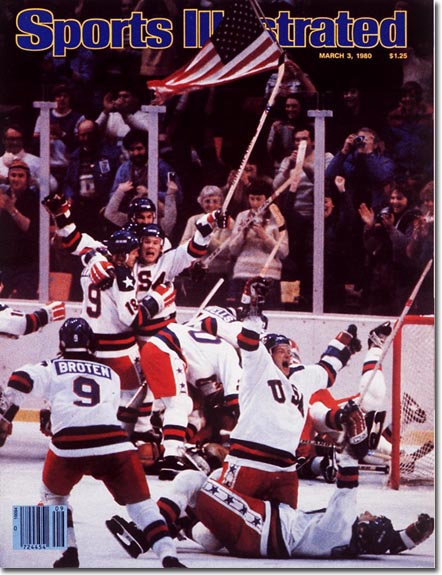
They did, of course, and the photo of their celebration became the only cover in Sports Illustrated's history that had no text with it — other than the magazine's nameplate, the date of publication and similar stuff.
But no headline. None was needed.
When the movie's final credits rolled, viewers were informed that it was dedicated to the memory of Brooks. He was killed in a car accident 10 years ago today, after the conclusion of filming but before the final product made its debut in theaters.
"He never saw it," the screen message said. "He lived it."
His life story was certainly compelling. As a young hockey player, he had been a member of the U.S. Olympic hockey team in 1960, but he was cut a week before the Games started.
The Americans went on to win the gold medal that year. The Soviets won the gold in every Olympics after that and didn't lose to the Americans again — until 1980, when Brooks guided the U.S. to the gold medal, finally winning the gold that had been denied to him 20 years earlier.
The year before he died, Brooks coached another U.S. Olympic hockey team, this time to a silver–medal finish. On the 22nd anniversary of the miracle on ice, the Americans defeated the Russians in Salt Lake City.
Talk about a storybook ending to a storybook life — a life that was filled, as most are, with disappointment and sadness but also a life that experienced joy and redemption.
It made me reflect, as I often do, about lives that are more inspiring than anything any fiction writer could make up.
Herb Brooks' was such a life.
He never saw "Miracle." He lived it.
And, because he lived it, the rest of us did as well.
Ironically, I suppose, I was thinking earlier this week about Michigan's last trip to the Elite Eight. Michigan faced my alma mater, the University of Arkansas, in one of the regional finals in 1994. The Razorbacks won the game and went on to face first Arizona and then Duke en route to the national championship.
The Wolverines haven't been this close to the Final Four since.
Had he known about that, I suspect it would have appealed to Steve. He was a diehard Razorback fan, and the victory over the Wolverines on March 25, 1994, surely ranks as one of the great moments in Arkansas basketball history.
That game was played during the "Fab Five" era. Until now, that was the most recent highlight for Michigan basketball, and it is a virtual certainty that none of the players on Michigan's current roster was old enough to remember it.
Tomorrow, the Wolverines will have an opportunity to go farther than any Michigan team has in 20 years. In 1993, Michigan went all the way to the national championship game but lost to North Carolina when Chris Webber tried to call a timeout in the final seconds. Unfortunately, the Wolverines no longer had one, which resulted in a technical being assessed against Webber.
Ultimately, the Wolverines lost the game — and then had to vacate their entire season when it was revealed that Webber had received payments from a booster.
No doubt the Wolverines would rather re–live the 1989 NCAA Tournament, when assistant Steve Fisher took over as head coach when Bill Frieder was fired after announcing just prior to the tournament that he had agreed to coach Arizona State the following season.
In spite of the instability, the Wolverines went on to win it all in a thrilling overtime triumph over Seton Hall.
That game was played in Seattle. This year's Final Four will be played across the continent — in Atlanta.
Nevertheless, will history repeat itself?
And, if so, how? By winning it all, a la 1989? Or blowing the opportunity, as was the case in 1993?
Or will the Wolverines come up short in the regional final, as they did 19 years ago?
All or part of the answer should be revealed tomorrow.
I'm not as much of a baseball fan today as I was then, but there was a time in my life when I collected baseball cards and I knew the names of the starting lineups of every major league club.
That was in the days before cable TV and the internet, before you could watch a baseball game every night of the week.
There was a "game of the week" televised every Saturday afternoon, and the all–star game was always an excuse for a special baseball broadcast. But, most of the time, I had to try to find a baseball broadcast on the radio if I wanted the experience of a major league game on a summer night.
Even though I couldn't watch much major league baseball when I was a child, I still felt fortunate to be living at a time when so many truly gifted players were playing — guys like Hank Aaron, Willie Mays, Lou Brock, Harmon Killebrew, Reggie Jackson, etc.
Where I grew up, the St. Louis Cardinals were the primary team of interest. There were fewer teams in those days, and, although I didn't live in Missouri, I did live close enough to get there in a day — and my family did go to St. Louis to see the Cardinals play a few times.
One of the Cardinals' division rivals when I was growing up was Pittsburgh, and the Pirates had one of my favorite ball players of all time — Roberto Clemente — so I always made a special effort to pick up the Cardinals broadcast when St. Louis played Pittsburgh.
I almost never got to see Clemente play. Once a year, I could usually count on seeing him in the all–star game — he made 15 all–star appearances in his career — and he played in two World Series, winning the MVP in the 1971 Fall Classic.
But I have few memories of seeing him play in the game of the week. That's a shame because he really was a great player — and a truly generous man.
That's what led to his death on this night 40 years ago.
While most of his teammates were celebrating the dawn of a new year, Clemente was trying to make sure that aid for earthquake victims in Nicaragua reached the people who needed it. Three previous flights carrying emergency relief aid had been diverted by corrupt government officials and had never reached their intended destination.
So Clemente decided to accompany the fourth shipment, apparently hoping that his status as a major–league baseball star would guarantee that the aid would get to the survivors. He chartered an airplane for a New Year's Eve flight.
The plane, however, had a history of mechanical problems and was overloaded by about 4,000 pounds. It crashed off the coast of Puerto Rico shortly after takeoff. A two–week search of the Atlantic Ocean failed to produce a body.
I remember hearing the reports that his plane had gone down. I was spending New Year's Eve at a friend's house, and his parents had told us we could stay up to watch the inaugural broadcast of Dick Clark's "New Year's Rockin' Eve," which became an annual event — and, presumably, will remain so even though Clark died earlier this year.
As the name would imply, there were many musical guests slated to appear on the show, one of which was Three Dog Night. My friend and I were big fans of Three Dog Night in those days, and, if Clemente's plane had not gone down a few hours earlier, that would have drawn all our attention that night.
But we were both baseball fans, and we both liked Clemente. I remember the two of us sitting in front of the TV, all thoughts of Three Dog Night and New Year's Eve driven from our minds as we hoped against hope that Clemente might be found alive.
But his body was never recovered.
We went ahead and watched Dick Clark's special that night, but the excitement was gone. I remember falling asleep thinking not of the new year that had dawned but of the lives — especially Clemente's — that had been lost.
I've been to Boston a few times in my life, and I've seen the historic sights that there are to see there, but I've never been to Fenway Park, the home of the Red Sox.
It's long been a fantasy of mine to go there — and to some of the other classic ballparks in America. A friend of mine and I used to talk about going on such a road trip — the way guys often do — and, to a certain extent, I think we were both serious about it.
But, on a more realistic level, I think we both realized it was just a fantasy, nothing more. Certainly nothing that we were ever likely to do.
The prospect became more remote as many of those historic, classic ballparks — Tiger Stadium, Yankee Stadium, Comiskey Park — disappeared. (I went to the old Busch Stadium in St. Louis several times when I was younger, but it has been replaced in recent years, and I went to the Astrodome in Houston when I was about 10 years old — but the 'Dome hardly qualifies as a classic ballpark.)
Fenway is the oldest active major league ballpark, and today is the 100th anniversary of its opening.
It's hard to imagine a Red Sox great who never played in Fenway. Babe Ruth pitched there. Tris Speaker roamed its outfield, as did Ted Williams and Carl Yastrzemski.
After I had graduated from college and went to work on sports copy desks for daily newspapers, Wade Boggs was a regular at third base for the Sox, and Roger Clemens set all kinds of records on the mound.
Talk about a field of dreams.
I, for one, will never forget watching Carlton Fisk wave his game–winning homer into fair territory against Cincinnati in the 1975 World Series.
(Not that the folks who put together the postseason highlight reels would ever let me forget it.)
The "Green Monster" is a fixture in left field, one of many quirks in an old ballpark where, apparently, amenities have always been rather sparse for spectators.
"It's not easy to find in the labyrinth Boston calls a city plan," writes Stephen Cannella in Sports Illustrated. "If you manage to get there by car, it's nearly impossible to park."
And that's just outside the ballpark.
I gather it's always been a kind of Joe–Friday–just–the–facts–ma'am sort of place.
"The Red Sox didn't even hold an opening ceremony ... until May 17," writes Cannella. "The implicit message from the new Fenway to its fans: This is a baseball park. You are here to watch baseball."
They still come to Fenway to watch baseball — which isn't such a bad thing at a time when so many entertainment venues seek to be all things to all people simultaneously — and they'll be celebrating this centennial in Boston all year.
For the rest of 2012, the ballpark and the ball club will have to share the billing.
There is a game being played at Fenway this afternoon, and it's appropriate that Boston's longtime rivals, the New York Yankees, are in town this weekend.
I have no evidence to support this, but I have to think the scheduling was by design.
Even if it wasn't, even if the opponent had been scheduled completely at random and the Sox were playing the most unexciting, nondescript franchise in the league (and, based on the 2011 standings, I suppose that would be the Twins or the Mariners — or, if the schedule makers wanted to keep it in Boston's division, the Orioles), this would still be a special day in Boston.
But the fact that the foe at Fenway today will be New York makes it that much more special.
When I was a child in Arkansas, I did as most people in Arkansas did on Saturdays in the fall. I listened to Arkansas Razorback football games on the radio.
When I began to follow Razorback football, the fellow who provided the radio play–by–play was a man named Claude Campbell — but he went by the nickname "Bud." In fact, I don't think I ever heard him called by his given name until I read it in his obituary.
I don't know how long he was the Voice of the Razorbacks — maybe 10 years or so — but Bud Campbell was an Arkansas institution, and I remember hearing one October morning — on the radio, appropriately — that he had died in an automobile accident the night before, two weeks before his 51st birthday.
I was shocked. Bud Campbell was only a voice to me. I never met the man. But, through that voice, he had become a friend of mine, just as he had become a friend to the hundreds of thousands who listened to him every week. The Voice of the Razorbacks had been silenced. Who would pick up the torch?
That was many years ago, and I don't remember now how Campbell's role in Razorback radio was filled immediately. I guess it was a collaborative effort. Everyone knew it would be difficult to fill Bud Campbell's shoes.
In the years ahead, though, a new Voice of the Razorbacks emerged, one that would be around for decades.
His name was Paul Eells, and he replaced Campbell — even surpassed him — in the hearts and minds of Razorback fans — in many ways. He took over the role of radio announcer for Arkansas games, and he served as sports director for the same TV station (KATV in Little Rock) where Campbell worked as a sportscaster.
By the time I left Arkansas, Eells was well established with Razorback fans. Since Eells came along, generations have been born who have no memory of Bud Campbell.
I find that remarkable — but not surprising. In fact, it is to be expected, isn't it? The passage of time.
Eells was one of those radio announcers who became known for his signature phrases — sort of like Harry Caray's "Holy cow!"
They were pretty basic — "Oh, my!" and "Touchdown, Arkansas!" — but, delivered in his distinctive voice, they had a unique quality to them.
Eells' voice was made for radio, I heard more than one person say. And, in hindsight, I would have to agree. Campbell's voice was my original standard for radio play–by–play because it was the one I knew first, but it didn't take long for me to accept Eells' voice.
Five years ago today, Eells died. For those who remembered Campbell's death in the mid–1970s, there were some obvious similarities.
Eells also perished in an automobile accident — about eight weeks before his birthday.
I never heard the causes of the accidents, but I did hear talk.
Campbell, folks said, had a problem with alcohol and may have lost control of his vehicle after a bender. I don't remember if any other vehicles were involved.
I had been away from Arkansas for many years when Eells died, but I still heard talk (albeit remotely). Eells was about 70. Could have had a heart attack or a stroke while he was operating his vehicle.
Unfortunately, Eells' vehicle did collide with another, and the driver of that vehicle died as well. I believe the occupant of the other vehicle was in his 30s.
Well, that was five years ago. I don't know who does the Arkansas play–by–play these days.
Twenty–five years ago, I was working on the sports desk of the Arkansas Gazette.
It was a morning paper so the folks who worked on the copy desks worked nights. Everyone worked weekends, but one's nights off generally were determined by seniority. As one of the most junior staff members (at that time), my days off were Mondays and Tuesdays — not exactly prime time.
That's important to note, though, because it was on Tuesday, June 17, 1986, that the annual NBA draft was held. My memory is that it was held in conjunction with the NBA Finals that year, but I could be wrong about that.
I do know that it was televised, and I remember watching it briefly with some friends — long enough, anyway, to see that Maryland's Len Bias had been selected by the Boston Celtics.
Larry Bird brought championship basketball back to Boston, but he was about to turn 30, and he had struggled with back issues. The comments I remember hearing and the articles I remember reading in mid–June 1986 suggested that Bias was going to be groomed to step in and take over the role of star player when Bird retired.
He couldn't miss, the experts said. With Len Bias, the Celtic dynasty would be in good hands.
The day after Bias was drafted, I returned to work to pull my graveyard shift on Wednesday night. I had to be back earlier the following day — I worked the sports wire on Thursdays in those days, which meant it was my job to constantly scan the wire for sports news.
I always enjoyed working the wire. When I arrived in the office to work it (a shift that typically began about two hours earlier than my usual shifts — and ended two hours earlier as well), I did a preliminary scan of the wire's contents so I could tell the editor who was in charge that evening what we could expect.
Then I would pick wire stories on sports events from all over the world and ship them over to the editor, who would decide where to put each article, assign a headline size to each and turn the stories over to the folks who were handling the copy editing that evening.
It was a procedure that had taken shape over a long period of time. The Gazette was the oldest continuously published newspaper west of the Mississippi. The system that was in place when I came on board was the product of years of evolution.
Usually, working the wire came down to the accounts of games in whichever sport happened to be in season, but there were times when unexpected stories demanded our attention. If a story was big enough, I might combine the best elements from all the wire services the Gazette received — and the Gazette subscribed to about half a dozen news services.
Nothing noteworthy happened that Wednesday night, but when I got up the next morning and switched on my TV, there was a sports story that I knew immediately would dominate my activities that night — and for many days to come.
I can't tell you the tsunami–like ripple effect this had — not only in sports and on college campuses but throughout American society as well.
When Bias was taken in the draft by the Celtics, he was widely expected to be at least one of the greatest players ever to play the game — if not the greatest. He would rewrite the record books, some people said.
And he might have. We will never know.
It does seem likely that, if he hadn't died, Bias' career would be over by this point. We would know if he set all those records that he was expected to set and if he won all those titles he was expected to win.
We didn't know much on this day 25 years ago, but we did know that Len Bias would never accomplish all those things.
Sports fans grieved as much for the potential that would never be realized as they did for the life that was cut tragically short. The circumstances were different but the sensation was much the same a few years later when Hank Gathers collapsed and died during a Loyola Marymount game in 1990.
His legacy lives on, though, says Jeff Barker in the Baltimore Sun, and his life story continues to influence the sport in ways that no one could have anticipated in 1986.
His death continues to influence people beyond the universe of basketball, writes David Steele in The Sporting News.
"His almost unfathomable death lingers as a cocaine deterrent," observes Barker. "He also maintains the power to rivet players and fans despite being from a wholly different basketball generation."
That's great, but even Barker gives in to the eternal, unanswerable question: What would Bias have accomplished?
Barker closed his piece with speculation from one of Bias' teammates — that, had Len Bias lived, people would be mentioning his name today in the same breath with his greatest contemporaries, like Michael Jordan, and the stars of today.
There are many interests, many tastes that I share with others in my native region.
But, in some ways, I guess I am out of step with the majority of my fellow Southerners. I have never particularly cared for iced tea, for example, and I have never been a fan of NASCAR.
That doesn't mean, however, that I don't respect those who do like iced tea or watch NASCAR.
My friend Phyllis, who died last year, became a NASCAR fan in the last years of her life, and she tried — with little success — to educate me in the finer points of the sport. We had lost touch, then got back in touch a year before she died. We communicated frequently by e–mail and via "chats" on Facebook during that final year.
It was like old times. I often thought, when Phyllis and I wrapped up one of our Facebook chats, that we were kind of like Forrest and Jenny in "Forrest Gump" after they were reunited as adults.
Phyllis and I were like peas and carrots. And it was over far too soon.
Considering how much I have written about Phyllis in the months since she died, there should be no doubt about my admiration for her. And, if she had lived, I probably would have tried to watch some races — if only to be able to discuss them intelligently with her.
But I doubt that she could have persuaded me to become any kind of regular NASCAR follower.
(Now, let me remind my readers that I worked for many years on newspaper sports copy desks, but I have never regarded auto racing as a sport. In my mind, "sport" implies athletic ability, and I see nothing particularly athletic about sitting behind the wheel of a car.
(It is a competition, but it is not athletic.
(I recall saying that once to Phyllis, and she vehemently disagreed with me — but she preferred to use the word "skill," not "athletic ability.")
I have missed Phyllis frequently in the six months since she died, and today is one occasion when I would have liked to have heard her thoughts.
Today is the 10th anniversary of the death of Dale Earnhardt Sr. in a crash at the Daytona 500, and I honestly wish I could ask Phyllis for her thoughts about an article by Liz Clarke in yesterday's Washington Post.
Not long before Phyllis died, she started a blog about NASCAR. She only made one entry — she may have been in a lot of pain when she wrote it, and I know she went into the hospital for what turned out to be the final time a few weeks later — but I had the distinct impression when I discovered the blog sometime after her death that she always intended to do much more with it. She just ran out of time.
But if she hadn't died, I imagine Phyllis would have had some interesting things to say about this anniversary.
At the end of her life, she liked to joke about herself. She called herself a "redneck," for example, even though those closest to her always knew that would never be true.
And I would have been the first to stand up and argue with anyone, even (or perhaps that should be "especially") Phyllis herself, who suggested that she might be "ignorant."
Phyllis was one of the most intelligent people I have ever known. Any competition that could capture her attention and retain her interest couldn't be as simple and dumb as some people contend.
Clarke writes that "for many, stock–car racing's soul died that day" in 2001 and asserts that NASCAR hasn't recovered.
"Attendance and TV ratings have slipped," Clarke writes, "a product of the malaise affecting the economy at large but also, in the minds of some, the result of a number of missteps made by the sport in reaction to Earnhardt's death."
That seems like an awful lot to pin on the influence of a single event — or a single death — but Earnhardt's death was a seismic experience for many people.
And, lest we forget the kind of impact a single event — or a single death — can have on people, let's remember things like the celebrations that followed the rescue of baby Jessica from the well in Texas more than 20 years ago — or the global grief after Princess Diana died in a car crash a decade later.
"[T]o millions of sports fans, NASCAR is simply an annoyance," writes Clarke. "They stumble on a stock–car race on TV and see nothing but cars going around and around to nowhere.
"But to Dale Earnhardt, NASCAR led past the textile mill's gates and farther than he ever dreamed. And with every high–banked, hair–raising turn he made in that black No. 3, he took legions of fans along for the wild ride."
Roy Lang III of the Shreveport Times says kind of the same thing. Lang observes that Earnhardt's crash led to some revolutionary safety changes in NASCAR, but his loss has hurt NASCAR in other ways.
"NASCAR has learned how to make the sport safer," Lang writes. "And the benefits are immeasurable. However, in the same period of time, we've learned Earnhardt was irreplaceable."
I don't know if Phyllis became a NASCAR fan before or after this day in 2001. Consequently, I don't know how much influence Earnhardt may have had on her.
I do know she was a fan of Jimmie Johnson, and, while I know little about stock–car racing, I know that Johnson was about half Earnhardt's age 10 years ago. His career was just getting started when Earnhardt's life was ending.
But, even if Phyllis became a NASCAR fan after Earnhardt died, I'm sure she would have had an opinion on where it was and where it was going. She just might not have had the perspective that came with watching Earnhardt compete in the years before his fatal crash.
I think Phyllis would agree, though, that Johnson, as successful as he has been, hasn't been able to fill the void that was left by Earnhardt.
Just as I doubt that anyone will ever be able to fill the void that was left by Phyllis. She was irreplaceable, too.
If you follow football, you know that field goals can be very important.
But, unless somebody kicks a game–winner in the last seconds, field goals don't get the same attention as touchdown runs and passes. That's understandable. They aren't worth as much — although there have been proposals that would add to the value for especially long field goals in recognition of their increased difficulty.
That's something I can support — kind of like the three–point shot in basketball. Reward kickers for doing something special. I guess I have a little recent personal motivation to say that. The kicker for my alma mater, the University of Arkansas, nailed a 51–yard field goal on Saturday.
That's the longest field goal that has been kicked at Arkansas in nearly 20 years. But it wasn't the game–winner. It came in the middle of a game that turned into something of a rout for the Razorbacks so it didn't get a lot of attention.
That, in turn, reminded me of when I worked on the sports desk at the Arkansas Gazette.
The Gazette is no longer in business, but, when I was there, we took a lot of high school football game accounts over the phone from stringers and such on Friday nights.
The newspaper served the whole state, and we didn't have enough reporters on the entire staff — let alone the sports side — to physically attend every high school game.
And we sure didn't have enough space for extensive articles on every game. Most of the time, we had to settle for a couple of paragraphs that mentioned the score, a couple of the outstanding players or the game–winning play and the teams' records.
That was about it.
I guess it goes without saying that the phone calls we took on those very busy Friday nights didn't last too long.
Anyway, one of the fellows on the staff used to love to come up with nicknames for players in game accounts he took over the phone — and sometimes he would try to sneak one into print. Typically, the nicknames he thought of were ones that were given, originally, to the gridiron legends of the 1940s and 1950s.
Those of us on the copy desk learned to be particularly alert for these nicknames, and we caught a lot of them. We didn't catch them all, but we tried. It helped if you were familiar with football history.
You know the kind of stuff I mean. If a kid kicked a game–winning field goal on the last play of the game, this guy wanted to nickname him "The Toe." If a guy ran for a lot of yards, he wanted to nickname him "Crazy Legs."
If I think about it, I can see him in my mind's eye, chuckling as he read the first paragraph in such a blurb he had written when he saw it on a page proof: "Joe (The Toe) Smith kicked a 31–yard field goal as time ran out to lift Little Rock Catholic to a victory over Little Rock Central ..."
The nickname was his inside joke. If it was a somewhat obscure nickname, he knew he had a good chance of getting away with it because the copy desk might not know that the nickname wasn't legitimate, that a coach or a teacher or whoever called in the score hadn't said it was the player's real nickname, that it was actually an homage.
Kim, you rascal.
He particularly loved that nickname "The Toe." I worked on the Gazette sports staff for four football seasons, and I think that is the nickname he mentioned more often than any other.
If you're a fan of football, you may know that the original "The Toe" was Lou Groza, an NFL kicker in the 1950s and 1960s who also played offensive tackle. He spent his whole professional career with the Cleveland Browns, and a writer for the Cleveland Press gave him that nickname.
Groza was a prolific kicker. He kicked game–winning field goals in pressure situations. He led the NFL in field goals five times. But today is the anniversary of something that even he, as successful as he was, never achieved.Forty years ago today, Tom Dempsey kicked a 63–yard field goal for the New Orleans Saints against the Detroit Lions, setting an NFL record that has not been exceeded, only matched.
There were a few things about this field goal that made it unique.
For one thing, the right–footed Dempsey was born without any toes on his right foot. He wore a special shoe that was believed by some to give him an unfair advantage.
(Some might argue that going through life with half the toes one is supposed to have qualifies as a disadvantage.)
For another, the Saints and the Lions were nothing like their modern incarnations. The Saints of 1970 were a young, struggling expansion squad while the Lions were on their way to the playoffs as the NFC's first wild–card team.
It was to be — at least, when compared to the next four decades — a rare postseason appearance for Detroit. At the time, though, the Lions were considered a competitive franchise that was usually included in any conversation about Super Bowl contenders.
Nevertheless, Dempsey's kick handed the win to New Orleans.
Ironically, Dempsey's record–setting field goal came eight days before the first anniversary of another team field goal record he set. On Nov. 16, 1969, against the New York Giants, Dempsey kicked six field goals in a single game, more than any other kicker in New Orleans history, as the Saints won by a single point.
In these days of political correctness, some people seem to believe that the way to handle an unpleasant truth is to change the language used to describe that truth — or ignore it completely.
I won't dispute the importance of language, but I think what is really needed is more role models who have overcome the barriers they faced — physical disabilities, prejudices of any kind, etc. — and achieved great things.
We need more people who will inspire us with their accomplishments.
I will always remember the night of Saturday, Oct. 26, 1985.
I was working on the sports copy desk of the Arkansas Gazette in Little Rock. Football season was two months old, and I had been working there long enough to know that Fridays and Saturdays in the fall meant everyone on the sports staff had to be in the office to handle the workload.
Football season was — and is — serious business in Arkansas. High school. College. The pros. All of it.
The University of Arkansas' Razorbacks, of course, were — as they are today — at the center of attention, but every high school in the state had its rabid followers for whom every Friday night in the fall was a life–and–death situation. And the pros — mostly the Cowboys when I was growing up — had plenty of devotees.
The Gazette's longtime sports editor, Orville Henry, was widely credited with saving the paper in the late 1950s when readers were leaving it over its series of Pulitzer Prize–winning editorials supporting the integration of Little Rock Central High School.
How did he do that? By promising that, during football season, the Gazette would have, in the Saturday morning papers, the scores from every football game involving every high school in the state that fielded a football team.
The Gazette, you see, served the entire state, and most of its sports readers, whether they lived in Little Rock or its neighboring counties or any of the 75 counties within Arkansas' borders, cared about high school football. But the paper had multiple deadlines each night, and the edition that went out to the far corners of the state went to press long before any night games had ended. Those readers — in places like Fayetteville and Blytheville and Texarkana and points in between — didn't expect to get the football scores in their Saturday morning papers.
But the edition that went out to the neighboring counties in central Arkansas went to press around 11 at night, and the city edition went to press around 12:30, so there were plenty of readers who did expect to see those scores in the paper that was delivered to their doorsteps on Saturday mornings.
And everyone on the sports staff had to stay in the office until we had scores for every game. As the hours went by, staffers were calling anyone they could think of from areas where we hadn't heard a score — a principal, a teacher, the county sheriff.
Many times, we published scores based on something as iffy as "Well, I think the score was ..." I'm sure we got it wrong sometimes. But, in all the years I worked there, we always had a score, whether it was right or wrong, for every game when the city edition went to bed on Friday nights.
There were — and, I presume, still are, although there was considerable consternation over the possibility of school consolidation at the time I left — many tiny, rural high schools all across the state. And it could be quite challenging at times to get their scores.
I was there for four football seasons, and I remember nights when we were in the office until nearly 3 in the morning trying to track down the score from a single football game.
I guess it goes without saying that, on many Saturdays, the sports staff was dragging.
I don't remember if Friday, Oct. 25, 1985, was such a night. It may well have been one of those (comparably rare) football Friday nights when everything went smoothly and we managed to put the paper to bed at what was a normal time for us. But, for those of us in the sports department, it was a time of year when things were complicated by the World Series.
And the sixth game of the World Series was to be played that Saturday night. The teams that were playing were the Kansas City Royals and the St. Louis Cardinals in what was known as the "I–70 Series" — in honor of the highway that directly connects the two cities.
With both of the teams coming from cities in the state the bordered Arkansas to the north, it should be obvious that there was a distinctly regional flavor to that year's World Series.
When I was growing up, central Arkansas was Cardinal country, and that tradition was alive and well in the Gazette newsroom in 1985. Lots of people, whether they worked on the sports side or not, were openly pulling for the Cardinals.
But there was no TV in the newsroom in those days — so many folks who had to work at night (usually that was almost exclusively the copy desk, but there were some reporters who wrote at night) had to listen to the radio at their desks if they wanted to know the score in that pre–internet world.
The Cardinals led the Royals, three games to two, when the Series returned to Kansas City, and St. Louis was on the brink of winning its second world title in four years. One of the guys on the sports copy desk brought a TV to the newsroom that night so we could watch the game while we worked.
And it was about the most dramatic World Series game I have ever seen.
It started as a pitchers' duel. Neither team scored until the Cardinals managed to score a run in the top of the eighth, and it looked like they were on their way. But, in the bottom of the ninth, trailing by a run, the Royals scored two runs, thanks to a blown call at first base by umpire Don Denkinger.
I guess it is possible that the Royals might have scored two runs in their half of the ninth even if Denkinger had made the right call. But it would have been a lot more difficult to achieve.
Replays from every angle clearly confirmed that Denkinger had made the wrong call, but he stubbornly refused to reverse himself and there was no mechanism in place for overturning an umpire's call through the use of instant replay. The call stood; the Royals rallied for an improbable victory and forced the decisive Game 7 the next night.
Except for football, major team sports championships are decided in a best–of–seven playoff series. When they happen, Game 7s are often dramatic events, reflecting the even split of the previous six games.
But there was nothing terribly dramatic about Game 7 of the 1985 World Series.
Maybe the Cardinals were shell–shocked, having come so tantalizingly close to winning the World Series only to have it snatched away from them by something that was beyond their control.
Whatever it was, the Cardinals, who had looked unbeatable on the eve of their series with their meek sister from western Missouri, couldn't scratch out a single run in the finale. Their manager, Whitey Herzog, and their pitcher, Joaquin Andujar, were ejected from the game, and Kansas City won a blowout, 11–0.
Compared to the previous night, it was anticlimactic.
For me, it is really incredible to think that it has been 35 years since the "Thrilla in Manila," the third and final fight between Joe Frazier and Muhammad Ali.
Few rivalries between individual athletes could match Ali and Frazier in the 1970s. The nation truly was transfixed every time they fought. I always felt that was because they represented — symbolically, at least — each side of the cultural divide that existed in those days. Ali, with his rebellious nature and his refusal to fight in the increasingly unpopular Vietnam War, seemed to represent the doves, whereas the obedient, establishmentarian Frazier represented the hawks in American society.
I was a great admirer of Ali as a boy, and one of the things I appreciated about him was that, after he won the title from George Foreman, he brought boxing back to the people. Prior to the second Ali championship era, most fights were shown only on closed–circuit TV. But after Ali defeated Foreman, most of his title defenses were on commercial TV.
Of course, at that point in his career, few of Ali's foes were truly on his level. But that didn't matter. I remember eagerly looking forward to those fights.
But the "Thrilla in Manila" was an exception, in more ways than one. Not only did it match Ali with a worthy adversary, but the fight was televised by the fledgling HBO network — which was then, as it is now, a subscription service — and its broadcast via satellite from the Philippines can be reasonably said to have been a pioneering event in the development of modern satellite TV transmission.
And, too, I always felt that, if it wasn't the initial inspiration, the "Thrilla" must have had some influence on the story that was told in the original "Rocky." At the very least, it was a damn good example of art imitating life — or perhaps anticipating is a better word.
In Manila, the defending champion Ali and his entourage did not take the fight seriously, believing they were doing Frazier a favor by giving him one more moment in the spotlight. But Frazier took the fight very seriously and went 14 rounds with Ali before losing by technical knockout.
Ali — whose blase approach to the fight encouraged many distractions that were unrelated to what he needed to do in the ring — was suitably impressed with Frazier. Before the fight, he believed Frazier was just a shell of his formerly dominant self after his humiliating loss to Foreman two years earlier.
But after the fight, Ali told anyone who would listen that Frazier "is the greatest fighter of all times ... next to me."
That was pretty high praise coming from a man who fought Sonny Liston (twice), George Foreman and Ken Norton, among others.
A relentless perfectionist, Lombardi probably would be disappointed that, in 40 years, medical science hasn't conquered the thing that killed him. Medical science has made great strides against other forms of cancer, including the variety that killed Bears fullback Brian Piccolo less than three months earlier, but colon cancer remains a formidable adversary.
I guess that's fitting. During his life, Lombardi also was a formidable adversary.
In the 1960s, Lombardi may have been the most respected coach in the NFL. He became the first coach to lead his team to three straight NFL titles, and he was the winning coach in the first two Super Bowls.
Today, his memory is not so vivid in most minds. He is remembered by some for saying things that are generally considered cliches now — things like "Winning is the only thing" and urging his players to "run to daylight."
My personal memories of Lombardi are still vivid, though, and they are in black and white. That's because our TV was a black and white in those days — and the screen wasn't very big so Lombardi, who was not a tall man to begin with, looked even smaller to my elementary school eyes.
Actually, my family got its very first color TV in 1970, a few months before football season was scheduled to begin. Then as now, I loved football, and I was looking forward to seeing football games in color.
And one of the things I was looking forward to the most was finally seeing Lombardi, who was coaching the Washington Redskins by that time, in color.
In hindsight, I probably didn't miss much. Even in the color film I have seen of the Lombardi Packers, Lombardi was a black–and–white figure, almost always wearing dark pants and a white shirt, occasionally wearing a tan overcoat. He always appeared somewhat colorless, with his salt–and–pepper hair and his dark–rimmed glasses.
But appearances can be deceiving. Lombardi was far from colorless.
I was — and still am — a Packers fan. Lombardi was the reason for that, but, as much as he did for the Packers, he seems to have done even more for the Redskins in 1969, laying a foundation for the franchise's future success in the 1970s and 1980s.
But even though he took a team that was unaccustomed to winning and molded it into a contender, Lombardi worried that he hadn't been as tough as he should have been. Sonny Jurgensen said that, before he was stricken with cancer, Lombardi told him he had been "too easy" on the players after taking a year off from coaching and pledged to be tougher.
In the spring of 1970, it seemed all but certain that, with Lombardi at the helm for the second year, the Redskins would be televised beyond their local viewing area. That was good news for a young Lombardi fan living in Arkansas.
And, in that spring of 1970, there was no ESPN where football fans could get offseason news, but the sports writers I read in the Arkansas Gazette in those days all seemed to feel the Redskins were poised to make a real run for the playoffs.
That was an unfamiliar feeling, even though Washington could have been in the playoffs in 1969 if the Redskins had defeated the Dallas Cowboys in their two meetings (in fact, they didn't really come close to winning either game).
The old NFL and its upstart rival, the American Football League, merged earlier in 1970, then divided into the NFC and AFC, and folks expected big things from the Redskins (who actually would have been in the running for a wild–card playoff spot in 1969 if such a thing had existed at that time).
But it was not to be. Lombardi was stricken with cancer that summer. The oncologist who treated him called it the most aggressive he had ever seen, and Lombardi died about 10 weeks after his diagnosis.
His memory is honored, of course, in the name of the trophy that is awarded annually to the team that wins the Super Bowl — a fitting tribute to the man who coached the winning team in the first two Super Bowls, even though those victories had none of the drama of the legendary "Ice Bowl."
I still remember when I heard that Lombardi was dying. It was a week night in early September 1970. My father, a college professor, had been spending the previous eight weeks taking continuing education courses in Chicago, and he was returning that night.
My mother took my brother and me, along with some family friends, to the Little Rock airport to meet his plane — only to be told at the airport that Dad had called. He had missed his flight — I think he got stuck in Chicago traffic — and was booked on another flight. He would be arriving late that evening, we were told.
So we turned around and drove back to our small hometown about 30 miles away to have some dinner and kill a few hours. I clearly remember, on that drive home, hearing reports on the radio that Lombardi was near death. And, by that time the next day, he was gone.
After Lombardi died, one of his former players from his glory days in Green Bay, Jerry Kramer, put together a book about Lombardi that was primarily transcriptions of interviews he did with people who were influenced by the legendary coach.
He had had some experience with this kind of thing. In 1967, he kept a diary of the football season, which, as it happened, was the last season Lombardi coached the Packers. The diary was published as a book called "Instant Replay" and became a best seller.
Kramer played one more season, then retired, publishing another book titled, "Farewell to Football."
Most of the people he interviewed for his book on Lombardi were men who played for Lombardi. One was his brother. Another was a college teammate who became, along with Lombardi, one of Fordham's "Seven Blocks of Granite." Kramer also interviewed legendary Army coach Red Blaik, who hired Lombardi as an assistant coach in the late 1940s.
And the final entry came from Kramer's conversation with Sonny Jurgensen, a talented quarterback who was trying to come back from rib and elbow injuries at the age of 35 when Lombardi arrived in Washington. They had one season together.
When Jurgensen met with Kramer, he told him, "I envy you ... all you guys from Green Bay. You had him for nine years. We only had him for one — just long enough for him to educate us as to what it takes to win."
When the transcription was finished, Kramer wrote, "I think I felt sorrier for Sonny than I did for any other man affected by Vince's death. He'd waited so long to be a winner. He'd waited so long to find a Vince Lombardi."
Some people never find a Vince Lombardi, and others, like Jurgensen, don't have their Lombardi long enough.
On the surface, his lessons were about football, but they were really about life.
"If you believe in yourself and have the courage, the determination, the dedication, the competitive drive," he said, "and if you are willing to sacrifice the little things in life and pay the price for the things that are worthwhile, it can be done."
And, while there was no way he could have known it at the time, he had good advice for those people in the 21st century who find themselves in a poor economy and working at a job for which they have no passion.
"If you aren't fired with enthusiasm," Lombardi said, "you will be fired with enthusiasm."
Lombardi. His wisdom still rings true 40 years after his death.
I don't know whether Howard Cosell listened to and enjoyed the music of Frank Sinatra — in hindsight, it seems odd not to know that because we knew Cosell's opinions on just about everything else.
But when considering Cosell's life, matching him with anyone else seems inappropriate.
They were contemporaries, quite close, in fact, to the same age (Sinatra was a little more than two years older). And, while Sinatra sang about "doin' it my way," that was how Cosell lived his life.
If someone ever does a film about the life of Howard Cosell, I think Sinatra's music should be the soundtrack.
Cosell certainly did things his way. Or, to paraphrase his own catchphrase, he told it like it was.
We knew that Cosell liked his ten–dollar words, which tended to make him come off as elitist, aloof. He couldn't resist the temptation. Maybe it was his legal training. Maybe he just always had a fondness for big words. But he just couldn't restrain himself, even on the most somber of occasions.
Like Dec. 8, 1980, when I and millions of people who were watching Monday Night Football learned from Cosell that John Lennon had been killed.
"Remember this is just a football game, no matter who wins or loses. An unspeakable tragedy confirmed to us by ABC News in New York City: John Lennon, outside of his apartment building on the West Side of New York City, the most famous, perhaps, of all of The Beatles, shot twice in the back, rushed to Roosevelt Hospital, dead on arrival."
"Unspeakable" struck some people as a bit much, but that was just Cosell expressing himself. Besides, to those of us who were Beatles fans, the murder of John Lennon really was unspeakable.
No other word was adequate.
Cosell definitely had his own style, and he was really famous, I suppose, for two things — his longtime affiliation with Muhammad Ali and his years with Monday Night Football. The stories of each could be books in themselves.
Ali and Cosell had something of a symbiotic relationship. Cosell did the ringside duty for most of Ali's early fights, then he made a name for himself as part of the Monday Night Football broadcasting crew.
But Cosell often seemed to be on top of the American sports scene — long before ESPN.
His astonished call during the Frazier–Foreman fight — "Down goes Frazier! Down goes Frazier!" — has become part of sports lexicon. He also covered the Bobby Riggs–Billie Jean King "Battle of the Sexes" and Olympics competition for ABC, including the murders of the Israeli athletes at the 1972 Summer Games.
When the subject was Cosell, you seldom found fence sitters. People either really liked him or really hated him, but it was a funny kind of hatred. People didn't hate him to the extent that they wouldn't watch Monday Night Football. Instead, they tuned in in huge numbers, hoping to witness the rare moments when he was caught unprepared. The meticulous Cosell brought the kind of in–depth reporting to sports that once was the hallmark of hard news coverage, and he was rarely unprepared. In the late 1970s and early 1980s, some enterprising bar owners sponsored contests, with winners getting the chance to throw a brick or something else that was big and heavy at Cosell's image on an old TV.
It's hard to believe it was 15 years ago today that Cosell died. In all honesty, I think his death was overshadowed by the Oklahoma City bombing four days earlier and the memorial service for the victims that was held only hours after Cosell's death.
Cosell's death may not have received the attention it deserved, but his absence has been felt.
Sometimes it's obvious. You know when they happen that you will always remember where you were and what you were doing when those moments occurred.
Most of the time, they seem to be moments you wouldn't want to repeat — like September 11 or the JFK assassination. But, from time to time, a moment comes along that is so inspirational, so uplifting that you wish you could experience it again and again.
Today is the 30th anniversary of such a moment. It was on this day in 1980 that the U.S. Olympic hockey team upset the powerful Soviets in Lake Placid, N.Y., and went on to win the gold medal a few days later.
I really thought somebody would show the movie "Miracle" today, but, if it is being shown, I haven't been able to find it in the listings. At the very least, I thought ESPN Classic would show a replay of the game, but that doesn't seem to be the case, either.
Apparently, though, some people are trying to recapture the feeling. Craig Custance of The Sporting News wrote the following about yesterday's victory over Canada in the Olympics: "If the Americans can play the role of favorite as well as they have the underdog, they're a serious threat to win [the gold medal]."
Fortunately, some people kept their perspective. "USA Hockey's win over Canada was hardly 'Miracle 2.0,' " writes Dan Shanoff.
With all due respect to the 2010 U.S. Olympic team and what it has accomplished so far, this is not 1980 and the Canadians are not the fearsome foes that the Soviets were — although, in some ways, the times are similar.
It's kind of hard to explain — if you aren't old enough to remember it — what a shot in the arm that victory was for the entire country. It was more than a game. It was about a beaten and bloodied America bouncing back in spite of the hostages in Iran, in spite of a recession and high unemployment.
Seems like a lot for a bunch of college kids to carry on their shoulders, but that was what those hockey players represented to millions of Americans who wanted to feel good about their country again. That became their mission, at least as far as the American public was concerned. They were standing in for the millions of Americans who had had it up to here, who were mad as hell and weren't going to take it anymore.
I don't believe that anyone who watched that game could ever forget it — or how they felt as sportscaster Al Michaels counted down the final seconds and uttered his legendary call as time ran out: "Do you believe in miracles? YES!" Just watching the clip at the top of this post brings the memories rushing back, and I feel the same chill run down my spine that I felt on that Friday 30 years ago.
I've never been a hockey fan. Most Americans probably wouldn't call themselves hockey fans. But the members of that U.S. team — Jim Craig, Mark Johnson, Mike Eruzione, coach Herb Brooks and all the rest of the squad — became latter–day American heroes. And, after that game, everyone in America was a hockey fan.
Until the end of the Olympic Games, anyway.
Two days after the Americans beat the Russians, I recall watching Jim McKay talking on ABC as the network prepared to televise the gold medal game. He told the audience about a conversation he had had with his wife earlier that morning. "This will be a first for you," he said he told his wife, "watching sports on TV on a Sunday morning."
He smiled as he recalled her reply: "I know — and to watch hockey!"
A year later, a made–for–TV film about the U.S. hockey team was shown on the small screen. It was OK, although even casual hockey observers could tell that Karl Malden was more than two decades older than Brooks. If it had anything going for it, it was the way it incorporated actual game footage, giving viewers an opportunity to relive a moment when they not only felt free to dream again but also to hope again.
It wasn't until nearly 25 years later that the story of the U.S. hockey team finally made it to the big screen with a cast that was plausible. I thought the movie was great. But I couldn't help wondering why it took a quarter of a century for someone to make a genuine dramatization of that accomplishment. Surely there were times in the intervening years when America needed the inspiration that hockey team provided the Americans of 1980.
Well, a recession has hammered America in the last couple of years, leaving more people filled with self–doubt than I have seen in my lifetime. Perhaps now, 30 years after that truly amazing achievement, this generation's hockey team will step forward and do the unthinkable — and inspire us to rise above our circumstances.
Beating Canada yesterday was big, but it wasn't really comparable to the win over the Soviets 30 years ago — even if the Canadians were wearing red uniforms.
At the end of "Miracle," some text appears on the screen dedicating the film to Brooks' memory. The film had been completed just before Brooks was killed in a single–vehicle crash at the age of 66.
Brooks never saw "Miracle," the dedication read. "He lived it."
In American sports, the late 1980s were the Age of Tyson.
Tiger Woods did not emerge until the late 1990s. Michael Jordan was starting to make a name for himself, but he didn't win his first NBA title until 1991.
Sure, there were other people doing things in sports in the late 1980s, but Mike Tyson cast a muscular shadow over the landscape. He became heavyweight champion in 1986, when he was barely 20 years old, and the expectation was that he could be heavyweight champion for 15–20 years.
He made quick work of many of his opponents, routinely knocking them out in the first couple of rounds.
A lot of sports fans didn't care for Tyson. He was a thug, boorish, abusive to his wife, not a pleasant person. But what could be done? It looked like we were stuck with him for at least a decade, maybe longer.
I remember that Saturday night. I was working on a newspaper sports desk that evening and the news of Tyson's defeat came in from Japan over the newswire shortly before our deadline. We didn't have a lot of space, but we got the story in. We knew our readers had other options for news, even in those pre–internet days, but we felt obliged to get the news in. Some of our readers might not have heard that the world had changed while they slept.
Just like that, it was over. The Age of Tyson was done. It didn't last 15 or 20 years. It was over in little more than three years.
Not with a bang, but with a whimper.
Well, there was kind of a bang, I guess. Less than a week after the fight, the replay was shown on HBO. A watering hole in the town where I was working advertised that people could see the tape of the fight on its big screen so a buddy of mine from work and I went over there to watch it. The place was packed, and the way the people in the bar cheered whenever Tyson got knocked down, you would have thought it was happening live.
A couple of years later, Tyson was convicted of sexual assault and wound up doing time in prison, then he tried to come back in boxing after his release, but he could never pull it off. Ring Magazine ranks Tyson as the 16th greatest puncher of all time, but his window of opportunity slammed shut 20 years ago, and he was never able to pry it open again.
I can't honestly say that there was a moment when I knew Tyson would never be heavyweight champion again. It just slowly dawned on me that, as fearsome as Tyson was in his prime, his time was over.
Twenty years ago, it seemed that hardly a week went by when Tyson didn't say or do something outrageous. But he became just another fighter on this night in 1990 before a stunned and, apparently, disappointed audience in Tokyo that seems to have paid for tickets expecting to see one of Tyson's one– or two–round knockouts.
The fact that they saw perhaps the most amazing upset in boxing history doesn't appear to have dawned on them — at least at that time. Maybe some of those who saw it came to appreciate the magnitude of what they had seen.
In this hemisphere, though, most sports fans understood the significance of what had happened, and most welcomed the end of the Age of Tyson.
Today is the anniversary of two similar events in two separate sports separated by more than two dozen years.
On Jan. 29, 1936, the first inductees into Baseball's Hall of Fame were announced. Those inductees were:
Ty Cobb
Babe Ruth
Honus Wagner
Christy Mathewson
Walter Johnson
In nearly three–quarters of a century, almost 300 people, of whom more than 200 were players (although managers, umpires, executives and Negro Leaguers are enshrined), have been inducted. Next summer, one former player — Andre Dawson — will be inducted, along with an umpire and a manager.
Twenty–seven years later, to the day, the Pro Football Hall of Fame announced its first group of inductees. A total of 17 people were named on that day:
Sammy Baugh
Bert Bell
Joseph Carr
Dutch Clark
Red Grange
George Halas
Mel Hein
Pete Henry
Cal Hubbard
Don Hutson
Curly Lambeau
Tim Mara
George Preston Marshall
Blood McNally
Bronko Nagurski
Ernie Nevers
Jim Thorpe
More than 250 people are in the Pro Football Hall of Fame. This year's class has not yet been announced.
Perhaps it was a coincidence that both sports announced their charter classes on January 29. Or maybe the NFL manipulated things — but why?
In a way, I guess it is appropriate that the New York Yankees won the World Series this year.
It was on this day in 1989 that Billy Martin, a second baseman for the Yankees from 1950–57 and later a five–time manager of the Yankees, died in a one–vehicle accident near his farm in Fenton, N.Y. And, in the two years ending in a "9" since then, the Yankees have won the World Series.
Martin, who was 61 at the time of his fatal accident, was known to have an addiction to alcohol, and he and the driver of the pickup in which he was riding had been drinking heavily that Christmas Day. It was suggested, by sports journalist Peter Golenbock, that Martin had been the actual driver of the truck, but Martin's widow and his drinking buddy attempted to cover up his complicity. The autopsy concluded that Martin had been a passenger and that he hadn't been wearing his seatbelt.
It is said that, at the time of his death, Martin was preparing for yet another stint as Yankees manager. Supposedly, he had even gone so far as to assemble a coaching staff. But it was not to be.
It would have been wildly entertaining to see Martin back in the dugout, I'm sure.
Martin played big–league baseball from 1950 to 1961 — most of that time (1950–57), he played for the Yankees. He was a teammate of Joe DiMaggio and Mickey Mantle. During that time, he was a member of four World Series–winning teams.
He was the manager of five teams between 1969 and 1988 (he didn't manage in 1984, 1986 or 1987) — and most of those seasons (1975–78, 1979, 1983, 1985 and 1988), he managed the Yankees. Reggie Jackson was one of his players. He won another World Series (in 1977) in that role.
He was talented, but he was volatile, and his drinking problem only exacerbated the situation. He got into fights as a player. He got thrown out of ball games as a manager. His frequent firings by Yankee owner George Steinbrenner became the subject of jokes in the 1970s and 1980s.
One can only wonder if he had mellowed enough, at the age of 61, to last more than a season as the Yankees' skipper.
I always felt a couple of statements summed up Martin quite nicely:
A few years before Martin's death, I remember reading "Bill James' Baseball Abstract," and James speculated about what each team's manager might be doing, presumably based on his education or experience or general personality, if baseball did not exist. The answer for Martin was "10 to 20."
The other was a comment from Martin himself that is chiseled in his grave marker: "I may not have been the greatest Yankee to put on the uniform, but I was the proudest."
Well, as a wise man once said, "Temper gets you into trouble. Pride keeps you there." Billy Martin was well acquainted with both.
A "tomato can" is a fighter who is believed to be past his prime and an "easy" or "guaranteed" win for an up-and-coming fighter who wants to pad his record.
Sometimes, though, the "tomato can" doesn't cooperate. For example, in 1990, undefeated heavyweight champion Mike Tyson lost the title to a 42-to-1 underdog named Buster Douglas.
Another heavyweight champion, Muhammad Ali, almost lost his title to lightly regarded Chuck Wepner in 1975. Wepner nearly went the distance against Ali and inspired the original "Rocky" movie.
I got my bachelor's degree in journalism from the University of Arkansas, and I got my master's degree in journalism from the University of North Texas. Most of my adult life has been dedicated to writing and editing in one form or another. Most recently I have taught writing (news and developmental) as an adjunct journalism professor at Richland College, where I advise the student newspaper staff. Go, Thunderducks!