Showing posts with label 1973. Show all posts

Monday, December 16, 2013

2003: A Juice Odyssey


Forty years ago today, my father was finishing up his sabbatical in Nashville, and my family was about to return to my hometown in Arkansas.

I remember that my brother and I had just finished school and been dismissed for the Christmas holiday, and we had been withdrawn from school by my mother. We would enroll in school for the spring term in my hometown in January.

Most of our furniture (except for our beds) was rented because we knew we would only be there four months, but we had many personal possessions to pack.

The plan was to leave Nashville around Monday or Tuesday, drive home and unload all our personal possessions, then (after returning the U–Haul trailer) hit the road for Dallas to spend Christmas with my grandmothers.

We were making progress in packing our things, but on this day, which was a Sunday in 1973, we stopped what we were doing to watch O.J. Simpson of the Buffalo Bills try to do what no one had ever been able to do before — run for 2,000 yards in a season.

Actually, the emphasis was on setting a single–season rushing record. Finishing the season with 2,000 yards was viewed, right up to kickoff, as a still possible but far from probable outcome.

No matter how it may seem from the perspective of 40 years later, Simpson needed nearly 200 yards in the final game of the season to make it to 2,000. He had done that before during the 1973 season but not in his earlier match with the New York Jets, one of the Bills' division rivals and their opponent that day. Two hundred yards didn't seem a realistic goal. His realistic objective that day was to pass the legendary Jim Brown, who ran for 1,863 yards in a single season 10 years earlier.

Simpson needed only 60 yards to match Brown, and common sense said he could get that with ease. Simpson ran for twice as many yards when the teams met back in the third week of the season. Only the defending Super Bowl champion Miami Dolphins and their no–name defense had held Simpson to fewer than 60 yards in a game.

Momentum was clearly on Simpson's side. He had run for more than 100 yards in each of the last four games (would have been five, but he fell a single yard short against the Cincinnati Bengals in mid–November).

As I say, he needed nearly 200 yards to break the 2,000–yard barrier, and most observers dismissed that as unrealistic. True, he had run for more than 200 yards the week before, but that was against another division rival, the New England Patriots, and Simpson had run for more than 200 yards against the Patriots in the season opener as well — but he hadn't managed to do it against anyone else.

In a steady snowfall, it was clear early that Simpson would set a new single–season rushing record. The next obvious question was whether he could reach the barrier of 2,000 yards against the Jets, who were 4–9.

Simpson was more dramatic on that one, going down to the wire before finally notching his 2,000th yard late in the fourth quarter of the last regular–season game.

The argument can be made that the Jets had nothing for which to play, but the same could be said of the Bills.

And, mind you, I make no excuses for anything Simpson may have done since his playing career ended. Forty years ago, he was the hottest thing in football, virtually the Johnny Football of his day. Whatever role he may or may not have played in the murders of his ex–wife and her friend and the crimes of which he was convicted in Nevada, they were still more than 20 years in the future.

Others have broken that 2,000–yard barrier since then. But Simpson is the only one to achieve it in 14 games. All the others ran for 2,000–plus yards in 16–game seasons.

O.J.'s is an accomplishment that may never be duplicated.

Friday, September 20, 2013

The Battle of the Sexes


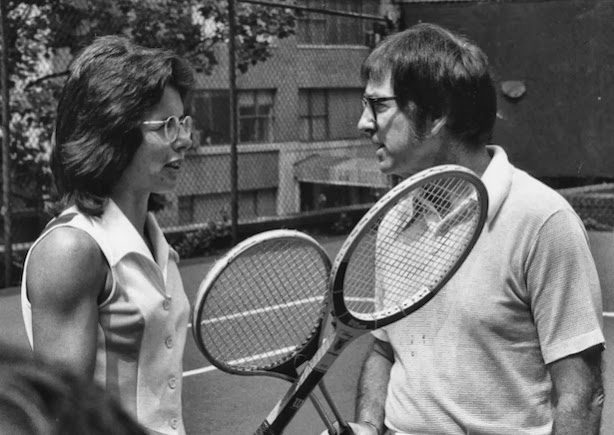
Forty years ago today, Billie Jean King struck a blow for women's liberation by beating notorious male chauvnist Bobby Riggs in a tennis match in Houston's Astrodome.

Or did she?

Just in time for this milestone anniversary came the revival of a longstanding urban myth — that Riggs deliberately lost the match, which was known as the "Battle of the Sexes." The story goes that he threw the match to settle a six–figure gambling debt with the mob.

ESPN wryly suggested that the match should have an asterisk next to it in the sports history books.

"We are always refighting old battles," wrote Gail Collins in the New York Times. "But I honestly did not expect to be spending any time in 2013 arguing about whether Billie Jean King beat Bobby Riggs."

There really are bigger fish to fry.

Such rumors have been around virtually since the match ended. I must admit that, as a child, I was baffled. Riggs (who died in 1995) was 55 years old and had been retired for many years; King was 29 and had just won both the singles and doubles championships at Wimbledon. In 1973, she was one of the best women's tennis players in the world.

The fact that she won raised no red flags for me. I expected her to win.

Howard Cosell, who was better known for calling professional fights and Monday Night Football, provided the commentary for ABC. That made the event more legitimate in my eyes.

Legitimacy was the issue, it seemed to me then — because it seemed that way to a lot of people. As Gerald Eskenazi, a veteran tennis writer, observes in the Wall Street Journal, "It wasn't until [this day] that I fully understood that a seismic change was under way." That's probably an apt description of my mindset at the time.

King responded to the allegations in the way that people, famous and not famous, tend to address things these days — via Twitter — and she insisted that Riggs wanted to win, that he tried to win.

"I just beat his butt and that's it," she said.

Seems to me that ought to be the final word on it.

But I'm certain that won't be enough for some people.

Sunday, June 9, 2013

Making It Look Ridiculously Easy


"It was Secretariat's 17th visit to the winner's circle and the only time he ever got there without working for it."

Red Smith

Winning the Belmont Stakes wasn't supposed to seem this easy.

They call it "the test of champions," and, at 1½ miles, that's exactly what it is.

Nevertheless, 40 years ago today, Secretariat won the Belmont Stakes in the most dominating way imaginable — by more than 30 lengths.

I know that not everyone who reads this is a horse racing enthusiast so let me define the term length for you. A length refers to the distance from a horse's nose to the tip of its tail — roughly 8 feet.

Therefore, a horse that wins a race by 30 lengths — this isn't an exact measurement, of course, merely an approximation — wins by about 240 feet — or eight–tenths of the length of a football field.

On the day of the race, a viewer could start counting — "One Mississippi, two Mississippi ..." — when Secretariat crossed the finish line and get to about "six Mississippi" before any other horse crossed it.

That's domination.

Of course, most of the major horse owners decided not to compete in the 1973 Belmont. Aside from Secretariat and his primary rival in that year's Triple Crown races, Sham, there were only three other horses entered in the race. Most owners conceded that the Belmont would be, essentially, a match race between Secretariat and Sham.

Ironically, though, Sham did not finish second to Secretariat that day. In fact, he finished last.

You might not have thought so the way the first half of the race went. Secretariat, who typically started in the back of the pack, uncharacteristically broke well and surged along the rail to take an early lead with Sham in hot pursuit on the outside, and, for the first half of the Belmont, the two ran virtually stride for stride with the other horses trailing farther and farther behind.

Then on the backstretch Secretariat began to pull away from Sham. As the horses made the turn, race caller Chic Anderson memorably said, "[Secretariat] is moving like a tremendous machine!" How could anyone forget that?

Actually, I have two specific memories of that weekend.

There is the memory of the actual race, of course. It was run, as the Triple Crown races always are, on a Saturday afternoon. I was a young boy. Summer vacation had just begun, and my family was visiting my grandmothers in Dallas. I remember being in my maternal grandmother's living room watching her TV and being amazed at Secretariat's performance.

I had seen several horse races on TV by that time — and I have seen quite a few in person since — and I have never seen another horse leave all the other horses in the dust like that. Never.

And Anderson's call has the iconic staying power of Al Michaels' exclamation, "Do you believe in miracles?" at the conclusion of the Olympic hockey game between the U.S. and the Soviet Union in 1980. Every time I have heard it in the last 40 years, it has taken me back to that sunny June afternoon.

The other memory is of the following day. My family took my father's mother out for lunch at a cafeteria she liked a lot. This cafeteria had portraits of the presidents lining the wall. It was known locally for those portraits as much as it was known for any of its dishes, and it was one of my favorite places to go because, well, I've had an interest in presidents since I was little.

(I can't explain it. My mother might be able to say when this fascination began, but she's been dead for nearly 20 years, and there's no point in asking my father because he was frequently absent in my early childhood — later childhood, too, for that matter, but that's another story.)

Anyway, whenever we visited Dallas, we always managed to visit this cafeteria — sometimes with Grandmother, sometimes not. It was the Highland Park Cafeteria. I'm not honestly certain that I ever knew that when I was a child. To me, it was the place with the pictures of the presidents.

Ordinarily, as I recall, the people who stood in line at the cafeteria commented on the presidential portraits that lined the wall. The portraits of the more recent presidents always prompted people to say things like "I was [insert age/marital status/place of residence/employed by/other relevant observation here] when he became president."

On that Sunday, however, everyone was talking about Secretariat.

On one level, that is understandable. Secretariat was the first Triple Crown winner in 25 years.

But that was also the summer of the Senate Watergate Committee. Allegations had been made regarding the conduct of the sitting president — who had just been re–elected about seven months earlier in one of the most lopsided elections in history.

But no one was talking about that in a cafeteria line with portraits of the presidents on the wall.

Everyone was talking about a racehorse.

Sunday, May 19, 2013

When Secretariat Won the Preakness


When a horse wins the Kentucky Derby, it sets off a certain amount of speculation about whether that horse can win the Triple Crown.

But most railbirds don't get excited about a horse's chances of winning the Triple Crown until the Derby winner actually wins that second jewel, the Preakness.

After all, someone has to win the Kentucky Derby, right? Win the Preakness, too, and then we'll talk.

(There will be no such talk this year. Oxbow won yesterday's Preakness, not Orb, the Kentucky Derby winner.)

When Secretariat won the 1973 Kentucky Derby, there was still some residual uncertainty about whether it was a true representation of the likely outcome of a duel between Secretariat and Sham. After all, Sham had beaten Secretariat decisively in the Wood Memorial a few weeks earlier.

The rematch of the top two finishers in the Derby was highly anticipated, and the Secretariat–Sham showdown riveted the attention of the sports world for the five weeks of the Triple Crown.

And when Secretariat won the Preakness 40 years ago today, it triggered a wave of excitement in the sports world. It had been 25 years since a horse had won the Triple Crown, and, in that time, only seven horses had won the first two jewels of the Triple Crown. Five of them had come along in the last 10 years alone.

While many people in horse racing did not believe a horse could win the Triple Crown again, others believed recent history indicated otherwise.

Could he do it?

The sports world was about to find out if Secretariat could become the eighth horse in 25 years to win the first two jewels of the Triple Crown, and a record crowd was on hand at Pimlico in Baltimore for the 100th running of the Preakness Stakes.

Other than the fact that Secretariat set a speed record in the Derby, perhaps the only thing that made him stand out was the hype that followed him everywhere. Investors had been paying record prices for breeding shares — as if Secretariat had already won the Triple Crown.

As he did in the Kentucky Derby two weeks earlier, Secretariat started almost casually, lumbering out of the gate and settling into the back of the pack. Investors' hearts must have skipped a beat or two.

But, about halfway through the race, he made his move and passed the other horses as if they were standing still, seizing the lead and sprinting down the stretch.

Frankly, I never saw anything like Secretariat. It's probably safe to say no one else had, either. He set records in all three Triple Crown races — records that still stand today.

And his most impressive performance was still to come — in the Belmont Stakes three weeks later when he beat Sham again, this time by 30 lengths.

Sunday, May 5, 2013

The Dawning of the Age of Secretariat


I don't know if Orb, the winner of yesterday's Kentucky Derby, will be the first winner of the Triple Crown in 35 years. I guess we'll know in five weeks.

But he's off to a start similar to Secretariat's in 1973. Like Secretariat, he had to come from behind to win the Kentucky Derby — and he won by two lengths.

Forty years ago today, most Americans probably had not heard much about Secretariat.

The name was familiar to those who followed horse racing, and a record crowd was on hand, many strictly to watch him run in the first jewel of the Triple Crown, but the average American who tuned in to watch the Kentucky Derby that Saturday afternoon in 1973 probably did not know who Secretariat was.

In fact, if casual horse racing fans had heard anything about Secretariat in the weeks prior to the Kentucky Derby, it wasn't good. In the Wood Memorial, his final Kentucky Derby prep race, Secretariat finished third behind his stablemate, Angle Light, and his top foe in the Triple Crown races, Sham.

It was discovered that Secretariat was suffering from an abscess in his mouth.

Secretariat recovered from the abscess by post time at Churchill Downs; nevertheless, many observers were influenced by the results of the Wood Memorial, leaving no clear consensus by the time the race began. Secretariat and his stablemate went off as 3–2 favorites. Sham was just behind at 5–2.

In his trademark fashion, Secretariat meandered out of the gate and ran at the back of the pack for awhile before making his move and giving the racing fans at Churchill Downs a dramatic finish in which he overtook Sham to win by two lengths.

I've known a few horse people in my day, and some would tell you that a horse knows a lot more than people give him credit for. Others would tell you that horses may have a certain level of intelligence, but they can't understand a language or speak one (sorry, Mister Ed), and they can't process/analyze information.

I don't know if either is true, but I do know Secretariat was different. Secretariat almost seemed to be lounging in the back, as if lolling in a hammock, conserving his energy until just the right moment — when he would burst from behind in the blink of an eye.

Secretariat seemed to shift into an entirely different gear, one unknown to mere horses. They called it hyperspace in "Star Wars," I think. But Secretariat came along several years before the first "Star Wars" movie. The concept of hyperspace was largely unknown.

Except, perhaps, to Secretariat.

Then again, maybe he was just making it look good.

Sunday, March 31, 2013

Jaw Breaker


For nearly 40 years, ABC's Wide World of Sports was a fixture on Saturday afternoons.

Its mission was really twofold. Ostensibly, I believe it began its existence as a catch–all for offbeat sports that were rarely, if ever, shown on the Big Three networks, but it also showed popular sports, primarily individual competitions, like boxing or figure skating or gymnastics.

As such, it filled a niche in those days before cable.

Everyone knew the intro in which the narrator spoke of "the thrill of victory and the agony of defeat."

As a boy, I often watched Wide World of Sports. The sports it showed really were off the wall most of the time, but, once in awhile, there was some good mainstream sports event on the program.

Such was the case 40 years ago today.

I don't remember much about that day except that my parents went somewhere that afternoon — they probably went to Little Rock to see a movie and have dinner — and a young couple had been hired to look after my brother and me.

As a college professor, my father often recruited his students to look after us when he took my mother out. My memory was that one, if not both, of the young people who came over that day had been in at least one of his classes.

Anyway, as I recall, the four of us started playing a board game of some kind after my parents left. Then, an hour or so later, the young man suggested that we watch Wide World of Sports. Muhammad Ali, who was only two years removed from his first fight with Joe Frazier, was to fight Ken Norton that afternoon.

That was fine with me.

I don't recall if I had ever seen Ali fight live before, but I had seen him on TV. Interviews. Fight highlights. That sort of thing. I liked him. He always seemed to be symbolic of the era in which he competed.

On this occasion, I got to see him fight — impressively, too, even though he didn't win.

It was a competitive fight, one that Ali lost in a split decision. It went the scheduled 12 rounds, and, after the fight had been awarded to Norton, it was revealed that Ali's jaw had been broken at some point. Norton has always contended that it happened near the end of the fight, probably in the 11th round. Angelo Dundee, Ali's trainer, insisted it was earlier.

Ali and Norton fought two more times. Ali won both — even though some observers will tell you they thought Norton actually won their last fight in 1976 — when Ali was heavyweight champion for the second time. If Norton had won on that day, he would have been heavyweight champ.

As it was, Norton did join that elite club of men who have been heavyweight champion. The title was awarded to him retroactively a couple of years later — after Ali had lost his title to Leon Spinks in early 1978. The crown did not remain on his head for long. In his first title defense, Norton was defeated in a very tight decision against Larry Holmes.

On this day 40 years ago, Norton was only the second professional fighter to defeat Ali (Joe Frazier was the other).

Talk about an exclusive club.

Tuesday, March 26, 2013

The Age of the Bruins


I hear the word dynasty tossed around rather casually these days.

It seems to be applied to any team that might win a second straight championship in any sport. But two in a row simply doesn't mean that much to folks of my generation. That isn't what we think of when we think of the word dynasty.

When I was growing up, everyone knew the real definition of the word. It was visible whenever the UCLA basketball team took the court — especially in the early '70s.

In fact, in the early 1970s, the UCLA basketball team put together what is likely to be the longest Division I winning streak ever — 88 wins in a row from 1971 to 1974.

Forty years ago tonight, the Bruins were in pursuit of their second straight perfect season. Not just a national title. It had become routine for UCLA to win national titles. The Bruins weren't always undefeated, but they usually won the national championship.

Maybe that was what it took to light a fire under basketball players from whom championships were expected. A perfect record was on the line this time.

On this night in St. Louis in 1973, they were looking for their seventh consecutive national title. Think about that for a minute. Can you imagine any college program in any sport maintaining that kind of dominance for seven consecutive years?

It's really more remarkable than that. In 12 seasons — from 1963–1964 to 1974–1975 — coach John Wooden led UCLA to 10 national titles.

Now, I don't want to say anything that detracts in any way from what Wooden achieved.

But the truth is that Bill Walton was the real story of the Bruins' victory over Memphis State 40 years ago tonight. He scored 44 points, making 21 of 22 field goal attempts.

It was an amazing performance to watch. Walton was unstoppable, and so was UCLA. It was the era of the Bruins' dominance — long before Duke became a fixture in the Final Four. It was inconceivable in those days that UCLA would not win the national title.

And, in 1973, it was inconceivable that UCLA would lose — ever.

Of course, the Bruins did lose eventually — nothing lasts forever — but not on this night in 1973.

UCLA has enjoyed a few other championship seasons since the one 40 years ago, but it seems safe to say that this night in 1973 was the program's peak — not unlike when Joe Montana and the San Francisco 49ers dismantled John Elway and the Denver Broncos in Super Bowl XXIV.

There really were no more worlds to conquer.

Neither team will be commemorating the 40th anniversary of that game with a return trip to the championship. Both were invited to the tournament, but neither survived opening weekend. UCLA was humbled by Minnesota on Friday night, and Memphis (the State part was dropped many years ago) was eliminated by Michigan State on Saturday.

But even if one (or both) could have played in this year's final, it's hard to see how what happened on this night in 1973 could possibly be topped.

Tuesday, January 22, 2013

Down Goes Frazier


Ever since his victory in his much–anticipated bout with Muhammad Ali in 1971, Joe Frazier had stood atop the boxing world.

He defended his title twice in 1972 but against inferior opponents who required him to spend little time in the ring before stopping both on TKOs. I remember hearing nearly all the grown–ups in my world say that, since Ali had been turned back, no one could topple Frazier.

(That was just fine with many of the men I knew, too. Many had pulled for Frazier against Ali, largely because the majority of adults in Arkansas supported the Vietnam War. Ali, of course, had spoken against the war and refused to fight in it.)

Always in the distance, though, was the imposing figure of George Foreman, the gold medal winner at the 1968 Olympics in Mexico City. He turned pro the following year, and, once in awhile, I heard a grown–up speculate that Foreman could beat Frazier.

Even though Foreman was five inches taller than Frazier (who won an Olympic gold medal in Tokyo in 1964) and enjoyed a 10–inch reach advantage, Frazier was a 3–to–1 favorite when the two men met in Jamaica 40 years ago today. I suppose that was based on his years of experience as a pro — as well as his triumph over Ali (who was in every boxing conversation in those days, even if he wasn't on the fight card).

But both men entered the fight undefeated. And it didn't take long for observers to conclude that Foreman's height and reach advantage really did make a difference.

I've heard people ask if Foreman's victory on that night was an upset. I can't really say it was a big upset, even though it was regarded as an upset by many. I presume that was because Frazier was the champion and Foreman was younger, less experienced but already seen as a man who would one day be heavyweight champion of the world. Whether his win 40 years ago tonight was seen as an upset depended, I suppose, on whether the observer believed his time had come.

As it turned out, Foreman's "time" to be heavyweight champion came twice — on this night in 1973 and again 21 years later. He lost the title to Ali about a year and a half after winning it from Frazier.

The three–knockdown rule had been waived for the bout, but Frazier almost immediately became the poster child for why such a rule has a valid purpose. He went down three times in the first round and three times in the second before the fight was stopped.

"Foreman's last punch, a perfect right uppercut, lifted Frazier's stocky body into the air for an instant before he hit the canvas yet again," recalls The History Channel. "Frazier struggled to his feet, but at that point, 1:35 into the second round, the referee Arthur Mercante called an end to the bout."

It was during that brief bout that sportscaster Howard Cosell, doing the blow–by–blow for that era's equivalent of a pay–per–view audience, uttered what may well be the most memorable line of his career:

"Down goes Frazier! Down goes Frazier!"

Years later, Foreman confessed that Frazier was the only fighter he ever feared.

Monday, January 14, 2013

The Perfectionists


Forty years ago today, the Miami Dolphins beat the Washington Redskins in Super Bowl VII, capping a perfect season.

Only one other team since that time, the 2007 New England Patriots, has gone into a Super Bowl with a perfect record, but the Patriots lost that game to the New York Giants. True, the Pats had to win two more regular–season games than the Dolphins did — and, with their two playoff victories, the Patriots were 18–0 going into their Super Bowl.

That means that, when they were 18–0, the Patriots actually had compiled a better record than the '72 Dolphins did, but they failed to win the Super Bowl, and that is how teams are judged.

Not by perfect seasons.

Championships. That's what counts. In the 39 years since the '72 Dolphins' 17–0 season, 39 NFL champions have been crowned. Only one team has gone into the Super Bowl with a perfect record, and it did not emerge with its perfect record still intact.

But a single moment of imperfection on that day, as I have written here before, threatened the Dolphins' achievement.

The Dolphins led, 14–0, in the fourth quarter when kicker Garo Yepremian lined up to attempt a 42–yard field goal that, for all intents and purposes, could have put the game on ice. Instead, it only put the outcome in doubt.

Yepremian's attempt was blocked, and he chased the ball as it bounced toward the sideline. But instead of falling on it, he picked it up and tried to throw the ball, but it slipped from his grasp and Redskins defender Mike Bass grabbed it in mid–air and ran 49 yards for a touchdown.

More than two minutes were left in the game, but the Dolphins held on to win the game and give Don Shula his first Super Bowl championship.

To this day, Super Bowl VII is the lowest–scoring Super Bowl — and would have been even lower if Yepremian had fallen on the ball or, better still, made the field goal.

Thus, it was appropriate, I suppose, that a defensive player — Miami's Jake Scott — was named the game's most valuable player. Scott picked off two Billy Kilmer passes in the contest and racked up 63 return yards.

Super Bowl MVPs typically are quarterbacks — or, at least, an offensive player. Only eight defensive players have been named Super Bowl MVP, and two of them (Dallas' Randy White and Harvey Martin) shared the honor in 1978.

In fact, had it not been for Chuck Howley winning the MVP in a losing cause two years earlier (still the only member of a losing team to be named the game's most valuable player), Scott's triumph would have been as ground–breaking — on an individual level — as the Dolphins' team achievement of going through a season without a single blemish.

On this day 40 years ago, it was often suggested that Larry Csonka, the Dolphins' hard–nosed fullback, deserved to be considered. He carried the ball 15 times for 117 yards.

But Csonka's time would come the next year when the Dolphins won their second consecutive Super Bowl.

That was quite an achievement, especially since the Dolphins lost only twice in their 1973 encore. When you consider that everyone on Miami's schedule wanted to beat the team that had been undefeated the previous year, the pressure must have been unrelenting.

Miami's '72 accomplishment was even more impressive in that the Dolphins' starting quarterback, Bob Griese, went down with a broken leg midway through the season and did not return until the playoffs. Veteran backup Earl Morrall led the offense until the second half of the AFC Championship game against Pittsburgh.

Sunday, May 6, 2012

Deja Vu All Over Again?


I had kind of a strange sensation when I watched I'll Have Another win the Kentucky Derby yesterday.

It was something of a flashback to the late spring/early summer of 1973, when Secretariat won the Triple Crown.

Secretariat is probably best remembered for his dominant performance in the third jewel of the Triple Crown, the Belmont Stakes, in which he practically strolled to a 31–length victory.

But most of the folks who were old enough at the time to absorb what it was that they were seeing — and to appreciate that they were witnessing something rare and remarkable, the first Triple Crown winner in a quarter of a century — will tell you that Secretariat came from behind to win the first two races.

That was his M.O. — until that memorable afternoon in June.

While it is entirely possible that I am overlooking something obvious, I don't think I have seen anything quite like it since — at least until yesterday's Derby.

Thirty–nine years ago, it seems to me that Secretariat had to come from dead last — or close to it — to barely win the first two races of the Triple Crown. Clearly, he was a speed horse, like all the other sons of Bold Ruler, but there were doubts that he had the endurance for a truly long race like the Belmont.

Such doubts were erased in the Belmont — and, as impressive as that victory was, there were lingering questions that went unanswered until 16 years later when, after Secretariat's death, a team of veterinarians examined his vital organs and discovered that his heart was twice the size of a normal horse's.

It's still early in this year's Triple Crown campaign. The Preakness is coming up on May 19, followed by the Belmont on June 9, and no horse has won a Triple Crown in nearly 35 years — so I'll Have Another's win yesterday may have no significance in the long run.

But his Derby run reminded me of those Secretariat days.

I honestly don't know anything about I'll Have Another's lineage. Maybe, like Secretariat, he is a descendant of not only a speed horse like Bold Ruler but also a power horse like the 18th–century British horse Eclipse (who was said to have passed along an x factor trait through his daughters that produced such oversized hearts).

Maybe not. I suppose we'll know more in a couple of weeks — or five weeks, if I'll Have Another wins the Preakness.

And he didn't have to come from the back of the pack yesterday — just the middle of it.

But I'll be damned if there aren't real similarities between yesterday's race and the one that started Secretariat on his Triple Crown–winning run 39 years ago.

In 1973, Secretariat overtook his primary nemesis, Sham. Will Bodemeister — one of yesterday's pre–race favorites and the leader until he was overtaken in the stretch — turn out to be I'll Have Another's arch rival in 2012?

Time will tell.

Tuesday, March 30, 2010

The Greatest Horse of All


1970 is remembered in the history books for all sorts of noteworthy events that are not remembered with any fondness — the My Lai massacre, the aborted space mission of Apollo 13, the Kent State shootings.

But 40 years ago today, a thoroughbred racehorse that is remembered by many as the greatest of all time was born.

He was Secretariat, the first horse to win racing's Triple Crown (the Kentucky Derby, the Preakness, the Belmont Stakes) in a quarter of a century. In fact, his times in the Kentucky Derby and the Belmont set records that still stand today.

I will always remember watching the Belmont in 1973 in anticipation of the first Triple Crown winner in my life. So often in the years since, a horse has entered the Belmont (also known as the "Test of the Champion" because it is the longest and final race of the Triple Crown) with wins in the Kentucky Derby and the Preakness only to go down in defeat in the Belmont.

But Secretariat did not disappoint observers on that Saturday in June. He seized control of the race early and romped to a 31–length victory, covering the 1½–mile distance in 2:24. He left no doubt in anyone's mind that he deserved to be the Triple Crown winner.

His achievement is commemorated by a statue at Belmont Park.

Because of a deal his owner made, Secretariat didn't race past the age of 3 and was retired to stud, but he never produced any offspring that came close to duplicating his accomplishments. Nevertheless, his reputation led to the sale of one of his early progeny for more than $1 million, something that had never happened before.

Secretariat's life ended in October 1989 when he was euthanized.