Showing posts with label Howard Cosell. Show all posts

Saturday, June 4, 2016

Muhammad Ali


"Don't count the days. Make the days count."

Muhammad Ali (1942–2016)

Nothing lasts forever.

Muhammad Ali himself said that when he retired from boxing. I knew at the time that he was right, but I didn't want it to be true. I wanted him to continue to box — and to win — just as I had wanted Roger Staubach to continue playing football and how, many years later, I wanted Brett Favre to continue playing.

I knew he wouldn't live forever, either, but, again, I didn't want it to be true. His death yesterday affected people everywhere, even people attending a Paul Simon performance.

Somehow, though, it seems appropriate that he should be taken from us this year of all years — when so many have already been taken. And when many more, no doubt, will be taken from us before this year is over. It seems to be that kind of year, a deviation from the norm from politics to mortality. The political process has been the same, but it has yielded two unusually unpopular nominees.

And mortality is about the same as usual, but it seems to be taking more influential prominent people than it does in an ordinary year. Actually, that probably isn't true. It just seems that way.

Muhammad Ali was a human magnet, drawing people to him more through the force of his personality than his boxing skills (although they played a role in it, too, make no mistake about that).

The thing about magnets, though, is that they repel as well as attract. And Muhammad Ali certainly repelled a lot of people. It was a divisive time in America, the late '60s. From the vantage point of half a century later — and with a black president in the Oval Office — it is easy for those who weren't there to think that the '60s were all about civil rights, but that was really only one issue that divided Americans in those days. The war in Vietnam divided people, too, and it was Ali's refusal to fight in Vietnam that exacerbated the situation.

It was often claimed that Ali said, "No Viet Cong ever called me nigger" as justification for his refusal to be conscripted into the Army, but that isn't what he said.

What he really said was, "My conscience won't let me go shoot my brother or some darker people or some poor hungry people in the mud for big powerful America. And shoot them for what? They never called me nigger. They never lynched me. They didn't put no dogs on me. They didn't rob me of my nationality, rape and kill my mother and father. Shoot them for what? How can I shoot them poor people? Just take me to jail."

There were a lot of people in America who didn't like Ali when he refused to go to Vietnam. They derided him for what they saw as arrogance in the ring and cowardice outside of it. Some people attributed that to racism, just as some people today dismiss opposition to Barack Obama's policies as thinly veiled racism, too. I didn't buy it then because I knew many people in my small hometown in Arkansas who supported the war and spoke critically of antiwar demonstrators, too, and most of whom were white.

Race can be a convenient scapegoat, and I have no doubt it plays a role for some people but not all. For most of the people in my hometown in the late '60s and early '70s, race really had nothing to do with it. It was all about politics.

When Ali fought Joe Frazier for the first time, in what was widely called the Fight of the Century, it became more than just a fight for many people. Folks who were against the war tended to support Ali, and folks who supported the war effort tended to support Frazier.

That, too, was called racism by many people, which never made sense to me, either. How could it be racist? Both Ali and Frazier were black.

Maybe it is true what they say about time healing all wounds, though, because I have heard nothing said about that time in Ali's life and career — except for the facts that he refused to serve and was stripped of his title. Nothing more than that.

Even from people who probably would be expected to be critical of Ali for his politics.

Remarkably, considering his chosen profession, Ali was a peacemaker. At the very least, that seems odd for a professional fighter, doesn't it? In trying to resolve this contradiction, comedian George Carlin described Ali's refusal to serve this way: "That's where I draw the line. I'll beat 'em up, but I don't wanna kill 'em."

Now, at the end of his life, Ali is being remembered for his pursuit of peace after his violent career. Part of his refusal to fight in Vietnam was grounded in his recent conversion to Islam, and he maintained his core beliefs throughout his life.

Last December, after the shootings in San Bernardino, California, Ali told NBC News, "I am a Muslim and there is nothing Islamic about killing innocent people in Paris, San Bernardino or anywhere else in the world. ... True Muslims know that the ruthless violence of so–called Islamic Jihadists goes against the very tenets of our religion. ... We as Muslims have to stand up to those who use Islam to advance their own personal agenda. ... They have alienated many from learning about Islam. True Muslims know or should know that it goes against our religion to try and force Islam on anybody."

There was a time when Ali was regarded as the most recognizable man in the world. Many saw him as an heroic figure.

Heroes usually need a reliable sidekick (i.e., Robin to Batman) or an arch rival (here I guess Larry Bird and Magic Johnson would fit the bill). Solitary heroes tend to have short lives in the spotlight.

In the ring, I suppose, Ali will always be remembered for his three epic fights with Frasier. As for sidekick ...

Broadcaster Howard Cosell was Ali's reliable sidekick, I suppose. He wasn't part of Ali's entourage, his traveling roadshow, but he always seemed to be ringside, providing the commentary at Ali's fights. It wasn't unusual to see the rich and the famous attending Ali's fights, but Cosell owed much of his fame and personal fortune to his association with Ali — as well as his Monday Night Football gig.

If you ever saw Cosell interviewing Ali, you could see what a symbiotic relationship they had. Ali had considerable skills and probably could have succeeded without Cosell. Cosell, though, might have found it much more difficult to succeed alone, being limited to only four months per year of Monday Night Football and Dandy Don.

Together they were an iconic pair, and now they're both gone.

Time doesn't march on, folks. It sprints.

Friday, September 20, 2013

The Battle of the Sexes


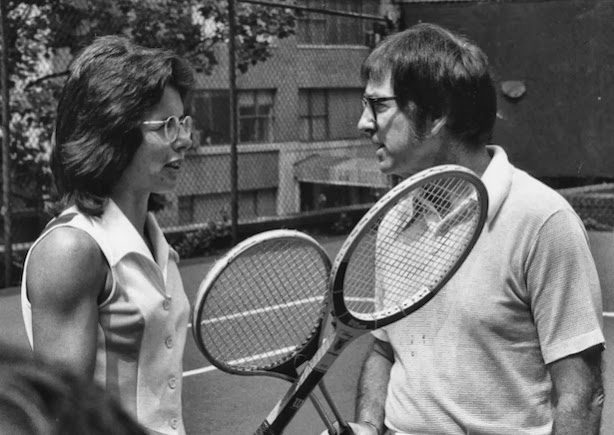
Forty years ago today, Billie Jean King struck a blow for women's liberation by beating notorious male chauvnist Bobby Riggs in a tennis match in Houston's Astrodome.

Or did she?

Just in time for this milestone anniversary came the revival of a longstanding urban myth — that Riggs deliberately lost the match, which was known as the "Battle of the Sexes." The story goes that he threw the match to settle a six–figure gambling debt with the mob.

ESPN wryly suggested that the match should have an asterisk next to it in the sports history books.

"We are always refighting old battles," wrote Gail Collins in the New York Times. "But I honestly did not expect to be spending any time in 2013 arguing about whether Billie Jean King beat Bobby Riggs."

There really are bigger fish to fry.

Such rumors have been around virtually since the match ended. I must admit that, as a child, I was baffled. Riggs (who died in 1995) was 55 years old and had been retired for many years; King was 29 and had just won both the singles and doubles championships at Wimbledon. In 1973, she was one of the best women's tennis players in the world.

The fact that she won raised no red flags for me. I expected her to win.

Howard Cosell, who was better known for calling professional fights and Monday Night Football, provided the commentary for ABC. That made the event more legitimate in my eyes.

Legitimacy was the issue, it seemed to me then — because it seemed that way to a lot of people. As Gerald Eskenazi, a veteran tennis writer, observes in the Wall Street Journal, "It wasn't until [this day] that I fully understood that a seismic change was under way." That's probably an apt description of my mindset at the time.

King responded to the allegations in the way that people, famous and not famous, tend to address things these days — via Twitter — and she insisted that Riggs wanted to win, that he tried to win.

"I just beat his butt and that's it," she said.

Seems to me that ought to be the final word on it.

But I'm certain that won't be enough for some people.

Tuesday, January 22, 2013

Down Goes Frazier


Ever since his victory in his much–anticipated bout with Muhammad Ali in 1971, Joe Frazier had stood atop the boxing world.

He defended his title twice in 1972 but against inferior opponents who required him to spend little time in the ring before stopping both on TKOs. I remember hearing nearly all the grown–ups in my world say that, since Ali had been turned back, no one could topple Frazier.

(That was just fine with many of the men I knew, too. Many had pulled for Frazier against Ali, largely because the majority of adults in Arkansas supported the Vietnam War. Ali, of course, had spoken against the war and refused to fight in it.)

Always in the distance, though, was the imposing figure of George Foreman, the gold medal winner at the 1968 Olympics in Mexico City. He turned pro the following year, and, once in awhile, I heard a grown–up speculate that Foreman could beat Frazier.

Even though Foreman was five inches taller than Frazier (who won an Olympic gold medal in Tokyo in 1964) and enjoyed a 10–inch reach advantage, Frazier was a 3–to–1 favorite when the two men met in Jamaica 40 years ago today. I suppose that was based on his years of experience as a pro — as well as his triumph over Ali (who was in every boxing conversation in those days, even if he wasn't on the fight card).

But both men entered the fight undefeated. And it didn't take long for observers to conclude that Foreman's height and reach advantage really did make a difference.

I've heard people ask if Foreman's victory on that night was an upset. I can't really say it was a big upset, even though it was regarded as an upset by many. I presume that was because Frazier was the champion and Foreman was younger, less experienced but already seen as a man who would one day be heavyweight champion of the world. Whether his win 40 years ago tonight was seen as an upset depended, I suppose, on whether the observer believed his time had come.

As it turned out, Foreman's "time" to be heavyweight champion came twice — on this night in 1973 and again 21 years later. He lost the title to Ali about a year and a half after winning it from Frazier.

The three–knockdown rule had been waived for the bout, but Frazier almost immediately became the poster child for why such a rule has a valid purpose. He went down three times in the first round and three times in the second before the fight was stopped.

"Foreman's last punch, a perfect right uppercut, lifted Frazier's stocky body into the air for an instant before he hit the canvas yet again," recalls The History Channel. "Frazier struggled to his feet, but at that point, 1:35 into the second round, the referee Arthur Mercante called an end to the bout."

It was during that brief bout that sportscaster Howard Cosell, doing the blow–by–blow for that era's equivalent of a pay–per–view audience, uttered what may well be the most memorable line of his career:

"Down goes Frazier! Down goes Frazier!"

Years later, Foreman confessed that Frazier was the only fighter he ever feared.

Friday, April 23, 2010

Telling It Like It Was


I don't know whether Howard Cosell listened to and enjoyed the music of Frank Sinatra — in hindsight, it seems odd not to know that because we knew Cosell's opinions on just about everything else.

But when considering Cosell's life, matching him with anyone else seems inappropriate.

They were contemporaries, quite close, in fact, to the same age (Sinatra was a little more than two years older). And, while Sinatra sang about "doin' it my way," that was how Cosell lived his life.

If someone ever does a film about the life of Howard Cosell, I think Sinatra's music should be the soundtrack.

Cosell certainly did things his way. Or, to paraphrase his own catchphrase, he told it like it was.

We knew that Cosell liked his ten–dollar words, which tended to make him come off as elitist, aloof. He couldn't resist the temptation. Maybe it was his legal training. Maybe he just always had a fondness for big words. But he just couldn't restrain himself, even on the most somber of occasions.

Like Dec. 8, 1980, when I and millions of people who were watching Monday Night Football learned from Cosell that John Lennon had been killed.
"Remember this is just a football game, no matter who wins or loses. An unspeakable tragedy confirmed to us by ABC News in New York City: John Lennon, outside of his apartment building on the West Side of New York City, the most famous, perhaps, of all of The Beatles, shot twice in the back, rushed to Roosevelt Hospital, dead on arrival."

"Unspeakable" struck some people as a bit much, but that was just Cosell expressing himself. Besides, to those of us who were Beatles fans, the murder of John Lennon really was unspeakable.

No other word was adequate.

Cosell definitely had his own style, and he was really famous, I suppose, for two things — his longtime affiliation with Muhammad Ali and his years with Monday Night Football. The stories of each could be books in themselves.

Ali and Cosell had something of a symbiotic relationship. Cosell did the ringside duty for most of Ali's early fights, then he made a name for himself as part of the Monday Night Football broadcasting crew.

But Cosell often seemed to be on top of the American sports scene — long before ESPN.

His astonished call during the Frazier–Foreman fight — "Down goes Frazier! Down goes Frazier!" — has become part of sports lexicon. He also covered the Bobby Riggs–Billie Jean King "Battle of the Sexes" and Olympics competition for ABC, including the murders of the Israeli athletes at the 1972 Summer Games.

When the subject was Cosell, you seldom found fence sitters. People either really liked him or really hated him, but it was a funny kind of hatred. People didn't hate him to the extent that they wouldn't watch Monday Night Football. Instead, they tuned in in huge numbers, hoping to witness the rare moments when he was caught unprepared. The meticulous Cosell brought the kind of in–depth reporting to sports that once was the hallmark of hard news coverage, and he was rarely unprepared. In the late 1970s and early 1980s, some enterprising bar owners sponsored contests, with winners getting the chance to throw a brick or something else that was big and heavy at Cosell's image on an old TV.

It's hard to believe it was 15 years ago today that Cosell died. In all honesty, I think his death was overshadowed by the Oklahoma City bombing four days earlier and the memorial service for the victims that was held only hours after Cosell's death.

Cosell's death may not have received the attention it deserved, but his absence has been felt.

He was one of a kind.

And he definitely did things his way.