Showing posts with label ABC. Show all posts

Saturday, January 13, 2018

Whoa, Nellie!


Here in Texas there is widespread reverence (except in College Station, I suppose) for the 2006 national championship game between the Texas Longhorns and the Southern Cal Trojans.

Even now more than a decade later.

If you ask people around here what they remember about that game, they are almost sure to mention Vince Young's scamper into the end zone in the final seconds to win it.

It was a classic, all right, and I remember that moment, too, but what I remember most about that game was how familiar it all felt — with Keith Jackson calling it.

It was the last game in a remarkable career, a career that included coverage of pro football, the Olympics, boxing, racing. All sports, really, but especially college football.

Jackson died Friday night at the age of 89.

His career spanned more than half a century so the odds are pretty good that you or someone you know — perhaps both — grew up listening to Jackson's play–by–plays.

Lots of people forget that Jackson was on the original Monday Night Football broadcasting crew doing the play–by–play. Frank Gifford was the original choice, but he had other commitments in that first season so Jackson handled the play–by–play. Gifford took over the next season.

People have been sharing their memories of Jackson on social media today, and they are all great memories.

I grew up listening to Jackson, and I can't say I have a special memory. But all those other moments sound familiar, whether I actually witnessed them or not.

One thing I can say is that Jackson and I were once at the same game — at least once.

My family attended the Sugar Bowl a couple of times when I was growing up, and I know that Jackson was on the broadcast team at one of them. Maybe both.

I didn't hear the broadcast, of course, because I was at the game, and it was long before people could watch TV from handheld devices. But I knew he was there.

Among other things, Jackson is remembered for his colorful descriptions of people and things. He was the one who called the Rose Bowl "the granddaddy of them all." He dubbed Michigan's football stadium "The Big House."

His signature line was "Whoa, Nellie!" when something big happened. If I happened to be in the kitchen getting something to eat and I heard Jackson exclaim, "Whoa, Nellie!" I knew I needed to get back into the living room pronto because there was sure to be a replay of whatever it was.

And it was not to be missed.

It's been awhile since Jackson participated in a broadcast, but he still will be missed. And whenever I hear anyone say "Whoa, Nellie!" I know I will think of him.

Friday, September 20, 2013

The Battle of the Sexes


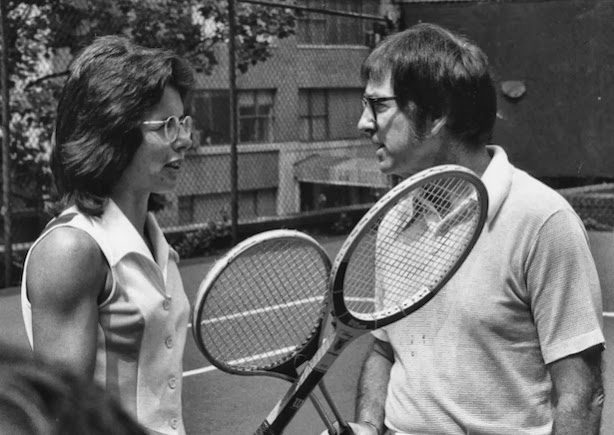
Forty years ago today, Billie Jean King struck a blow for women's liberation by beating notorious male chauvnist Bobby Riggs in a tennis match in Houston's Astrodome.

Or did she?

Just in time for this milestone anniversary came the revival of a longstanding urban myth — that Riggs deliberately lost the match, which was known as the "Battle of the Sexes." The story goes that he threw the match to settle a six–figure gambling debt with the mob.

ESPN wryly suggested that the match should have an asterisk next to it in the sports history books.

"We are always refighting old battles," wrote Gail Collins in the New York Times. "But I honestly did not expect to be spending any time in 2013 arguing about whether Billie Jean King beat Bobby Riggs."

There really are bigger fish to fry.

Such rumors have been around virtually since the match ended. I must admit that, as a child, I was baffled. Riggs (who died in 1995) was 55 years old and had been retired for many years; King was 29 and had just won both the singles and doubles championships at Wimbledon. In 1973, she was one of the best women's tennis players in the world.

The fact that she won raised no red flags for me. I expected her to win.

Howard Cosell, who was better known for calling professional fights and Monday Night Football, provided the commentary for ABC. That made the event more legitimate in my eyes.

Legitimacy was the issue, it seemed to me then — because it seemed that way to a lot of people. As Gerald Eskenazi, a veteran tennis writer, observes in the Wall Street Journal, "It wasn't until [this day] that I fully understood that a seismic change was under way." That's probably an apt description of my mindset at the time.

King responded to the allegations in the way that people, famous and not famous, tend to address things these days — via Twitter — and she insisted that Riggs wanted to win, that he tried to win.

"I just beat his butt and that's it," she said.

Seems to me that ought to be the final word on it.

But I'm certain that won't be enough for some people.

Sunday, March 31, 2013

Jaw Breaker


For nearly 40 years, ABC's Wide World of Sports was a fixture on Saturday afternoons.

Its mission was really twofold. Ostensibly, I believe it began its existence as a catch–all for offbeat sports that were rarely, if ever, shown on the Big Three networks, but it also showed popular sports, primarily individual competitions, like boxing or figure skating or gymnastics.

As such, it filled a niche in those days before cable.

Everyone knew the intro in which the narrator spoke of "the thrill of victory and the agony of defeat."

As a boy, I often watched Wide World of Sports. The sports it showed really were off the wall most of the time, but, once in awhile, there was some good mainstream sports event on the program.

Such was the case 40 years ago today.

I don't remember much about that day except that my parents went somewhere that afternoon — they probably went to Little Rock to see a movie and have dinner — and a young couple had been hired to look after my brother and me.

As a college professor, my father often recruited his students to look after us when he took my mother out. My memory was that one, if not both, of the young people who came over that day had been in at least one of his classes.

Anyway, as I recall, the four of us started playing a board game of some kind after my parents left. Then, an hour or so later, the young man suggested that we watch Wide World of Sports. Muhammad Ali, who was only two years removed from his first fight with Joe Frazier, was to fight Ken Norton that afternoon.

That was fine with me.

I don't recall if I had ever seen Ali fight live before, but I had seen him on TV. Interviews. Fight highlights. That sort of thing. I liked him. He always seemed to be symbolic of the era in which he competed.

On this occasion, I got to see him fight — impressively, too, even though he didn't win.

It was a competitive fight, one that Ali lost in a split decision. It went the scheduled 12 rounds, and, after the fight had been awarded to Norton, it was revealed that Ali's jaw had been broken at some point. Norton has always contended that it happened near the end of the fight, probably in the 11th round. Angelo Dundee, Ali's trainer, insisted it was earlier.

Ali and Norton fought two more times. Ali won both — even though some observers will tell you they thought Norton actually won their last fight in 1976 — when Ali was heavyweight champion for the second time. If Norton had won on that day, he would have been heavyweight champ.

As it was, Norton did join that elite club of men who have been heavyweight champion. The title was awarded to him retroactively a couple of years later — after Ali had lost his title to Leon Spinks in early 1978. The crown did not remain on his head for long. In his first title defense, Norton was defeated in a very tight decision against Larry Holmes.

On this day 40 years ago, Norton was only the second professional fighter to defeat Ali (Joe Frazier was the other).

Talk about an exclusive club.

Friday, February 8, 2013

Peggy Fleming's Triumph


I'm not precisely sure when my family got a television set for the first time.

But I'm pretty sure we had one 45 years ago this month.

I say that because I can remember my mother gathering my younger brother and me in front of the TV to watch Peggy Fleming skate in the 1968 Winter Olympics, which began in Grenoble, France, on Feb. 6. We were both very young at the time. I'm reasonably sure I had no idea who Peggy Fleming was — nor, for that matter, did I know what the Olympics were — and I am almost positive that my brother knew nothing about either as well.

But Mom definitely knew who Fleming was, and what I remember most of that occasion was Mom watching our tiny (by modern standards) black–and–white TV in rapt silence. Whenever I started to ask her anything, she would hold up one hand to quiet me, her eyes never leaving the screen.

I have fleeting memories of watching Fleming skate that night. I have since watched film of her performance, and each viewing serves to confirm what I remember. She was brilliant, and she, probably more than anyone, was responsible for the explosion in popularity of the Olympics in America.

Well, ABC's coverage of those Games — including extensive reports on Fleming and French skier Jean–Claude Killy — had a lot to do with it, too.

As far as American audiences were concerned, though, Fleming was the clear star. She was the only American to win a gold medal in the Grenoble Olympics.

Other American women achieved stardom as Olympic figure skaters in the years to come, but Fleming, while not the first, blazed the modern–day trail. It was Fleming who truly made it possible for Dorothy Hamill, Kristi Yamaguchi, Tara Lipinski and Sarah Hughes to claim Olympic gold.

She overcame the loss of her coach in an airplane crash in Belgium almost exactly seven years earlier. That plane crash decimated the American skating program, and it must have been devastating for Fleming, who was 12 at the time. Nevertheless, Fleming rose to Olympic prominence from the ashes of that crash, in large part because of her unusual style.

Even though Christine Brennan writes in USA Today that there is no dominant American woman in figure skating today, it seems to me that modern American observers, being as provincial as they are, long ago grew accustomed to the idea that an American woman will be among the favorites at the Winter Olympics. It's taken for granted by some.

But that is a relatively recent phenomenon.

By 1968, only five American women had ever won medals for figure skating since the Winter Olympics began six decades earlier — and only two won gold. Four U.S. women have won gold since, and none of them really carried the national burden that Fleming did.

(Perhaps the 1980 U.S. hockey team did, but no single individual has — at least not in the Winter Games.)

When she ascended the podium to receive her gold medal, Fleming was joined by silver medalist Gabriele Seyfert of East Germany and bronze medalist Hana Mašková of Czechoslovakia. It was, as I say, the United States' only gold medal of the Winter Olympics.

That made her the darling of the Olympics as far as Americans were concerned.

I didn't fully understand the significance of Fleming's triumph at the time. I was just too young.

But, as young as I was, I could see that it had a great impact on my mother. I always felt that Mom looked at Fleming as a role model, a symbol of what a woman could achieve.

Mom seldom spoke of it, but she always made a point of watching Fleming when she was on TV; sometimes I watched with her.

And sometimes she asked me if I remembered watching Fleming win her gold medal.

I always told her I did, but the truth was that my memory was spotty.

The truth also was that I clearly saw a lot of pride in Mom's eyes — and I heard a lot of pride in her voice — when she spoke of Fleming.

It made me realize how symbolic these triumphs were to young women in America.

Such symbolic victories, though, are accomplished through a lot of hard work and dedication. That was the thing I didn't appreciate at the time.

But I do appreciate it now.